A corporate gift order has a different finish line from a retail stock order. The right people need to receive a suitable, complete appliance for a specific occasion. Buying food choppers for corporate gifts therefore starts with the recipient and distribution plan, not with the largest logo or the lowest factory unit price.
For a promotional-products distributor, importer or company purchasing team, the decision is whether a particular household chopper can meet the campaign brief on an affordable delivery basis. The buyer must connect product selection, client approval, packing and allocation. A factory quotation for goods is only one part of that program.
JINJIE supplies household electric bowl choppers and discusses model-specific branding and packaging. This guide uses that product scope. It does not imply that JINJIE operates a gift-redemption platform, holds local campaign stock or delivers parcels to individual recipients. Those services need an identified provider and a separate agreement where required.
Decide whether an electric chopper fits the recipients
Start with how the gift will reach a household. An appliance offered as an employee take-home gift has a different use context from an item handed out at a conference. A recipient collecting a box by car may accept a package that would be inconvenient to carry through an exhibition and onto an aircraft. Find out the likely journey before selecting the format.
Keep the intended use domestic. A food chopper given to employees is not an appliance for continuous preparation in the office canteen. If the client actually needs equipment for workplace food service, evaluate that requirement separately. Calling it a corporate purchase does not change a household model’s operating scope.
Consider access to a suitable kitchen and the correct electrical supply. For recipients in several destinations, the apparent simplicity of one gift can conceal different product-version requirements. Give the manufacturer the destination breakdown. Do not ask the local distributor to solve an incompatible electrical version with an improvised adapter after the goods arrive.
The recipient’s experience also matters. The package should identify what the appliance does, contain its matched components and provide the applicable instructions. A gift recipient may never visit your client’s product page or speak to a salesperson. The supplied information needs to make sense without that extra explanation.
Avoid claiming universal appeal. If the client cannot establish that a kitchen appliance is a suitable reward for its audience, discuss another gift or an available choice mechanism with the campaign organizer. The factory can evaluate a product request; it cannot infer recipients’ preferences from a company logo.
Ask the client which promise is essential. It might be a useful household preparation appliance, an identifiable branded presentation or a box that can be collected at a scheduled event. Rank those requirements. A costly finishing detail should not consume the budget needed to deliver a complete, usable product.
Shortlist the complete appliance rather than a gift-box concept
Use the JINJIE electric chopper range to identify real available formats. Compare an assembled sample, its supplied contents and the proposed packed dimensions. A rendering of a gift box cannot establish the recipient’s experience of handling the product inside it.
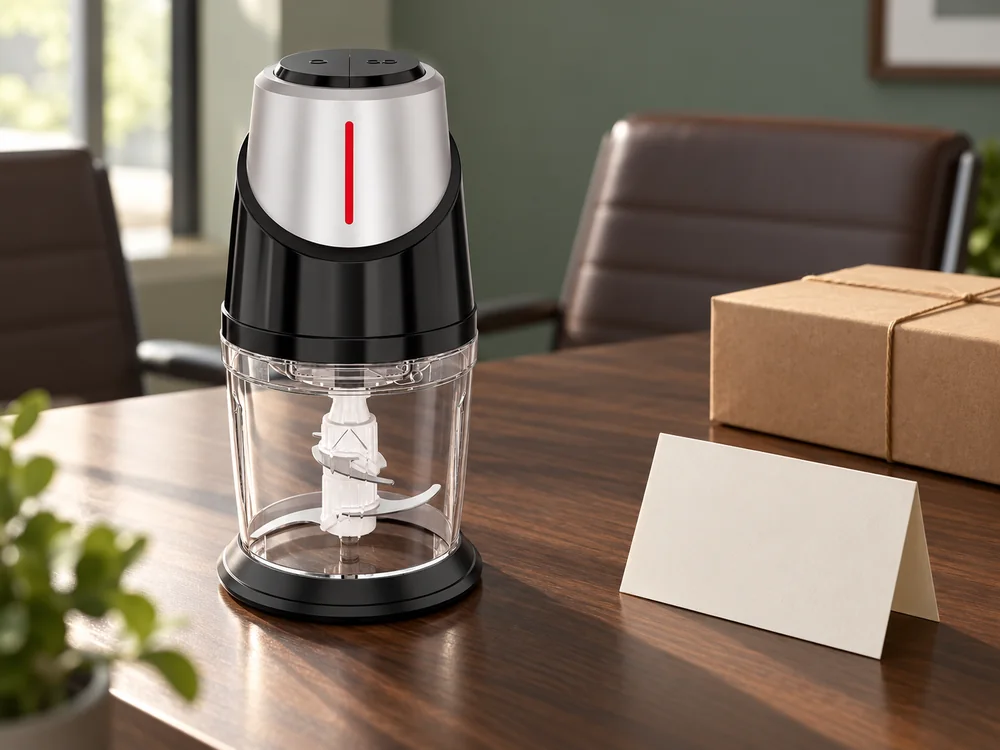
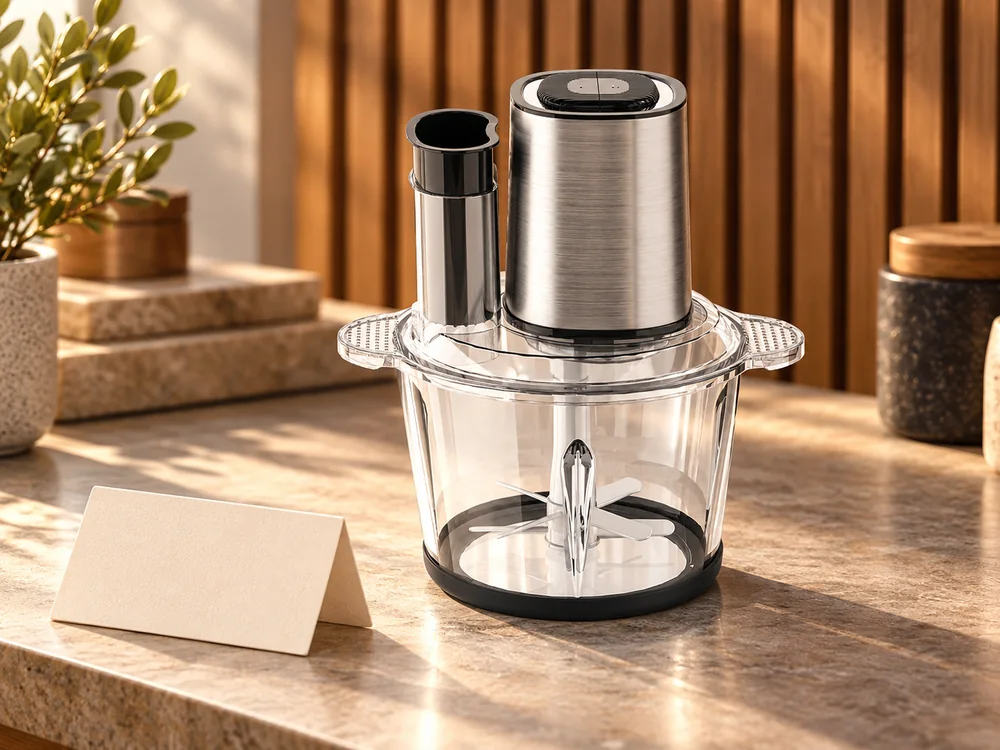
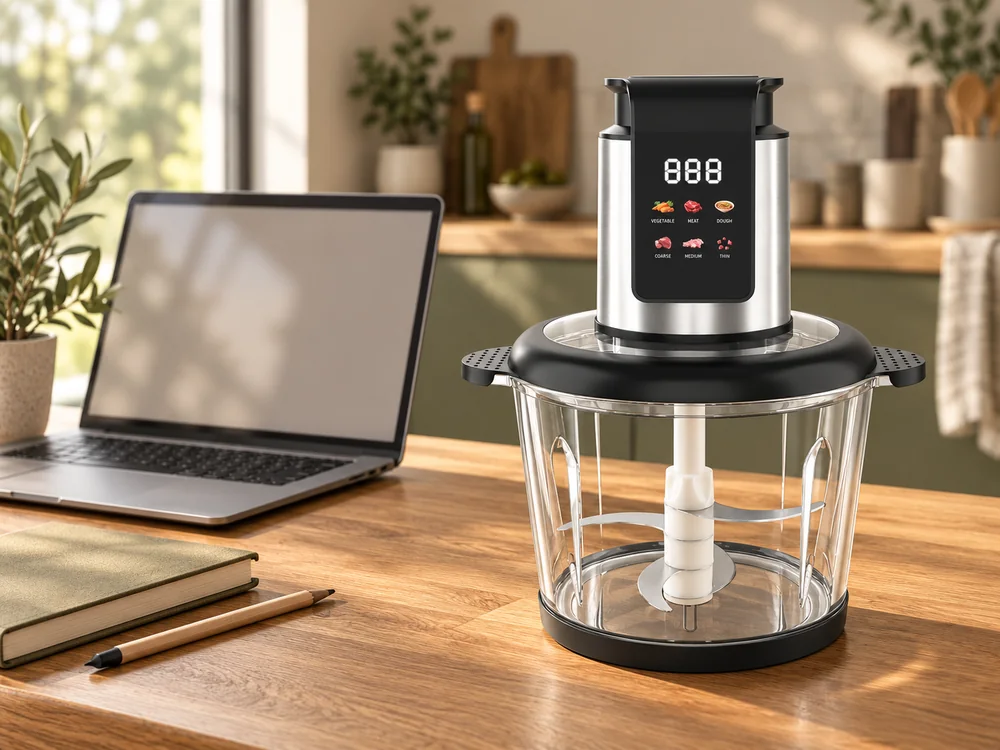
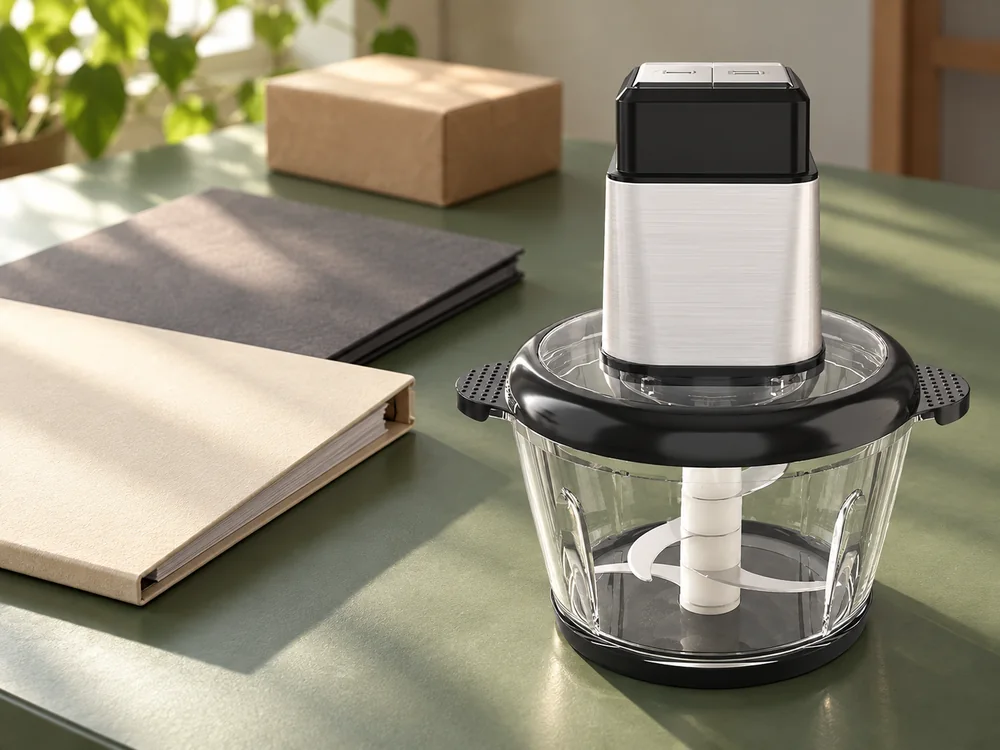
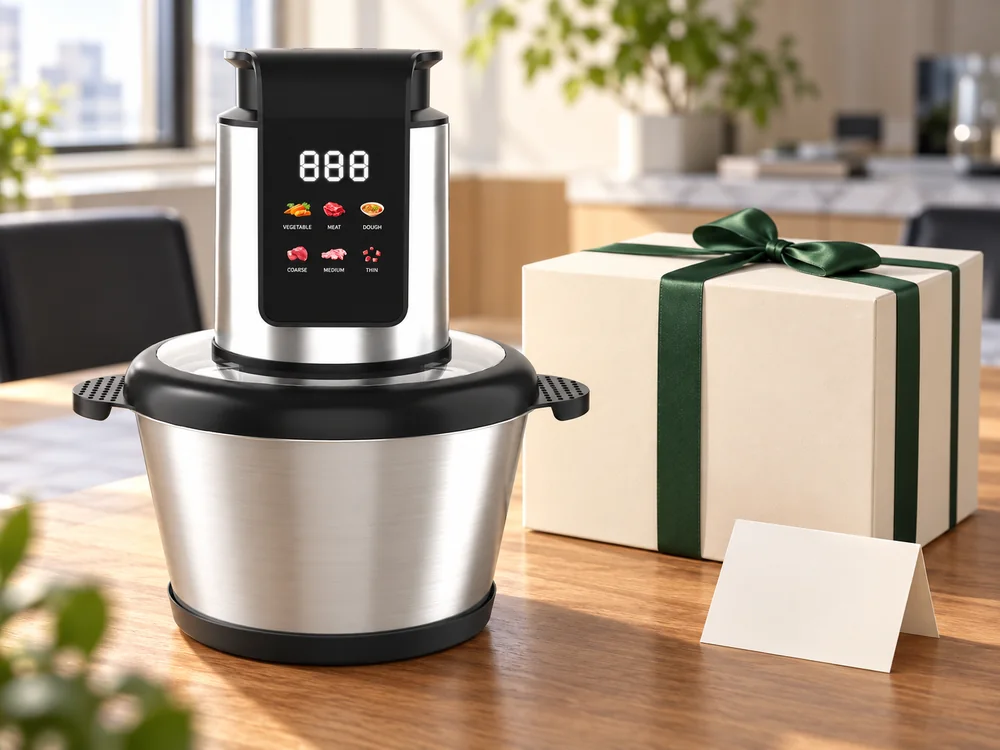
For example, the quotation reference identifies SD-02 with a nominal 2 L stainless-steel bowl, 400 W power and digital controls. BG-05 is a separate nominal 1.2 L AS-bowl model with 400 W power and two-speed controls. These are configuration references, not interchangeable sets or proof that one produces a better result.
The smaller nominal bowl may be worth evaluating when the client wants a less substantial-looking household gift. The steel-bowl proposal may suit a different presentation. Obtain the actual assembled and packed dimensions before deciding which is easier to distribute. Nominal liters are not package measurements or permitted food-load quantities.
Handle the controls and matched set as the recipient would, within the model’s instructions. Assess whether the proposed explanation is clear, whether the components are easy to identify and whether the complete offer fits the brief. Do not expand a product’s claims because its panel shows an ingredient icon. Any advertised preparation task still needs the selected model’s supported scope.
Distinguish client preferences from acceptance requirements. A preferred housing color might be negotiable. The required electrical version and complete contents are not cosmetic issues. If the exact color cannot be offered within the campaign conditions, the buyer can consider an acceptable available version without abandoning the entire product choice.
| Campaign condition | Product question to answer | Effect on the shortlist |
|---|---|---|
| Recipients carry gifts away from an event | What are the real packed dimensions and handling needs? | Compare practical collection, not bowl liters alone |
| Gifts go to more than one market | Which complete electrical and information versions are needed? | Separate incompatible destination offers |
| Brand visibility is important | Which actual product or package surface can carry the agreed mark? | Assess the proposal on the selected model |
| Budget must cover distribution | What complete product leaves room for local handling and support? | Avoid selecting on factory unit price alone |
| Recipient explanation must be simple | Can the contents and supported use be understood from the supplied information? | Review the product and instructions together |
Use an evaluation sample to settle the open selection question. Once the client chooses the product, a further approval reference may still be needed for the agreed branding, contents and packaging. Keep those approvals identifiable instead of calling every stage the final gift sample.
Separate the gift presentation from the protective package
The attractive surface and the protection around the appliance perform different jobs. Establish the complete package before costing a sleeve, ribbon or extra presentation box. A decorative outer layer cannot replace the agreed protection for the bowl, lid, motor head and other supplied items.
Decide what the recipient should see first. The mark might belong on the appliance, the retail box, a removable sleeve or a separate message. These choices have different preparation requirements and leave different identities after the package is discarded. Ask for the available application proposal rather than assuming every option uses one shared minimum or schedule.
JINJIE’s OEM and ODM options provide a route to discuss the selected appliance and requested presentation. Identify which elements the factory is being asked to supply and which will be added by a local campaign partner. If a greeting card or external hamper is outside the quoted scope, keep it outside the factory’s approved contents list.
Review the artwork with the client’s authorized approver. A distributor should not choose a brand variant or recipient message from several old files without a decision from the owner. If different branches need different messages, make the quantities and identities clear before discussing preparation.
Keep essential product information readable and accessible. A campaign sleeve should not create an inaccurate product description, conceal information the recipient needs or imply functions that the selected version does not support. Ask the responsible product reviewer to assess the proposed presentation for the actual destination; this guide does not prescribe a universal labeling layout.
Do not add unrelated food, a decorative utensil or another appliance to the pictured gift unless the supplied offer really contains it. A photograph can create an expectation just as easily as a written contents list. If the campaign organizer assembles a larger bundle locally, its proposal should show those additions separately from the factory’s appliance set.
Budget the campaign per delivered gift
Set the budget boundary at the point that matters to the client. Goods delivered to an importer’s warehouse are not yet gifts delivered to recipients. Identify the work after that warehouse: receiving, any approved local presentation work, allocation, onward delivery and the agreed support route. Price each required service through the responsible party.
Separate the number of intended recipients from the number of appliances purchased. Samples used for client evaluation, goods allocated to demonstrations and an agreed service reserve may be unavailable for the main distribution. Treat each allocation explicitly. An arbitrary extra percentage is not a replacement for a reasoned quantity plan.
For an invented planning example, suppose a campaign needs 600 recipient gifts. The buyer allocates four further units to client and distributor review and twelve to an agreed service reserve, giving a proposed purchase of 616 complete units. The manufacturer still needs to quote whether that quantity and presentation can be supplied. These figures are not a JINJIE minimum or a recommended reserve rate.
Now suppose the product and agreed packaging cost USD 18 per purchased unit on a stated delivery basis. Suppose other campaign costs outside that basis total USD 1,200 and one-time preparation is USD 300. The illustrative cash requirement is 616 × USD 18 + USD 1,200 + USD 300 = USD 12,588. Dividing by 600 planned recipient gifts gives USD 20.98 per gift allocated to the campaign.
The reserve remains an asset until used or otherwise resolved. The calculation allocates the purchase cash to the initial campaign; it is not a claim that every reserve unit has already been consumed or that the campaign’s accounting profit is known. If leftovers can support another program, review their value on that actual basis.
Keep the quotation’s delivery point beside the cost. Do not add the same transport service twice or omit destination work because a quote includes some shipping. Use the applicable currency, fees and tax treatment supplied by the responsible providers. If essential costs remain open, show the range or unresolved amount rather than inventing a fully landed figure.
Work backward from the recipient date
An event date creates a hard distribution requirement. Work backward through local receiving, presentation or allocation, transport, the supplier’s readiness and buyer approvals. Give each stage an owner. Production finished before the event is not enough when the goods are still elsewhere.

Obtain a schedule for the selected product, quantity and presentation. A standard-product inquiry and a proposal involving new artwork do not have the same prerequisites. Ask which buyer decision determines the next date. One consolidated client approval can be more valuable than repeated small comments arriving from several departments.
Identify the last useful decision date for each unresolved option. If an optional sleeve is not approved in time, consider whether an accepted simpler presentation can still meet the campaign. If a mandatory electrical or product requirement is unresolved, hold the dependent commitment and resolve it. A fixed event date is not a reason to treat missing evidence as acceptable.
Plan the local receiving review before the goods arrive. Establish how the actual model, presentation, complete contents and quantities will be compared with the accepted offer. JINJIE’s quality and testing information can start the discussion about relevant factory checks. Separately allocate the receiving and onward-distribution work at the campaign destination.
| Readiness finding | Campaign action | What must remain explicit |
|---|---|---|
| Product fits but optional presentation is late | Evaluate an accepted simpler presentation | Client approval and the revised complete offer |
| Delivery reaches a warehouse but not the event | Review local handling and transport | Recipient date, responsible provider and actual cost |
| Essential product evidence is missing | Hold the dependent approval and seek clarification | Missing item and decision owner |
| Confirmed version cannot meet the requirement | Select an appropriate alternative | The mandatory requirement, not merely appearance |
| Fewer recipients are confirmed than planned | Reassess allocations and uncommitted quantity | Existing order obligations and leftover treatment |
Discuss alternatives before they become urgent. Moving the recipient date, changing the gift or reducing optional work are commercial choices for the client. Faster transport is useful only if the actual product and presentation are ready and the route can achieve the required receiving date. Do not promise a rescue option before it has been evaluated.
Keep distribution and recipient support attached to the right version
For several destinations or client branches, map each accepted offer to its quantity and receiving point. Branch names, artwork variants and electrical versions are not interchangeable picking notes. Give the receiving team an identification method that survives removal of the master carton.
Avoid requesting personal recipient lists from the factory when it is shipping a bulk order to one nominated receiver. Share the information the agreed service actually needs. If another provider handles individual addresses, settle that handover and its information responsibilities with that provider rather than assuming the manufacturer runs the campaign’s data platform.
A recipient may need help after the event. Decide whether questions go to the client, distributor or another agreed support contact. Give that team the selected model, applicable instructions and the actual response arrangement. A person receiving a free gift may have no retail receipt, so the campaign needs a workable way to identify what was supplied.
Agree how missing items, transit damage and reported operating problems are raised and assessed. They are different situations. Do not promise replacement parts, automatic credits or a fixed warranty response unless the proposal actually provides them. A reserve of complete units is one possible buyer arrangement, not a substitute for investigating a reported product concern.
After distribution, reconcile issued units, reserves and leftovers. Record which version went to each allocation and whether remaining branded goods can be used for a later program. Do not silently sell a client-marked gift as ordinary retail stock or mix its support promise with another channel’s offer.
Request a campaign-specific appliance proposal
Send JINJIE your corporate gift appliance brief with the recipient context, destination quantities, preferred chopper model, required receiving date and product or package branding. Identify the bulk delivery point and any local presentation work handled elsewhere. Request the complete appliance offer first, then assess whether its conditions fit the campaign budget and distribution plan.
FAQ
Can we order one electrical version for employees in several countries?
Give the supplier the destination breakdown and ask which versions can be proposed. Have the appropriate reviewer assess the complete offer for each market. A common company logo does not make one electrical configuration suitable everywhere, and a plug adapter should not become an improvised solution after purchase.
What if the client changes its message after packaging preparation starts?
Identify the affected files and materials, then request the consequences for cost, quantity and timing. The client can decide whether the change is essential. Preserve the accepted reference until a replacement is authorized; do not keep promising the old schedule while reopening the presentation.
Must the appliance itself carry the company logo?
No universal rule requires that choice. Decide what the campaign needs after the packaging is removed. Compare the available appliance marking with an appropriate package or message treatment, including the preparation and client approval required. Obtain a proposal for the selected product rather than assuming all surfaces are brandable.
Can spare campaign units be used for late recipients?
They can be allocated where the same complete version and presentation remain appropriate. Keep enough for the support arrangement the buyer has chosen, and check whether a new destination needs a different version. Record the allocation so a reserve is not promised simultaneously to recipients and service staff.