An online retailer can approve an attractive chopper sample and still have no viable product to launch. The proposed page may promise functions the sample has not established. The expected selling price may leave too little room for delivery and customer acquisition. Or the opening quantity may commit the entire budget before the listing and support arrangements are ready.
Buying private label food choppers for online retail means choosing the product and the offer your business can honestly sell around it. The next decision is not simply where to put the logo. It is whether one identified appliance can support a clear customer promise on workable purchasing and channel terms.
This guide covers household electric bowl choppers sourced for a buyer’s own brand. JINJIE discusses model selection, branding and packaging within that scope. Marketplace admission, advertising performance, overseas fulfillment and retail sales remain separate matters. A manufacturer proposal cannot guarantee that a platform will accept the product or that customers will buy it.
Start with the customer question your page must answer
An online shopper cannot normally handle the appliance before choosing it. Your page needs to explain the relevant preparation task, the complete supplied set and the practical difference from alternatives. Define that proposition before buying several variations for photography.
Use a specific requirement rather than an unsupported superlative. A buyer might want to sell a household bowl chopper with a transparent vessel, or a steel-bowl version with a particular control format. Those are starting directions. Claims about the finished food, permitted quantity or operating sequence need the selected model’s instructions and relevant evaluation.
Keep the product category clear. A countertop bowl chopper is not a screw-fed meat grinder or an industrial bowl cutter. Search terms can overlap, but customers arriving from those other searches may expect a different appliance. A broad keyword is not a reason to describe your product as performing every neighboring task.
Review what your intended customer needs to know without asking support. The bowl type, contents, storage dimensions and operating scope may affect the purchase. Identify the information that must be obtained before the page is complete. Give the manufacturer those questions rather than asking for generic selling points.
Use JINJIE’s electric chopper category to start the shortlist with actual platforms. Its format choices can guide an inquiry; they do not decide which proposition belongs in your store. That decision needs your channel, customer and cost assumptions.
If two proposed variants answer the same question in nearly the same way, test the reason for buying both. A different finish can be a legitimate choice for a customer group, but it adds stock and presentation work. Do not assume a larger online assortment creates enough extra sales to pay for that work.
Select the whole configuration before preparing the listing
Connect the product reference with the matched motor unit, bowl, lid, blade assembly and included items. State the electrical version and destination. A supplier photograph showing alternative containers is not a promise that all of them belong in one retail box.
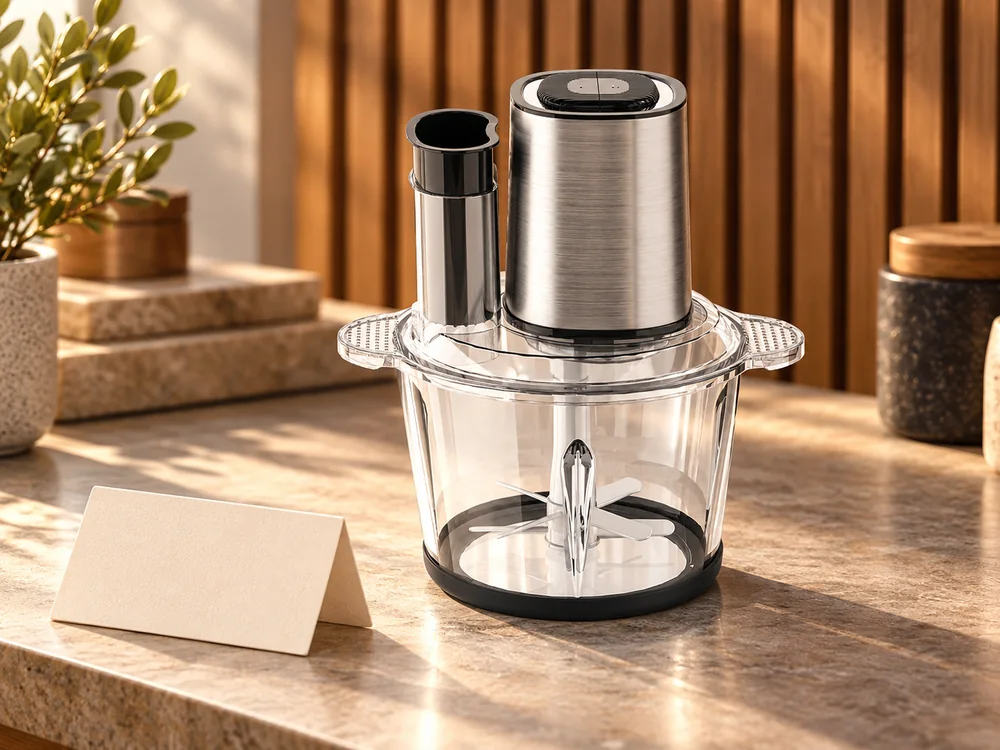
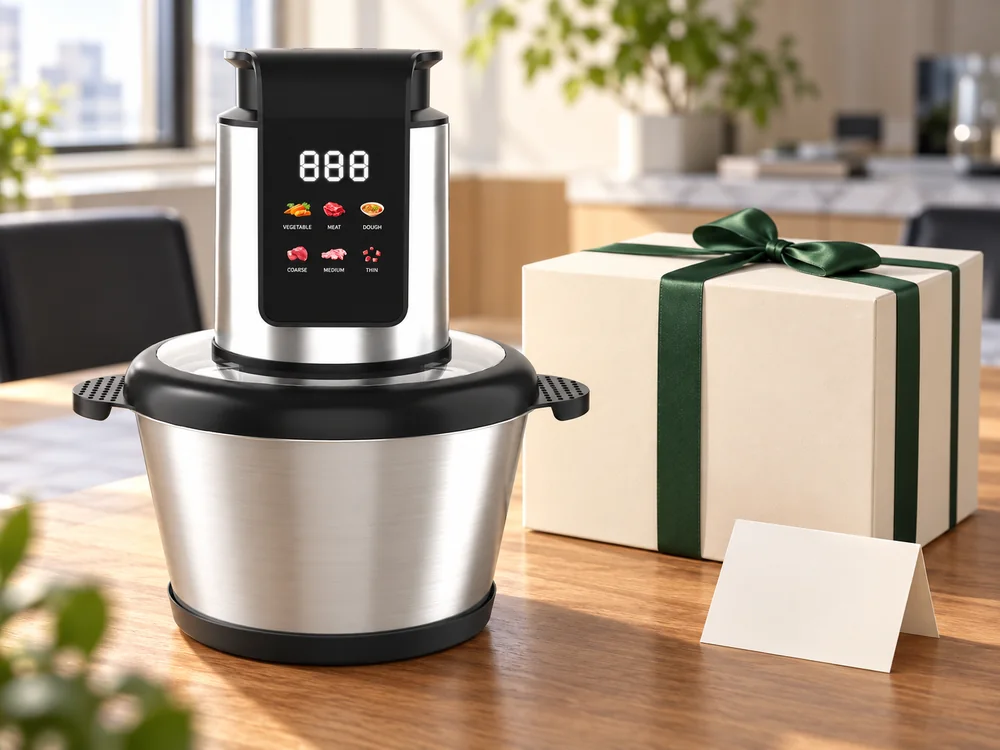
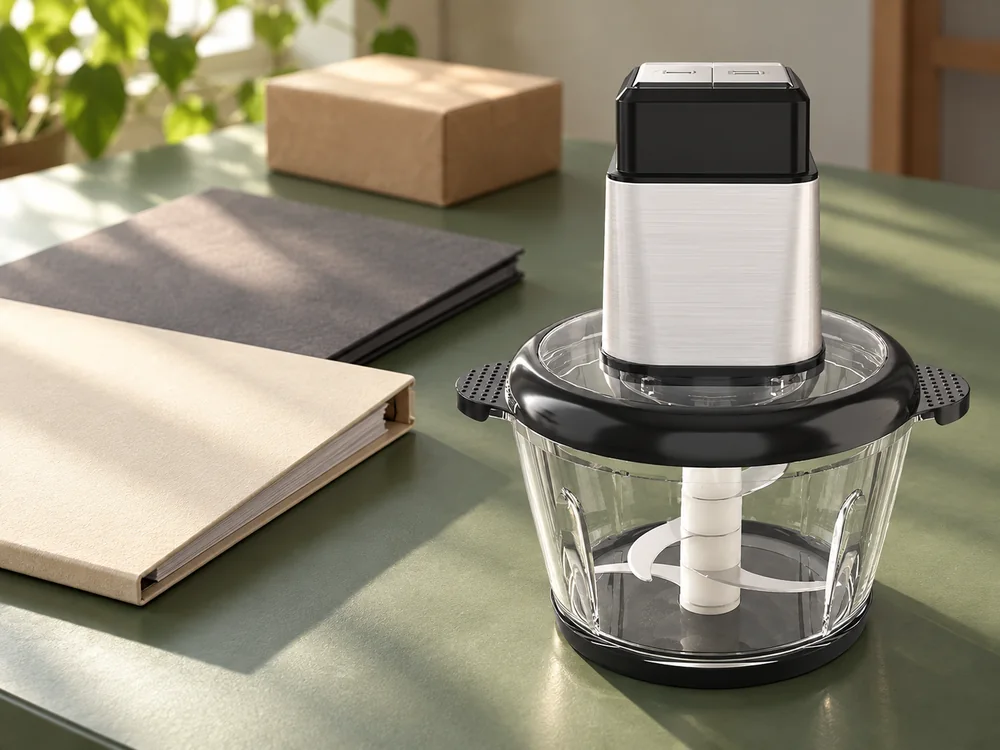
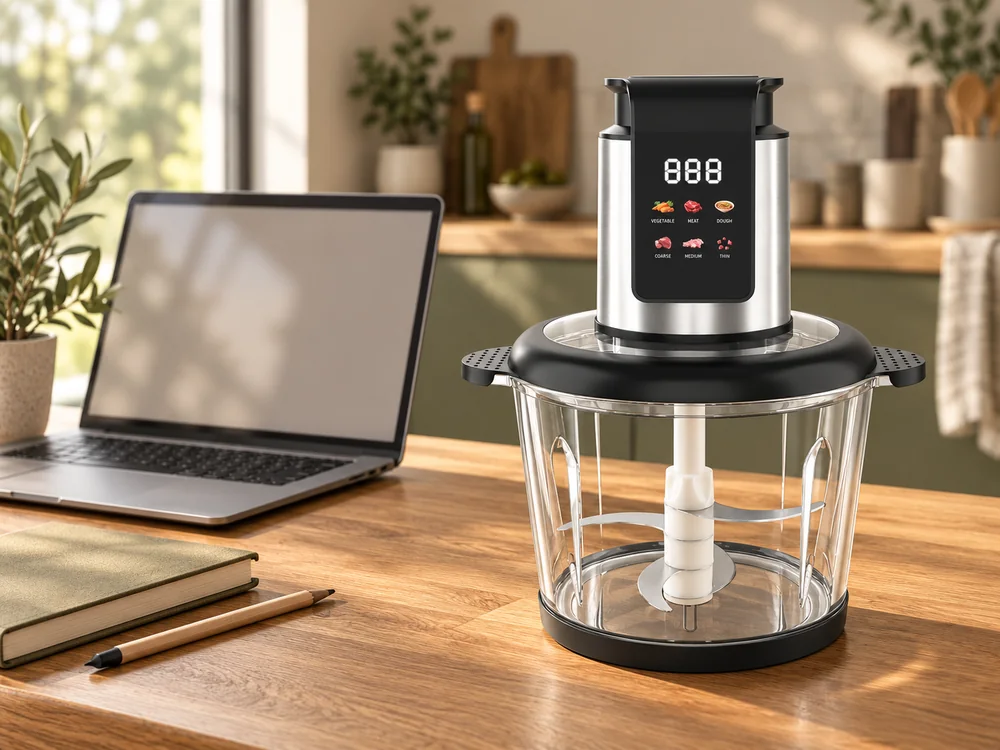
The current quotation identifies SD-02 as a nominal 2 L stainless-steel bowl model at 400 W, and SD-04 as a nominal 2 L glass-bowl model at 400 W. Both entries list digital controls. The shared nominal capacity and power can help frame a bowl-choice comparison. They do not prove identical internals, permitted loading or chopping performance.
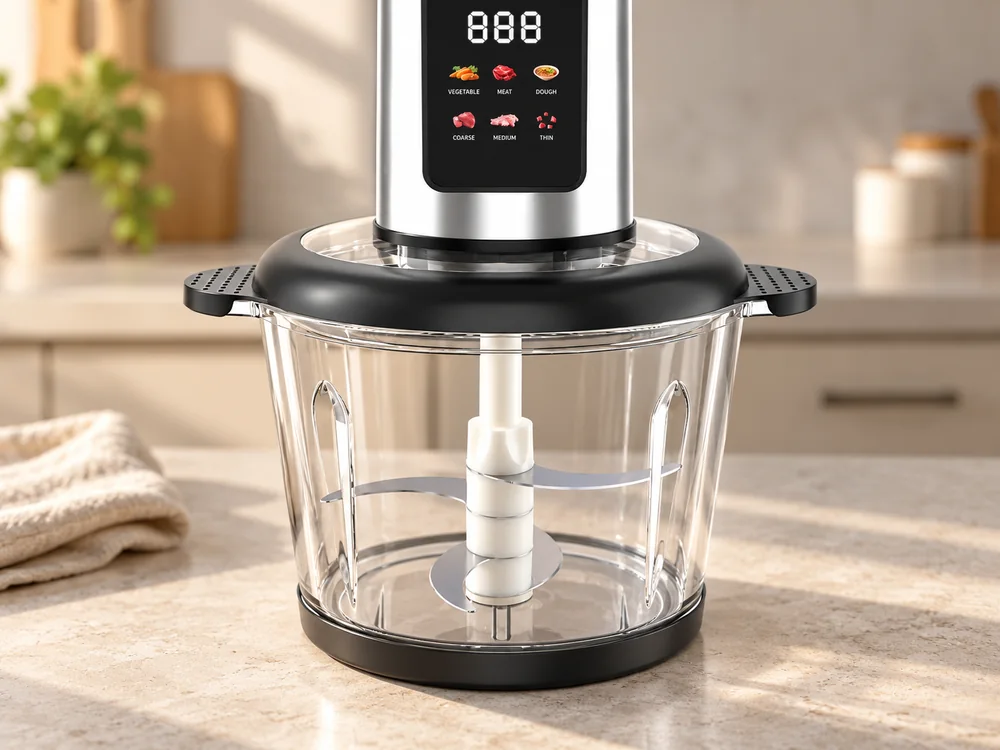
The transparent vessel is a visible distinction the page can show accurately. The steel vessel provides a different appearance and handling experience. Choose the difference that supports the customer proposition, then evaluate the complete sample within its instructions. Do not turn a material preference into an unsupported durability or freight claim.
Request dimensions for the actual assembled and packed version. A nominal-liter figure cannot fill every capacity, serving or processing field in a marketplace form. Where a channel requests a value the product evidence does not establish, resolve the field with the responsible channel reviewer rather than copying a convenient number.
Give sample work a purpose. An evaluation sample can settle handling or a permitted preparation question. Once selected, the branded product and package may need their own approval reference. A standard sample can support early content preparation without approving an artwork or set that has not yet been supplied.
Choose the minimum useful opening scope. One accepted version is easier to photograph, explain and replenish than several unsettled alternatives. That does not make a single-SKU launch universally correct. If two variants have distinct customer roles and workable quantity conditions, maintain separate configurations and cost them individually.
| Listing promise | Basis needed for the selected product | Purchasing consequence |
|---|---|---|
| Visible bowl material and format | Identified complete sample and accurate product description | Choose the version the images will represent |
| A specified preparation result | Applicable instructions and a relevant permitted evaluation | Resolve the claim before relying on it to sell |
| Contents shown in the offer | Agreed supplied-set list and matching photographs | Price the whole unit, not an incomplete base product |
| Practical size or storage claim | Correct measurements for that assembled version | Assess whether the proposition fits the customer |
| A stated service promise | Actual buyer and supplier response arrangement | Include the work and cost the brand will carry |
Turn the approved product into a truthful content set
Prepare a content set around one accepted reference. Include the complete product view, useful details, agreed contents and measurements needed by the customer. A beautiful hero image can attract attention; it cannot replace a clear picture of what arrives in the box.
Separate the requirements of a product listing from an editorial article. Your own blog may use a staged kitchen scene. A marketplace can impose different main-image and content conditions. Check the current rules for the channel you intend to use and prepare assets for those requirements. Do not treat one image format as automatically acceptable everywhere.
Amazon’s seller guidance emphasizes accurate product information and images that show what is being sold. That is useful context for an Amazon project, not proof that a particular appliance or content set has been approved. Apply the current product and account requirements directly before building a purchase plan around that channel.
Show optional items honestly. If a second bowl is offered separately, a contents image should not suggest it is included. If a photograph uses food or a decorative prop, keep the supplied set clear. Avoid an image that depends on tiny qualifying text to undo its main visual message.
Use a demonstration only for a supported task on the identified version. Record the relevant ingredient condition, preparation and permitted operating method. A short clip can help a shopper understand the product, but editing should not conceal a sequence necessary to interpret the result. Do not represent another model’s clip as your ordered appliance.
For U.S. marketing, the Federal Trade Commission states that advertising claims must be truthful and evidence-based. Keep that principle attached to the words and images you publish. This guide does not provide a complete legal review for every destination or decide which particular claims your product evidence supports.
Agree permission to use supplied images and brand files. Availability in a catalog does not establish unrestricted rights to edit or reuse every asset. The JINJIE OEM and ODM discussion can connect your presentation request with the actual branded product proposal. Identify the assets you need, who prepares them and which reference they must follow.
Keep the final information consistent across the store, advertising, package and customer support. A corrected page can still leave an old advertisement circulating. Allocate responsibility for withdrawing or updating obsolete content before the first stock becomes available.
Work backward from the channel’s usable revenue
The advertised selling price is not the amount available to purchase the appliance. Define the revenue and cost basis your business will use, then separate platform or payment charges, fulfillment, delivery, customer acquisition and the service work you expect to carry. Obtain current amounts from the actual providers.
Use the completed packed unit for relevant estimates. A glass-bowl and steel-bowl proposal may have different packing arrangements, but material alone does not tell you their parcel charges. Ask for the actual information before treating one as the lower delivered-cost choice.
For an invented example, suppose a retailer plans a USD 39 selling price on an accounting basis that excludes applicable tax. Its assumed platform and payment cost is USD 5, fulfillment and delivery is USD 7, and landed product cost is USD 15. Before advertising and other business expenses, the remaining amount is USD 12 per sale. None of these figures is a JINJIE quote or a published marketplace fee.
Suppose the retailer wants USD 4 per sale left toward its further overhead and profit. Under those simplified assumptions, it has USD 8 available for customer acquisition and any other costs not yet included. If its measured acquisition cost is USD 10 on the same basis, the intended USD 4 contribution is not available. The response needs a real change in cost or proposition, not a more optimistic spreadsheet.
An average acquisition cost can conceal different orders. Separate repeat customers from paid first purchases if their costs differ. Treat new-channel assumptions as provisional until the business has relevant evidence. A supplier’s favorable unit price cannot establish the conversion rate your page will achieve.
Budget launch expenses outside recurring unit contribution. Sample review, content production, brand preparation and any one-time project work require money before routine sales begin. Do not subtract the same expense twice, but do not let it disappear because it is absent from the factory unit price.
Assess discounted promotions separately. A lower selling price can remove the allowance you intended for paid acquisition. Use the actual promotional price, fees and costs before authorizing a campaign. An appliance that works economically at the planned regular price may not support every discount your marketing team proposes.
Size the first commitment to what you can learn and fund
Request the quantity conditions for the selected model, finish and presentation. JINJIE’s public sourcing information makes those conditions model- and customization-dependent. A common logo does not establish that two variants can share one minimum. Ask for the actual proposal before allocating stock between them.
Separate demand evidence from interest. Competitor reviews, a keyword estimate or a prospective retailer’s positive sample comment can inform a plan, but they do not equal accepted customer orders. Use your own channel evidence where available and show uncertainty when the product has not yet launched.
Set a cash boundary for the entire launch. Suppose, only as a planning illustration, a business can commit USD 12,000. It allocates USD 2,000 to launch preparation and USD 2,500 to operating cash before customer receipts. That leaves USD 7,500 for the initial inventory on the chosen basis. At the illustrative USD 15 landed cost, this represents 500 units, before any further costs omitted from that basis.
This is a financing boundary, not a supplier minimum or a recommendation to buy 500 units. If the supplier’s acceptable proposal requires a larger commitment, the business must revisit funding, optional variants or the offer itself. A lower unit price attached to more stock may increase, rather than solve, the funding problem.
Choose an operating review point before ordering. The first period should reveal whether customers understand the proposition, whether reported issues concern expectation or the product, and whether contribution supports the next commitment. Define the decision the review will inform; do not assume it must always lead to a larger reorder.
| Launch finding | What to investigate | Next purchasing action |
|---|---|---|
| Customers expect a different appliance type | Search language, page images and category description | Correct the offer before adding stock |
| Product fits but acquisition consumes the allowance | Actual channel costs and customer proposition | Reassess economics before expanding |
| A variant adds no distinct customer role | Sales evidence and inventory by version | Narrow future commitment where obligations allow |
| Complete-set or condition complaints recur | Supplied version, packing and receiving evidence | Resolve the specific issue with the responsible party |
| Demand and contribution support replenishment | Current available configuration and order conditions | Request a defined repeat proposal |
Close the factory, warehouse and support handoffs

Establish what the factory supplies and what happens after arrival. The product may be received as retail units inside master cartons, while a fulfillment operation prepares individual customer orders. Give each party the information needed for its own work without assuming one supplier runs the whole online business.
Check the receiving identity before releasing stock. The warehouse needs to distinguish product versions and confirm the actual supplied contents. The identifiers used by your store and channel should map back to the selected manufacturer’s reference. Similar package photographs are not a reliable picking instruction.
Use the JINJIE quality and testing discussion to identify the checks relevant to the actual order. Separate factory evidence from your destination receiving process and customer feedback. A general workshop image does not prove that a named batch or parcel arrangement passed a particular test.
Give support staff the actual instructions and scope behind the page. Distinguish a customer’s missing item from dissatisfaction with the result or a reported operating problem. A potentially unsafe condition needs the appropriate escalation, not an improvised customer test. Establish the response route before promising a remedy in the listing.
Keep returned stock out of automatic resale until the buyer’s appropriate review determines its condition and disposition. A box that looks presentable is not evidence of a complete, suitable appliance. Record the affected version and issue so the next purchasing discussion has more than one combined returns number.
On replenishment, request the current offer for the accepted version. If the supplier proposes a change, identify which images, description, instructions and previous evaluations are affected. A change to a visible feature should not arrive silently under an unchanged page that promises the earlier product.
Request one launch-ready product proposal
Send JINJIE your online retail chopper brief with the preferred product, destination, estimated opening quantity, complete-set requirements and intended customer proposition. Include branding, content needs and the bulk receiving point. Ask for a coherent product quotation and unresolved-item list, then compare it with your own launch economics before committing to stock.
FAQ
Can a supplier guarantee that our marketplace listing will be accepted?
Do not build the purchase around that assumption. Obtain the product information and evidence the proposal can supply, then assess the current channel requirements through the responsible account or reviewer. A factory quote, a brand mark and an attractive sample do not settle platform admission.
Should we buy several colors before we have sales data?
Compare the additional quantity and preparation commitments with the customer role for each choice. A color can be useful, but interest in photographs is not a sales allocation. Where the proposition is still untested, ask whether a narrower available offer can answer the first commercial question.
Can we use a standard sample for early product photography?
It can help prepare a concept if its differences are recorded. Final customer content must represent the actual supplied branded version, contents and scope. Replace or correct early assets when the ordered configuration changes; do not use a small disclaimer to conceal a material difference.
What if the product sells but the contribution is below plan?
Identify the changed input: selling price, acquisition, fees, delivery, service or product cost. Recalculate on one consistent basis before ordering more. Volume alone does not repair an unfavorable per-order result, and reducing a mandatory product requirement is not an acceptable hidden cost adjustment.