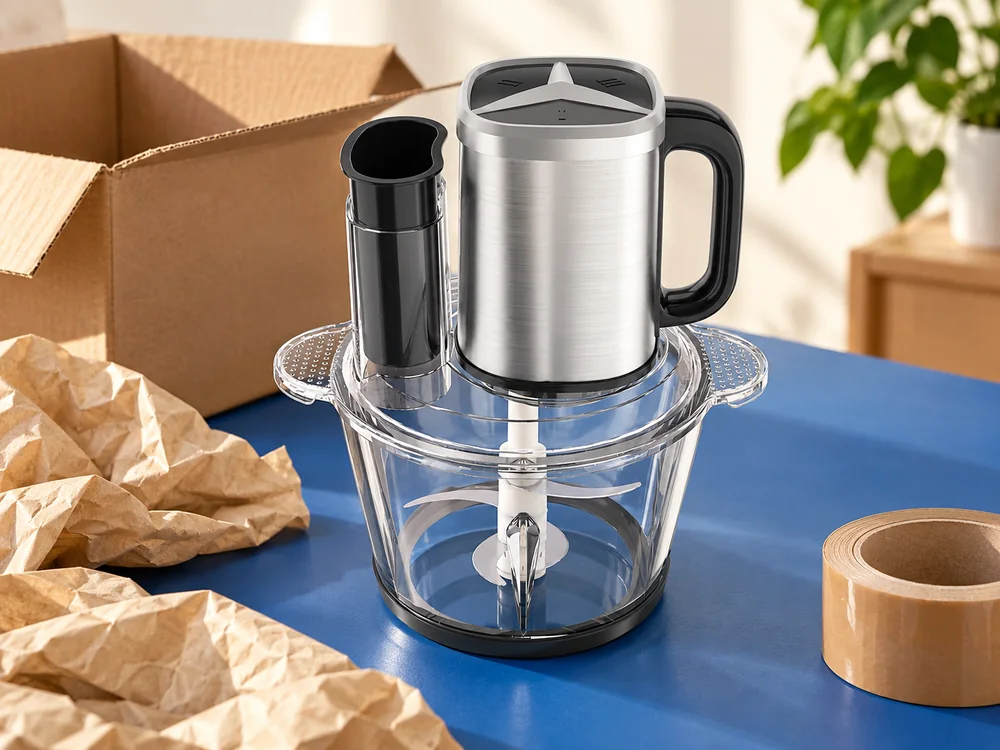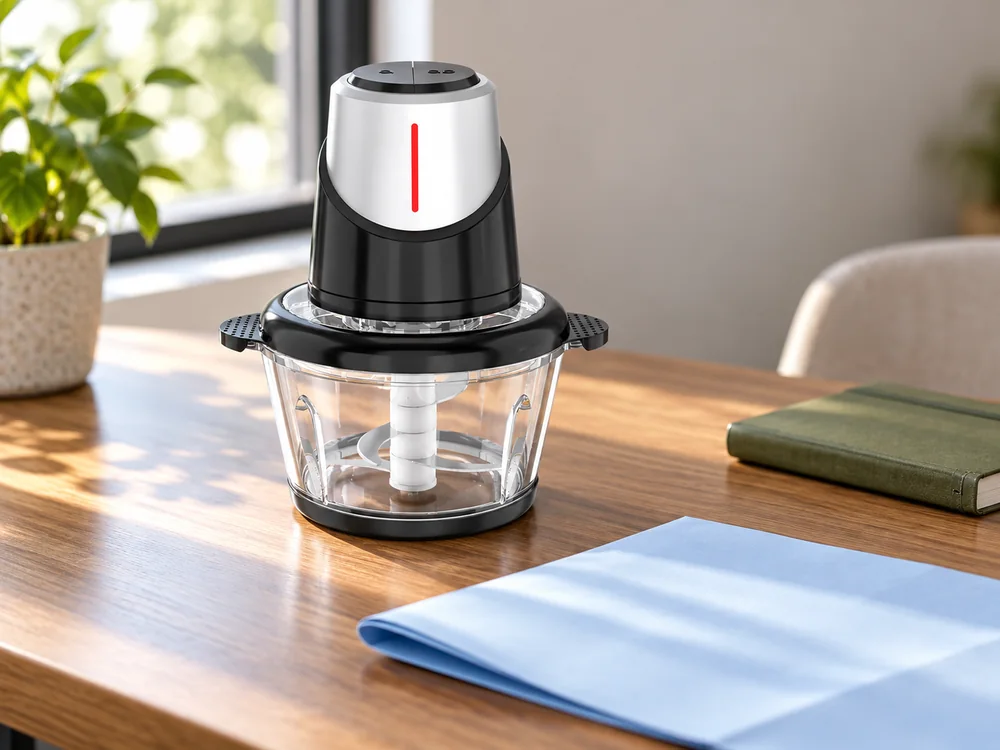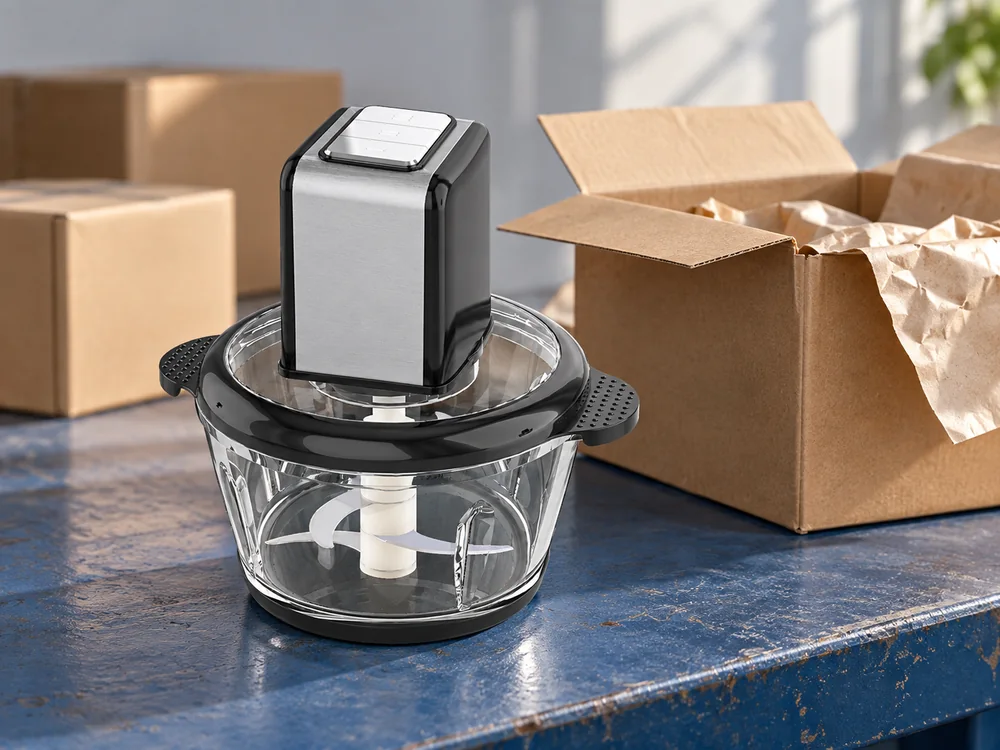
The packing list shows 300 complete choppers. The warehouse receives 48 cartons, while the dispatch record lists 50. Before the sales team promises stock, purchasing needs to establish what arrived, what remains elsewhere and which units are actually available to sell. A delivery notification alone cannot answer those questions.
Small appliance receiving should connect the physical shipment with the accepted purchase and its current release allocation. The useful outcome is a reconciled quantity, a clear stock status and an assigned response to each exception. This guide concerns household food-preparation appliances imported for resale. It does not prescribe a universal inspection plan, claim deadline or right to a refund.
Give receiving the shipment allocation, not just the purchase total
An order can travel in more than one movement. Give the receiving team the supplier, purchase reference, actual dispatched lines, version quantities and expected cartons for this delivery. Keep the remaining order balance separate. Otherwise, a correctly received partial shipment can be reported as a supplier shortage, or an incomplete delivery can be mistaken for an agreed split.
The dispatch allocation should identify any exceptions to normal packing. A carton containing fewer units needs its actual count. A sample packed separately needs its own destination and purpose. A carton number used by the logistics provider should remain connected to the product line it contains, even if the warehouse assigns another receiving reference.
Use the JINJIE electric meat chopper range to establish the purchased platform. The quotation lists SD-01 with a nominal 3 L 201 stainless steel bowl, 500 W and digital controls. SD-02 is a separately listed nominal 2 L steel-bowl version at 400 W. Similar motor-over-bowl silhouettes do not make them one interchangeable receiving line.
Connect the supplier model to the buyer’s SKU and agreed electrical version. Receiving staff may work from the buyer’s code; product reviewers may use the manufacturer’s reference. Both should lead to the same accepted configuration. A barcode that scans successfully into the system does not settle a mismatch between those records.
Identify the receiving owner and where discrepancies go. Warehouse staff need enough information to report a visible difference without deciding the commercial settlement themselves. Purchasing needs a contact who can obtain the supplier’s response. A technical concern should have an appropriate review route rather than becoming a request for an improvised warehouse test.
Separate the carton count from the complete-unit count

Count what is physically received on the applicable delivery record and note visible exceptions through the provider’s actual procedure. Preserve the shipment reference and the timing of the observation. Follow the responsible carrier’s reporting requirements promptly; do not borrow a deadline from a different country, service or contract.
DHL Freight’s Germany claim guidance requests identified transport details and photographs of goods and packaging, and advises preserving affected goods and packing for review. That is useful preparation context, not a universal deadline or a finding that any particular supplier caused damage. Obtain the rules for your actual movement.
For an invented example, the dispatched quantity is 300 sets in 50 cartons of six. Receiving counts 48 of those cartons. Their expected contents would be 288 sets, leaving a 12-set difference against this dispatch allocation. Six is an illustrative packing count, not a JINJIE specification. The number still needs comparison with the actual carton contents and exceptions.
If the purchase was for 360 sets but only 300 were allocated to this movement, keep two balances visible: the apparent 12-set receiving difference and the 60 sets outside this dispatch. Combining them into a 72-set transport shortage would misdescribe the problem. Likewise, finding two cartons at another approved location may reconcile the shipment without changing the original purchase quantity.
Do not infer every carton’s contents from one opened carton. Use the agreed receiving and product-check scope. Where a discrepancy warrants a broader count, assign and record that work. The warehouse’s initial observation should show what was actually checked, not an exact whole-shipment conclusion derived from a convenient sample.
| Receiving record | Basis to retain | Decision it supports |
|---|---|---|
| Expected delivery | Actual dispatch allocation and packing exceptions | What should arrive in this movement |
| Physical receipt | Cartons and identified items actually received | Which quantity is at this location |
| Product identity | Buyer SKU linked to the accepted supplier version | Whether the line matches the purchase |
| Condition review | Observations and the completed check scope | What stock needs a separate hold |
| Outstanding balance | Shipment difference separate from undelivered order balance | Which party needs to answer each issue |
Review the complete retail set before making stock available
A received motor unit is not necessarily a complete retail set. Compare the relevant supplied contents with the accepted order reference. For a bowl chopper, that can involve its matching bowl, lid and blade assembly, as well as the agreed instructions and presentation. Only the actual accepted contents determine what is missing.
Where private-label material forms part of the purchase, compare it with the applicable approved revision. An older leaflet and a missing leaflet require different responses. Through JINJIE’s OEM and ODM information, discuss the identified presentation difference rather than treating all printed-material issues as one product fault.
Decide which receiving tasks your team is competent and authorized to perform. Counting, reading identifiers and photographing visible condition can support reconciliation. Powered function checks need appropriate instructions, personnel and scope. Do not energize an appliance with a damaged vessel, questionable electrical condition or another safety concern simply to establish whether it works.
If an inspection or approved reference accompanies the delivery, retain its identity and limitations. A pre-shipment report describes its recorded work at that stage. It can help investigate a later difference, but does not replace the receiving observation. Keep earlier and current evidence in chronological order rather than choosing whichever document gives the most reassuring result.
Record physical receipt and saleable stock separately
A unit can be present in the warehouse while remaining unavailable for sale. Give the inventory team distinct quantities for physically received, accepted for the intended channel, held for review and outstanding. Use the actual system’s functions without allowing its default status to decide the product question.
Shopify’s current purchase-order transfer guidance separates the commercial order from physical movement and tracks accepted, rejected and outstanding quantities. The transferable principle is to keep the agreement and receiving result connected but distinguishable. This article is not a tutorial for your particular inventory software, whose workflow may differ.
Consider an invented receiving result of 288 physically received sets, with 276 accepted and 12 held for an identified review. The warehouse contains 288 sets, but only 276 are available under that decision. The 12 held sets and the separate 12-set dispatch difference are different groups. Do not add the same units to both a damage total and a shortage total.
Record the reason for a hold and who can clear it. A suspected version mismatch needs comparison with the accepted specification. A visible packing concern needs its own assessment. Avoid an unexplained global hold on unrelated stock, but do not narrow a hold prematurely where a qualified review indicates a potentially wider issue.
Preserve the product and shipment identity when goods move to another location. A correction area should not become an anonymous pile of appliances. If a held unit later becomes acceptable, record the action and authorization that changed its status. Re-entering it as a fresh receipt can inflate stock unless the system’s reconciliation is handled correctly.
Ask for the response that resolves the identified difference

Send the supplier a concise factual record: order and shipment references, selected version, expected quantity, observed quantity, relevant photographs and the specific question. State what is known and what still needs investigation. An unexplained message saying the delivery is wrong can start several different discussions without closing any of them.
For an apparent shortage, ask whether the outstanding goods were dispatched, remain at the factory, reached another location or require correction to the packing record. Request the relevant record and proposed response. Do not assume a particular cause simply because the carton count differs.
For a configuration concern, compare the received unit with the operative order revision before requesting rework. An old receiving sheet can create an apparent supplier error. If the mismatch is confirmed, ask how the affected scope will be established and what correction is actually available. Missing evidence needs clarification; confirmed inability to meet a mandatory need requires a different buying response.
Use JINJIE’s quality and testing discussion for the appropriate product review. Keep a carrier investigation, a supplier configuration question and a buyer inventory correction identifiable even when one person coordinates them. Their conclusions may arrive at different times and address different responsibilities.
| Confirmed receiving situation | Response to obtain | Stock action to assess |
|---|---|---|
| Goods arrived at another identified location | Reconcile the movement and destination record | Avoid creating a duplicate receipt |
| Undelivered balance remains at the supplier | Current status and agreed next movement | Keep it outside physically available stock |
| Wrong version or contents are confirmed | A correction proposal for the affected scope | Hold the affected retail release appropriately |
| Condition concern needs qualified review | Review owner, method and next decision | Preserve goods and restrict affected handling |
| Records were wrong but actual goods match | Identified record correction | Update quantities without inventing another shipment |
Compare a remedy with the stock decision it must restore
A future credit may settle an amount without providing goods for an immediate retailer commitment. A replacement shipment may supply the right units but arrive after the selling window. Compare the actual remedy with the downstream need before describing the issue as resolved.
Use an invented 12-set replacement proposal to make the comparison concrete. If a confirmed retailer allocation needs those 12 sets before a particular date, ask whether the proposed correction can meet that need. If it cannot, purchasing needs a separate plan for the retailer. The article does not infer a refund entitlement, free replacement or JINJIE service promise.
Where replacement parts are proposed, obtain availability, compatibility and the appropriate correction method for the specific product. A visually similar bowl or blade is not automatically a suitable service item. Qualified work may be needed; warehouse staff should not be told to combine unverified parts merely because that route appears cheaper.
Record settlement separately from stock correction. Finance may need a credit reference, logistics may need a replacement movement, and inventory may need to move held goods to another status. Each should point to the same identified issue without treating another team’s completed task as evidence that its own task has finished.
After closure, retain the useful receiving lesson for the next purchase. A recurring confusion between complete sets and cartons may need a clearer order field. A repeated destination mismatch may need better handover instructions. Do not respond to every discrepancy by commissioning a larger product inspection if the actual problem was an allocation or receiving record.
Discuss the selected order and receiving arrangement with JINJIE. Provide the model, accepted configuration, dispatch allocation and actual observation. Ask for the specific reconciliation or product response, then give the receiving team the resulting stock decision and any remaining action.
FAQ
What if our warehouse has already marked every expected unit as received?
Reconcile the physical count and correct the inventory record through the authorized process. Preserve the earlier entry and the reason for the adjustment. A software receipt should not become the evidence used to prove that the expected quantity physically arrived.
Should every delivery repeat the original sample review?
Not automatically. Use the agreed receiving and inspection scope, considering changes and relevant earlier findings. A sample-selection exercise and a shipment receiving check answer different questions. Add work for an identified need rather than recreating every earlier task.
Can apparently unaffected goods be sold while another line is under review?
Assess whether the issue is confined to an identifiable scope and whether the applicable requirements permit that release. Keep qualified safety and product decisions separate from commercial urgency. Clear unrelated goods only on an appropriate actual decision, not a guess that the visible problem is isolated.
What if the supplier’s quantity record and our count still disagree?
Retain both records and identify the next useful evidence or recount. Check shipment boundaries, quantity units, partial cartons and other receiving locations. Keep the disputed balance open with an assigned response rather than repeatedly rewriting one total to match the latest message.