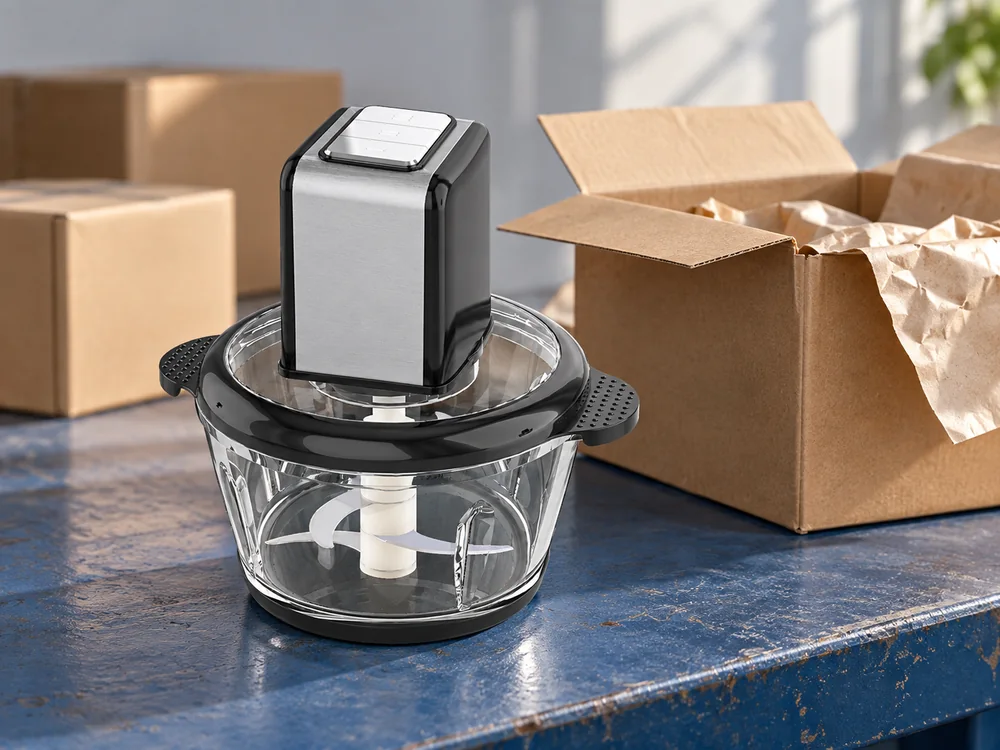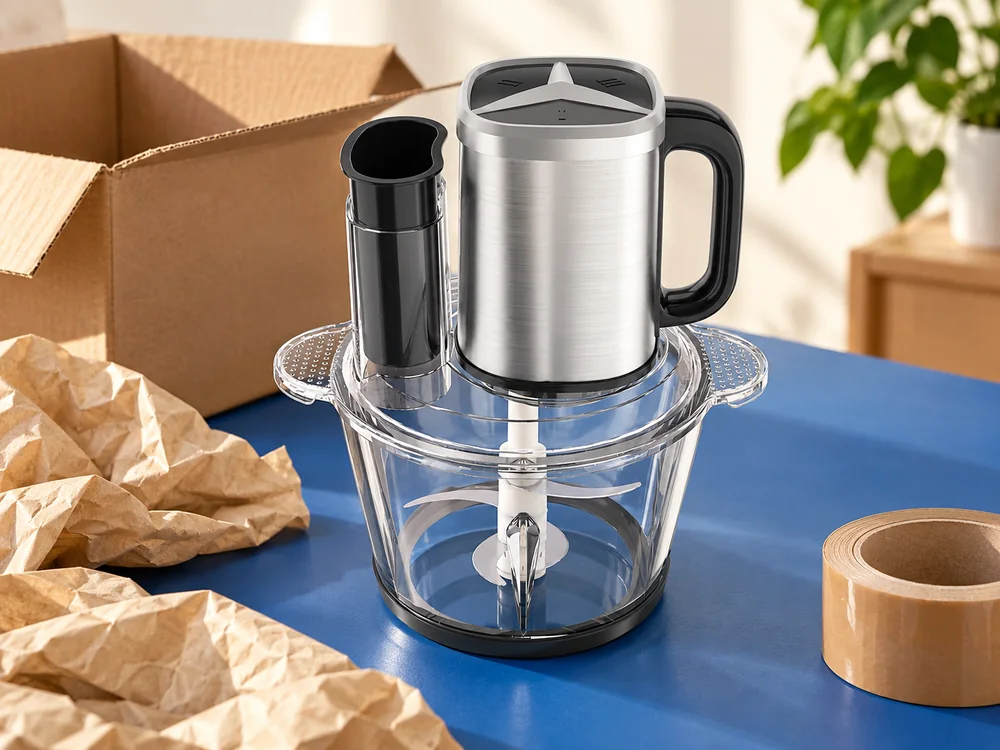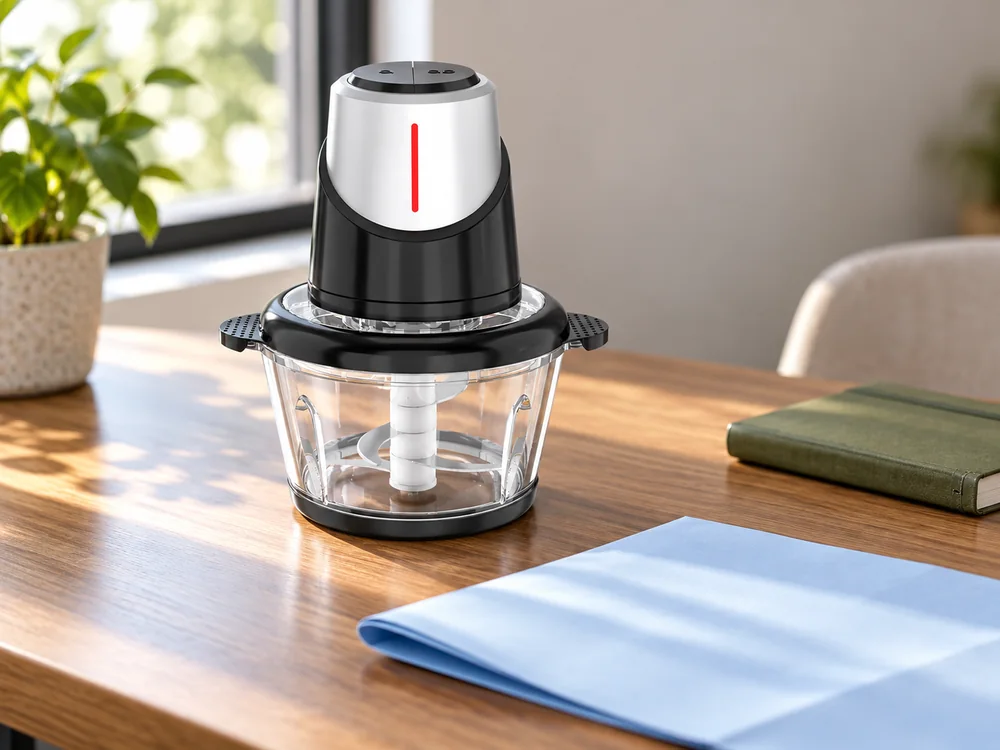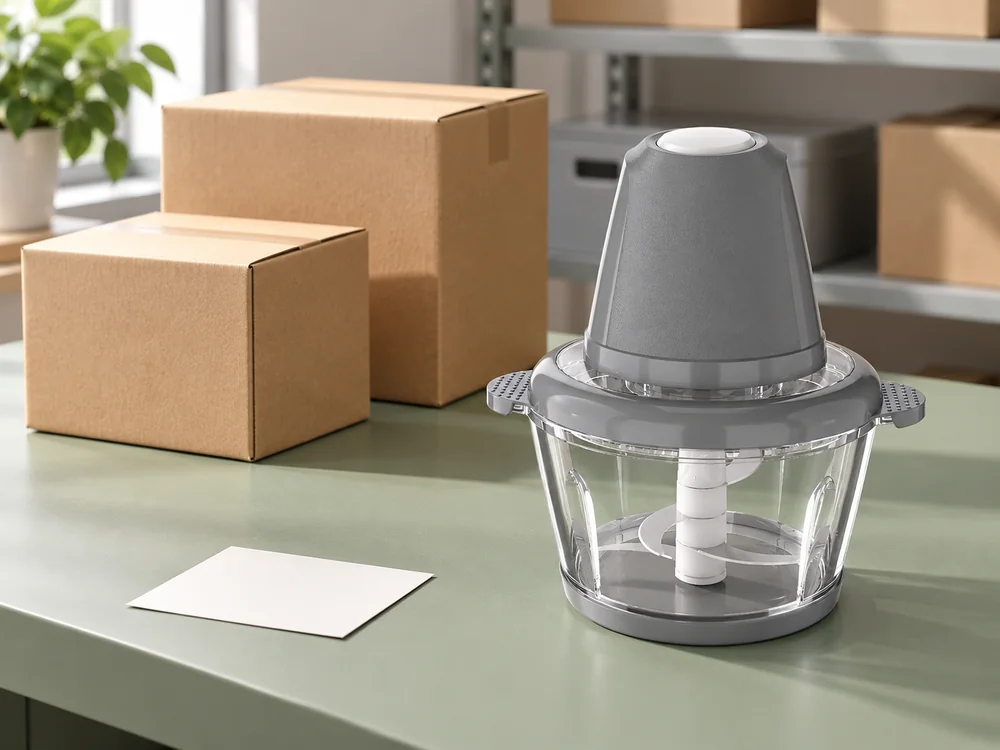
Your warehouse holds 300 electric choppers, and another 200 are on order. Sales are averaging five units a day. Purchasing can see both quantities, but still cannot tell whether to place the next order. Some stock is already committed, the incoming shipment has a different availability date, and the latest factory estimate ends before goods reach your warehouse.
Small appliance inventory replenishment turns those separate facts into a purchasing decision. The question is when another commitment is needed, how much it should cover and whether the currently available supply proposal fits that requirement. A low-stock notification is a signal to review those inputs, not permission to repeat the previous quantity automatically.
This guide concerns established household appliance lines sold by importers, distributors and private-label retailers. It uses hypothetical arithmetic, not JINJIE demand, stock or delivery promises. New product launches, one-off promotions and unresolved product-selection questions need their own planning basis.
Keep each replenished offer identifiable
Plan the appliance customers actually buy. A single product family can include bowl materials, controls, electrical versions and retail sets that cannot fill the same customer order. Stock for one offer should not disguise a shortage in another.
For example, JINJIE’s quotation identifies BG-05 with a nominal 1.2 L AS bowl, 400 W and two-speed controls. That is a product reference for a household chopper inquiry. It does not establish your retail pack, destination version, usable food load or current availability.
Use the JINJIE electric chopper range to keep the sourcing reference connected to the buyer’s item record. If one model is supplied in two presentations, retain their allocation difference even when purchasing discusses them under a shared platform.
Ask whether the repeat proposal still matches the accepted offer. An unchanged retail product can use its existing reference; a proposed change needs review of the affected scope. Replenishment should not silently introduce different contents to a listing whose description has stayed the same.
Separate usable alternatives from operational substitutes. A glass-bowl chopper may serve a related preparation need, but it should not fill a steel-bowl customer order without an appropriate, accepted change. Quantity planning cannot settle that product decision on its own.
Start with usable stock rather than the warehouse total
Count what can serve the planned sales, what is reserved and what remains under review. Returned, damaged or incomplete units do not become available merely because they remain physically present. A display unit and a complete retail unit also have different inventory roles.
Shopify’s inventory documentation distinguishes available, committed, unavailable and incoming quantities. Those software labels illustrate a useful operational distinction; use the definitions in your own system and reconcile them with the actual goods. The sum of physical stock is not automatically the quantity available for new promises.
Consider an invented example. Of 300 units physically held, 60 are committed to existing customer orders and 20 are under an unresolved hold. If the remaining 220 are suitable for the intended sales, use 220 as the available quantity for those new sales. Do not subtract the 60 again if your system’s available field has already excluded it.
Connect incoming quantities to their actual order and expected usable date. A confirmed purchase can contribute to future coverage without being available for a customer shipment today. A pending quotation is not an incoming purchase, and a production update is not proof of warehouse receipt.
Keep transfers visible. Stock in another location may help if it can be moved on suitable terms and in time. Until that route is established, do not count it simultaneously as available at both locations. An internal transfer changes allocation; it does not create another appliance.
Measure demand over a useful selling opportunity
Use actual sales for the identified offer, together with the time it was available. A period with stockouts can understate the demand your business might have served. A large temporary promotion can overstate the ordinary run rate. Examine those conditions before selecting a daily average.
Separate firm customer orders from forecast sales. Keep a consistent basis: if a committed quantity is deducted from usable stock, decide whether the corresponding sales also appear in the forecast. Recording the same commitment on both sides can produce an unnecessarily large purchase.
For a regular appliance line, examine whether demand differs by channel or presentation. The same motor platform in two packs may sell at different speeds. A combined total can hide a slow version whose next minimum commitment would create excess stock.
Treat weak observations as uncertainty rather than a confident rate. Ten sales during a short opening period do not establish steady demand for the next six months. The buyer can use a cautious scenario while accumulating evidence and ask which supply quantity is actually available.

Give the forecast an owner and review date. Purchasing should know whether a changed sales plan has been authorized or is only a possibility being discussed. Supplier communication works better when the buyer can distinguish expected demand from a firm order request.
| Inventory or demand input | Basis for the review | Common error to avoid |
|---|---|---|
| Available current stock | Usable version after stated allocations | Counting held or display units as ordinary retail stock |
| Confirmed incoming quantity | Identified order with usable-date estimate | Treating a quotation as goods already purchased |
| Firm unfilled demand | Actual customer commitments | Deducting the same allocation twice |
| Expected sales rate | Relevant selling opportunity and channel | Using a stockout period without interpretation |
| Protection quantity | Buyer-selected uncertainty provision | Treating an arbitrary percentage as a proven need |
Define replenishment time through usable receipt
Choose the start and end events behind the estimate. For this buying review, use the time from a releasable purchase commitment to stock usable for the intended sales. Product preparation, agreed reviews, transport and receiving can all sit within that period where they apply.
A factory completion estimate covers only its identified event. Ask the responsible logistics and receiving parties about the remaining work. If preparation depends on new artwork or a changed configuration, identify that prerequisite before treating an earlier repeat-order timing as current.

Use the JINJIE manufacturing discussion to locate preparation questions for the actual proposal. Obtain the order-specific answer rather than using a general factory page as evidence that a particular quantity is scheduled.
Review known uncertainty with its consequence. A possible extra receiving step may affect the usable date; a settled shorter route may change it in the other direction. Do not add every imagined delay together as if they were all certain, or erase an unresolved dependency to make the order appear timely.
An incoming shipment arriving after a projected shortage can still help later, but it cannot protect the earlier gap. Use a dated stock projection alongside a total quantity check. This is especially important when several open orders have different readiness states.
Set a trigger, then choose the purchase quantity separately
Shopify’s reorder-point guide describes a simple trigger using expected demand during replenishment time plus safety stock. It is a starting model rather than a guaranteed service result. Keep the assumptions current and use the inventory-position definition appropriate to your planning system.
In an invented scenario, expected sales are five units daily, the relevant replenishment time is 40 days and the buyer elects to hold 50 units of protection. The illustrative trigger is five times 40 plus 50, or 250 units. Neither 40 days nor 50 units is a JINJIE condition or a recommended policy.
For this example, define inventory position as usable on-hand stock plus valid open receipts, less customer demand not already deducted. With 220 available units and a valid 200-unit open receipt, that position is 420 before any other such demand. The total alone does not call for another order at a 250-unit trigger. It also does not guarantee that the 200 will arrive before the current 220 run out.
At five units daily, those 220 cover 44 days under the stated steady-sales assumption. If the open receipt becomes usable on day 30, it supports a different dated plan from a receipt expected on day 50. The latter leaves a potential six-day gap even though inventory position is above the simple trigger.
The trigger answers when to review or initiate replenishment under the selected policy. It does not specify how many units to buy. Choose quantity from the desired coverage period, available supply terms, capital and space, then test the resulting dated plan.
Reconcile the useful quantity with the actual supply proposal
Suppose the buyer projects 360 further sales over its chosen planning horizon and expects 120 suitable units to remain at the start of that horizon. Adding a separately justified 40-unit ending provision produces a simple illustrative purchase need of 280. Keep the assumptions and timing attached to that number.
If the supported offer is 300, the extra 20 units need a plausible role. If it is 600, the additional commitment is much larger and should not disappear inside a rounded unit-cost comparison. Obtain the actual version, pack and quantity conditions rather than inventing a universal factory minimum.
Compare cash and space for the supported alternative. A buyer may accept a larger available purchase when credible ongoing demand supports it. Another may simplify presentation, postpone a slower variant or seek a different supported offer. Choose from actual options, not presumed flexibility.
Use the JINJIE OEM and ODM discussion when buyer-specific packaging or finish affects the repeat commitment. Dedicated materials may have their own quantity and ownership conditions. Existing print does not justify replenishing an appliance whose retail role has ended.
Avoid spreading an opening cost across uncommitted future orders to make today’s cash requirement look small. Show the amount needed for the proposed purchase and any separately agreed preparation. A future repeat remains a future decision until its conditions are accepted.
Respond to a projected gap without increasing every commitment
A gap may result from stronger sales, later incoming goods or stock that cannot yet be used. Identify which condition changed before choosing a response. Buying more from the same delayed route may increase later surplus without solving the near-term shortage.
Assess available location transfers, a supported earlier receipt or revised customer promises through the responsible parties. An accelerated route needs its real cost and readiness answer. An alternative product needs its own accepted customer scope. Neither should be treated as automatically available.
If a hold concerns the condition or identity of existing stock, resolve it through the applicable qualified process. Pressure to replenish does not make held units saleable. Keep the affected inventory separate while finding an appropriate commercial response.
| Finding in the dated review | Response worth assessing | Purchase consequence |
|---|---|---|
| Current and incoming stock cover the horizon | Retain the next review point | Avoid another unnecessary commitment |
| A valid receipt arrives after a near-term gap | Earlier supported route or revised allocation | Do not rely on the later total for the earlier promise |
| Sustained demand exceeds the prior basis | Update the forecast and available proposal | Recalculate timing and quantity together |
| Offered quantity greatly exceeds useful need | Simpler supported scope or another plan | Expose the excess cash and storage requirement |
| Necessary product evidence is unresolved | Hold the affected approval | Do not convert missing information into saleable stock |
Make each review lead to one usable next action
Keep the latest model, available quantity, open receipts, demand basis and next decision date together. A spreadsheet can be sufficient if those inputs are reconciled. More elaborate software cannot repair an incorrect version or an order counted twice.
After each receipt, replace the expected date with the actual usable event and review the relevant variance. After a significant sales change, update the demand basis. This creates a purchasing record grounded in what happened rather than a permanent rule inherited from the first shipment.
Send JINJIE a defined replenishment inquiry with the actual model, market version, complete-set reference, desired usable window and quantity being considered. Identify proposed changes separately and ask for current supply conditions. Use that answer to decide the next commitment, not to retroactively guarantee your forecast.
FAQ
Should returned units immediately reduce our next order?
Only units assessed as suitable for the intended sale belong in usable stock. Preserve the actual condition and handling route. A return receipt by itself does not establish saleability or a confirmed supplier replacement.
Can we share one replenishment trigger between two colors?
Only if the planning basis and customer allocation genuinely permit it. If customers order a particular color or the supply conditions differ, keep the quantities identifiable. A family total should not conceal a shortage of the required version.
What if the supplier cannot confirm current timing yet?
Request the prerequisite and next update point. Test a conservative dated scenario without promising it as fact. Hold dependent customer commitments where necessary and assess supported alternatives; missing timing is not itself proof of a failed manufacturer.
Does a replenishment calculation authorize a purchase order?
It supports a buying recommendation. The actual commitment still needs the accepted product, current commercial scope and the buyer’s authorization. Keep the forecast and supplier order distinct so a planning revision does not accidentally change purchased goods.