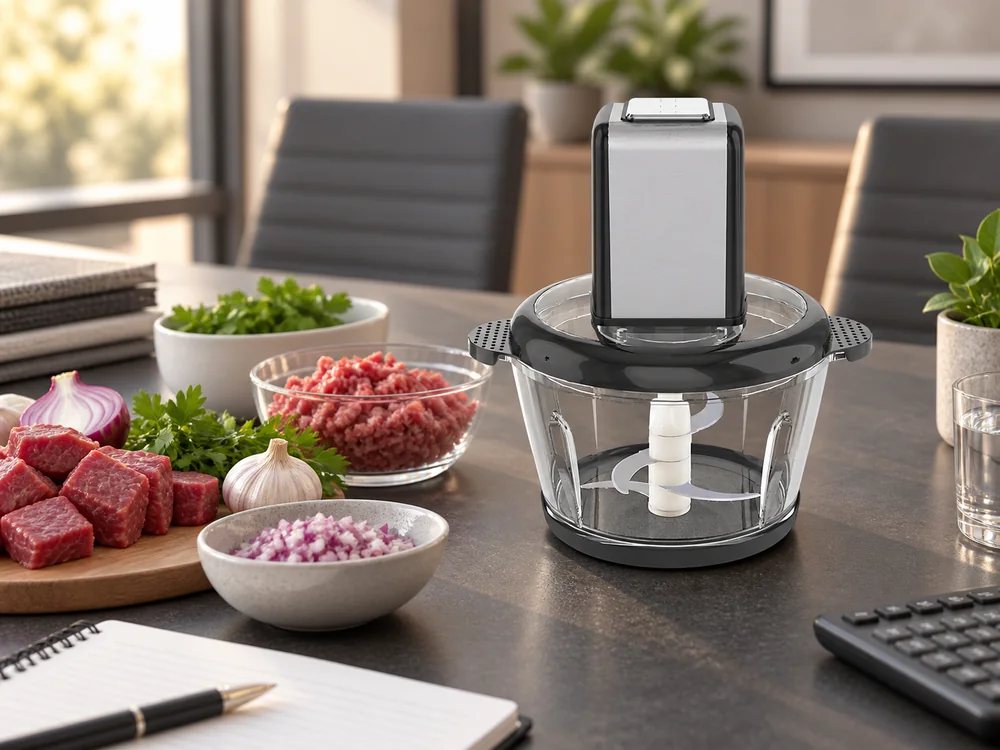
Compare a meat chopper quotation only after the product, included set and delivery assumptions match. A lower unit price can describe a different bowl, motor version, accessory package or packing arrangement. Put those differences beside the price before deciding which offer is better for your product line.
For importers, distributors and private-label buyers, the task is to choose an offer that meets the intended retail proposition at a cost the business can support. That requires a common specification and a way to separate recurring unit cost from project charges. It also requires knowing which decisions remain open, because a provisional packing size or unapproved electrical change can alter the final quotation.
This article concerns household electric bowl choppers rather than industrial meat-processing equipment. It explains how to establish a comparison basis, assess inclusions, examine quantity conditions and turn several supplier responses into one useful purchasing decision. The examples are arithmetic illustrations, not JINJIE prices or customer orders.
Establish one basis for the meat chopper quotation
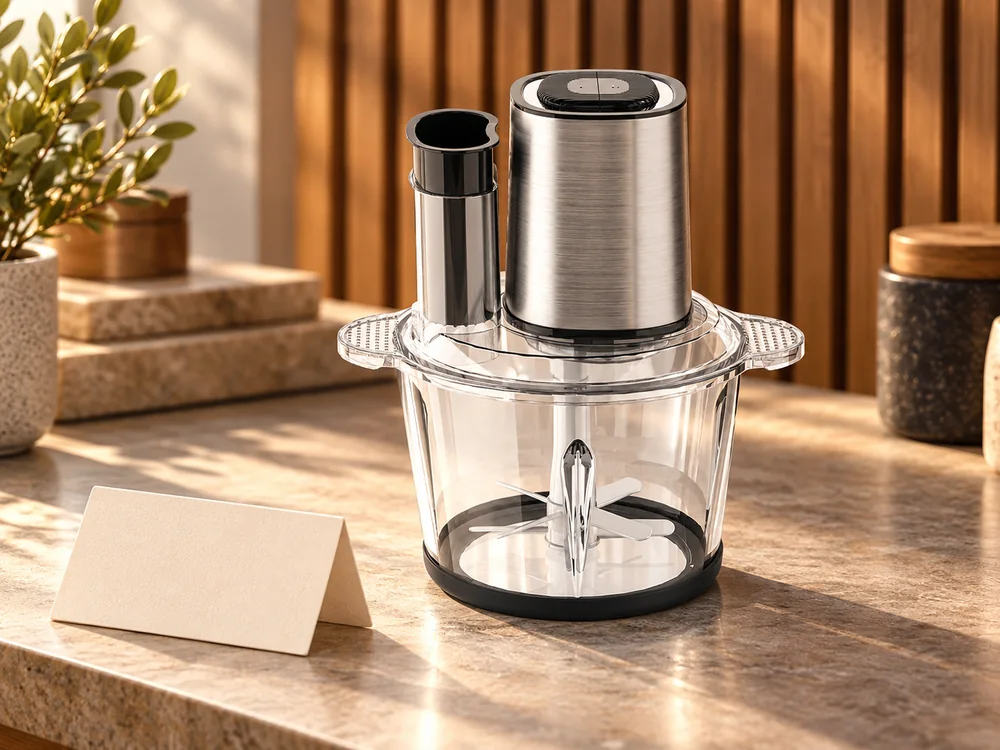
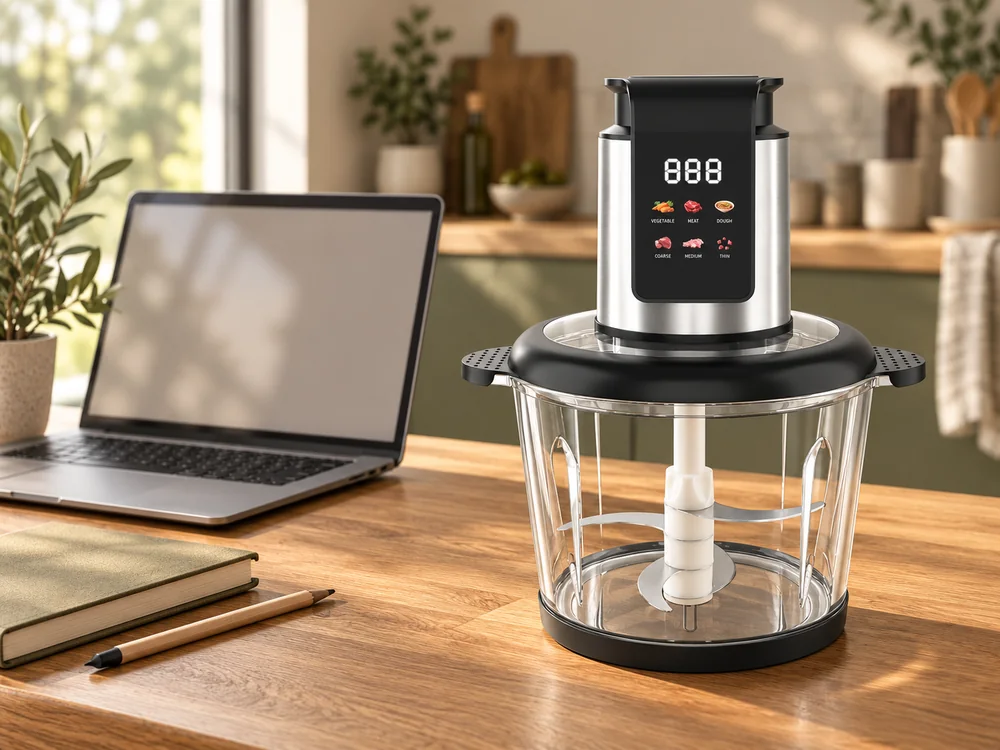
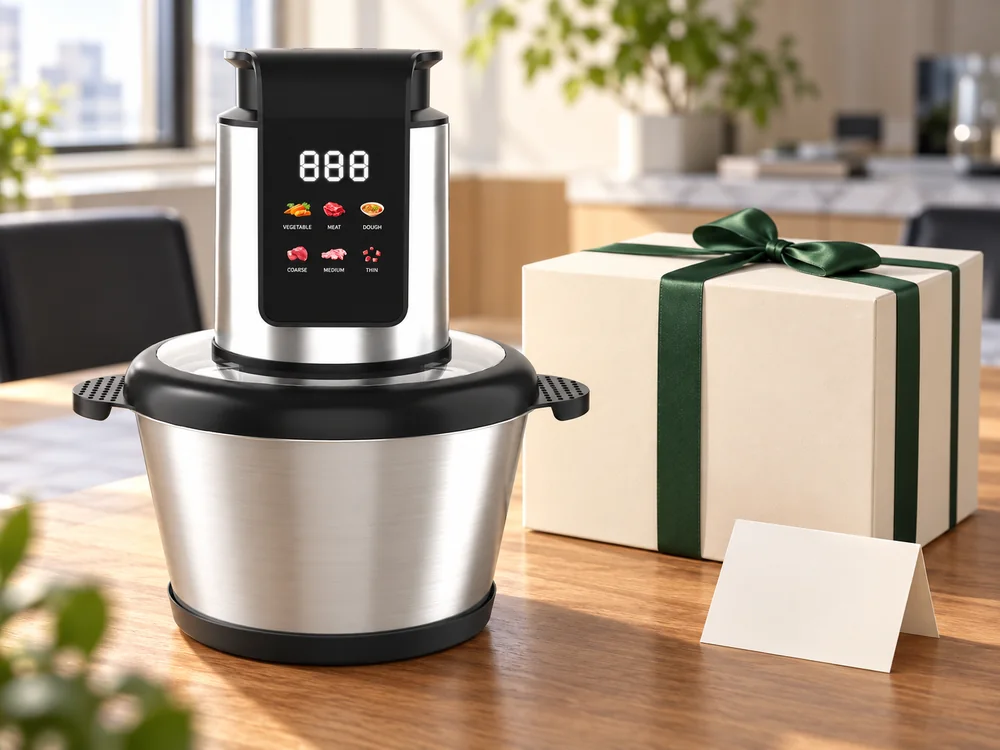
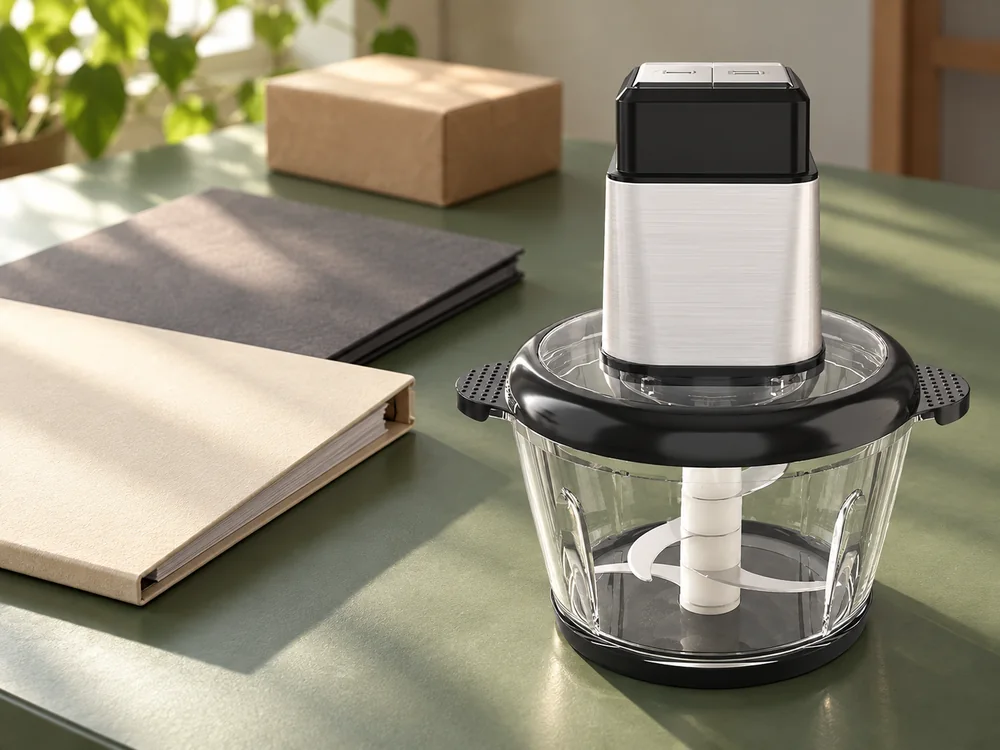
Use one line for each model and electrical version. Identify bowl material, stated capacity, controls, included accessories, color and packing arrangement. Attach the agreed product image to the inquiry, particularly when several units have very similar motor housings. A photograph makes the reference easier to recognize, while the written specification defines what must be supplied.
JINJIE's quotation sheet, for example, lists KD-A1 and KD-A2 with the same stated 3 L capacity but different bowl materials: 201 stainless steel and glass respectively. KD-A3 and KD-A4 are listed at 5 L with the same material distinction. These are separate configurations for quotation purposes. The stated bowl capacity should not be interpreted as a recommended meat load.
Keep the material grade when one has been specified. Replacing “201 stainless steel” with “stainless steel” makes a later comparison less precise. Likewise, retain the model reference beside the capacity instead of treating all bowls of the same nominal size as equivalent. Fit, dimensions and packaging still belong to the selected version.
Start with JINJIE's electric meat chopper options if you need a reference model. Then tell the supplier which properties are fixed and which can be proposed as alternatives. A buyer who requires a glass bowl should say so. A buyer who is still testing a price position can request separate glass and steel offers without pretending they are the same product.
The distinction between mandatory and optional requirements helps negotiation. A mandatory item protects the intended use, sales channel or approved design. An optional item should earn its cost through a clear benefit to the assortment. If an alternative removes a requirement that matters to the customer, treat it as a different offer and evaluate that change openly.
Record the quotation date and revision. When a supplier answers a question by email, ask for the agreed change to appear in the updated offer or attached specification. Comparing an old PDF with a later message about a different set is an easy way to lose track of what the price includes.
Compare inclusions before comparing the totals
A product photograph may show optional parts. Ask for a written inclusion list so the quoted set has a defined boundary. A second bowl, additional blade assembly or other attachment should be listed individually if it belongs to the offer. Keep the base appliance identical when asking for the cost of additions.
Packing belongs on the same comparison sheet. Establish whether the quoted price includes an individual retail box, the internal protection, instructions and the master carton. If artwork has not been approved, ask which packing assumption the supplier used. A price based on standard packing cannot be treated as a price for a fully developed custom retail box.
Use the following comparison fields across every offer. The purpose is to expose a difference that needs a decision, rather than to award points for a longer accessory list.
|
Comparison field |
Record in each offer |
Difference that matters |
Buyer response |
|---|---|---|---|
|
Base appliance |
Model, bowl, controls and electrical version |
A different product is being priced |
Request the same base or evaluate a separate alternative |
|
Supplied set |
Each included part and its quantity |
One offer includes an additional bowl or attachment |
Price the addition separately and assess its retail role |
|
Retail packing |
Box type, protection and printed materials |
Standard packing is compared with custom packing |
Ask for both prices on the same agreed packing basis |
|
Project work |
Artwork, sample changes or tooling scope |
Development is included in one offer but excluded in another |
Separate the charge and identify the deliverable |
|
Quantity basis |
Units per model and customized version |
A lower price depends on a larger commitment |
Compare the total cash and stock exposure |
|
Delivery basis |
Named arrangement, location and exclusions |
Responsibility for transport differs |
Obtain a comparable logistics estimate before choosing |
An incomplete cell is a question for the supplier, not a zero-cost item. If a requested part is absent from the offer, ask whether it is included, unavailable or separately priced. Entering zero without a response creates a false advantage in the comparison.

The most complete set is not automatically the right set. An accessory can justify a higher retail price when customers understand its purpose and the package explains it clearly. Otherwise, it adds handling, packing space and another item that the receiving team must identify. Keep the commercial role of the set visible while reviewing the technical inclusions.
For private-label changes, JINJIE's OEM and ODM scope distinguishes branding an existing appliance from changing a design or developing a new product. Ask which route the proposed work follows. A quotation for logo placement should not be compared as though it includes a new housing or revised control system.
Separate recurring unit cost from project charges
Ask the supplier to distinguish recurring unit cost from one-time or order-specific charges. Printing setup, a new component, tooling work and sample development do not all behave like a normal per-unit accessory cost. Record what each charge buys, the quantity on which it is based and whether it applies again on a reorder.
For internal planning, divide a confirmed one-time charge by the quantity over which your business expects to recover it. Label that result as your allocation assumption. It is not an additional supplier quote, and it changes when the order quantity or recovery period changes. Keep the original charge visible so another person can reproduce the calculation.
Consider this illustrative example. Offer A has a unit price of USD 12.00 and a one-time project charge of USD 600. Offer B has a unit price of USD 12.40 with no separate project charge. Assume the specification, packing and all other costs are identical solely for this example. At 1,000 units, A costs USD 12,600 and B costs USD 12,400. At 2,000 units, A costs USD 24,600 and B costs USD 24,800.
The arithmetic changes the choice because the fixed charge is spread across more units. It does not prove that ordering more is sensible. The buyer still needs demand, cash and warehouse space for the additional stock. In this example, the cost lines meet at 1,500 units, calculated as USD 600 divided by the USD 0.40 unit-price difference.
A reorder also needs its own calculation. If the USD 600 charge genuinely does not recur and the product remains unchanged, the recurring-price comparison differs from the first-order comparison. If a new color, artwork version or component requires additional setup, that work needs a fresh answer. Do not carry a first-order total into every future purchase.
Treat unquoted costs as unknowns. Sample shipping, a requested third-party inspection, extra documentation or a changed packing design may sit outside the appliance price. Ask whether each requested service is included and who supplies it. Add only confirmed charges to the supplier comparison; keep estimates in a separate planning column with their basis and date.
Price is also connected to the acceptance basis. If one offer includes the checks your team requires and another does not, resolve that difference before ranking the totals. JINJIE's quality and testing process is a starting point for discussing the product, inspection scope and records needed for your order. A general promise of quality does not define the purchased service.
Read quantity and timing conditions together
Ask at what level a minimum quantity applies. A supplier's general order minimum may differ from a minimum for one model, color, electrical version or printed box. If an assortment contains several versions, request the conditions for each line. A total order quantity alone does not explain whether the proposed mix is acceptable.
The buying consequence is stock exposure. A lower unit price may require more units than the launch can reasonably absorb. Compare the total order value and the number of units you must hold, not just the discount. A slightly higher unit cost can be appropriate for a smaller initial commitment when the difference buys useful flexibility.
For an illustrative comparison, suppose one option requires 1,000 units and another allows 600, with the same intended product. The additional 400 units are part of the first option's purchasing consequence even before you assign storage or financing costs. Use your own demand and cost assumptions to evaluate that difference. The quantities are examples, not JINJIE minimum-order terms.
Customization can create a separate quantity condition. If a low-volume variant requires unique printed materials, ask whether standard packing or fewer variants would change the offer. Keep customer-facing requirements intact. Reducing the number of colors may be commercially acceptable; replacing a required language manual with the wrong version is a different matter.
Read lead time with its starting conditions. Does the stated period begin after sample approval, artwork approval, deposit, component readiness or another agreed event? Ask which items are still outstanding and whether the quoted timing assumes they arrive together. “Thirty days” and “thirty days after all approvals” can describe different calendar outcomes, even though the number looks the same.
JINJIE's production preparation process connects scheduling with approved product details, component and packaging readiness, quantity and requested timing. For a quotation comparison, request those dependencies for the actual order. A general production-capacity statement cannot tell you when a particular customized set will be ready.
Keep split delivery separate from the standard offer. If some versions can ship earlier, ask for the revised quantities, packing and delivery costs. An earlier partial shipment may help a launch, but it can also change the cost basis. Compare the proposed split against the original shipment as a complete option.
Check packing and delivery assumptions before landed cost
Obtain the proposed units per carton, outside carton dimensions and gross weight. A larger bowl or an additional accessory can change packed volume even when the motor housing stays the same. Freight calculations based on an older set can therefore miss part of the cost of the revised offer.
Keep preliminary packing data visibly separate from measurements of the approved packed sample. Use estimates for early budgeting, then update the calculation when the packing arrangement is fixed. If the receiving route requires pallets, ask for the pallet dimensions, loaded height and weight as well. The product's own dimensions are not a substitute for shipping dimensions.
The quotation should state the delivery arrangement and named location clearly. If two offers use different arrangements, ask a logistics provider to translate them into the same comparison basis. Avoid adding a guessed allowance and presenting it as a confirmed landed cost. The missing responsibility might concern a service your estimate has not included.
Write down which costs are estimates and which are actual offers. Currency conversion, transport and destination charges may have different dates or validity periods. The supplier's appliance price can remain unchanged while the overall comparison moves. Preserve the date and basis beside each input rather than overwriting the previous calculation without explanation.

Packing quality and packing volume should be considered together. A smaller carton is useful only if the chosen arrangement still protects the supplied set and meets the agreed handling needs. If protection changes to reduce volume, ask what review or packed-sample work is needed. A shipping estimate should follow the approved packing decision rather than dictate an unsupported change to it.
Keep detailed carton-volume calculations in the shipping worksheet and bring its current totals into the quotation comparison. This lets the logistics team update transport assumptions without changing the supplier's product price. Both offers should describe the same set and include the services needed to reach the same delivery basis.
Send one clarification and choose the appropriate offer
After reviewing the quotations, return a consolidated list of unresolved differences. Group questions by the decision they affect. “Please price the glass-bowl version with the same controls and packing as the steel-bowl offer” is more useful than a general request for a better price. It tells the supplier what must stay constant.
Use this checklist before approving the commercial comparison.
|
Item to close |
What the buyer sends or checks |
What should be recorded |
|---|---|---|
|
Common specification |
Mark mandatory requirements and the selected model |
One agreed product and version reference |
|
Inclusion differences |
Identify any missing or optional contents |
Included quantity and separate option price |
|
Project charges |
Ask what each charge covers and whether it recurs |
Deliverable, payment basis and reorder treatment |
|
Quantity conditions |
State units by model and customized version |
Accepted mix and applicable minimums |
|
Packing basis |
Confirm whether figures are estimated or measured |
Current set, carton data and packing revision |
|
Timing and validity |
Identify open approvals and decision dates |
Starting conditions and offer validity |
Close the important unknowns before negotiating the final reduction. Otherwise, the supplier may lower the price by changing an assumption you intended to preserve. Keep the accepted comparison with the latest offer and the sample reference so the purchasing team can explain why the selected option won.
The lowest comparable offer may still require a trade-off. A leaner set can suit a price-sensitive channel. A broader set can suit a retailer that can explain the extra functions. Make that assortment decision deliberately, then assess price within the chosen specification. It is easier to negotiate a defined product than two loosely described bundles.
Conclusion
A useful quotation comparison shows what you will receive, what work remains and what the order will require from your business. Establish the same base configuration, separate project charges from unit cost, and make quantity, packing and delivery assumptions visible. Only then does the price difference describe a purchasing choice you can defend.
For a JINJIE quotation, prepare the model reference, destination market, quantity by version and required set contents. Include packaging needs and any custom work already discussed. Return one marked list of differences if the first offer leaves a question open. Once the revised quotation and specification agree, use that version for sample approval and the order discussion.
FAQ
Should I ask for the supplier's lowest price first?
Start with a defined product and quantity. A lowest-price request without those details can produce a cheaper but different set. After the comparison basis is agreed, ask what changes in quantity or optional scope could reduce cost. Keep any required features fixed so the revised price still serves the intended channel.
Does a free sample make an offer better?
Only if the sample answers the question you need to resolve and the other costs are clear. Check the sample version, included parts, customization and delivery charges. A paid sample matching the intended order can be more useful than a free unit that represents a different configuration.
Can I compare quotes with different currencies?
Yes, using one stated exchange-rate assumption and date for your internal comparison. Retain the supplier's original currency and price beside the converted value. Recheck the assumption before committing if it materially affects the decision. A planning conversion does not change the currency agreed for payment.
When should I request a new quotation?
Request an update when a change affects the product, supplied set, quantity, customization, packing or delivery basis, or when the offer has expired. Identify the changed item and ask which other figures are affected. A revised quotation should remain connected to the specification and sample version you intend to approve.