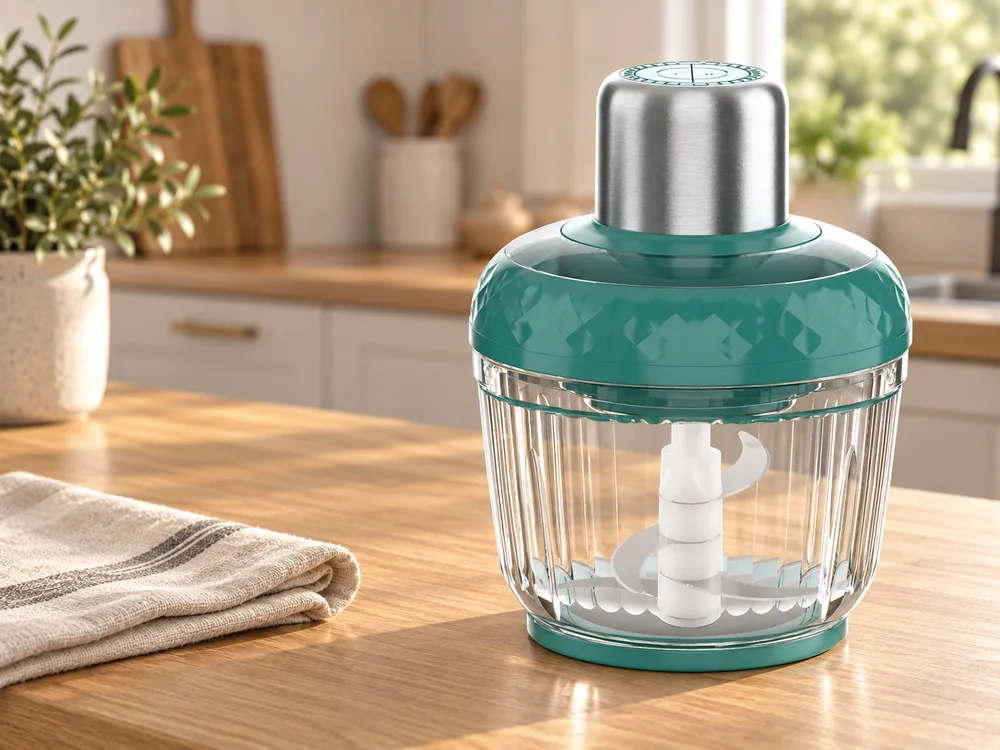
A dual bowl food chopper wholesale offer needs to say what the second bowl adds. Two equal-size bowls, two different capacities and two independent appliances are different retail purchases. A photograph showing two assembled arrangements may still describe a set supplied with only one motor head.
For an importer, the decision is whether the two-bowl configuration gives customers a useful reason to choose one complete set. The additional bowl must have a clear role, supported operation and an understandable place in the package. Otherwise, it adds cost and parts without improving the offer.
JINJIE's ZD-A1 and ZD-A3 references provide a specific starting point: one machine head with two cups, listed as 2.5 L plus 0.3 L. This guide concerns that different-capacity household format. It does not assume simultaneous operation, an independent second motor or unrestricted use of either cup for every ingredient.
Identify which kind of two-bowl offer you are buying
Ask the supplier to describe the relationship between the containers before discussing price. An additional bowl of the same size may serve a different purpose from a much smaller working cup. A spare container is different again if it is supplied without the parts required for operation. The term dual bowl does not resolve those distinctions.
Start with the complete retail unit. Count the motor heads separately from the containers and ask which lids, cutting assemblies and other parts belong with each arrangement. A buyer should not have to infer the supplied quantity from the number of assembled products in a marketing image.
Where one head is shared, the customer uses the supported arrangements in the sequence described by the instructions. Do not present the set as two machines available for simultaneous operation. That distinction matters when a retailer explains why the combined offer costs more than a single-bowl product but is not equivalent to buying two independent appliances.
|
Proposal described as two-bowl |
Difference to establish |
Purchasing consequence |
|---|---|---|
|
Two different nominal capacities, one head |
Each bowl's working arrangement and supported role |
A possible two-task set rather than two appliances |
|
Two same-size bowls, one head |
Whether the second bowl includes its required operating parts |
A different customer benefit from a small-cup combination |
|
One working bowl and one spare container |
Whether the spare can form an approved working assembly |
Do not price it as another complete preparation arrangement |
|
Two independent appliances |
Two complete motor-and-container systems |
Different cost, storage and support from a shared-head set |
Use the JINJIE electric chopper range to identify the actual format under consideration. Keep the supplier model beside your description. A generic request for a double-bowl chopper can otherwise return offers with very different contents that appear comparable only because they use the same words.
Ask whether the proposed two-bowl configuration is a current supplied set or a combination being considered for your project. If it is a new combination, compatibility and the complete commercial offer remain open. Do not create a set yourself by selecting a small cup from one model and a large bowl from another catalog row.
Use the ZD references without adding their capacities together
JINJIE's current quotation lists ZD-A1 and ZD-A3 with 2.5 L plus 0.3 L, glass, 500 W and two speeds. The supplied arrangement is described as one machine head with two cups. Retain the two capacity figures separately when requesting the configuration; a single 2.8 L description would hide the two different containers.
Those nominal figures identify the proposed vessels. They do not establish permitted ingredient weights, maximum filling levels or a minimum successful preparation quantity. Ask for the operating information that belongs to each arrangement. The smaller container's volume alone is not evidence of a particular recipe result.
The two model references share several listed fields, but that does not establish that every detail is identical. Request the actual difference between the proposed ZD-A1 and ZD-A3 versions before choosing. If the difference is mainly appearance, evaluate it as appearance rather than inventing a performance distinction to justify another SKU.
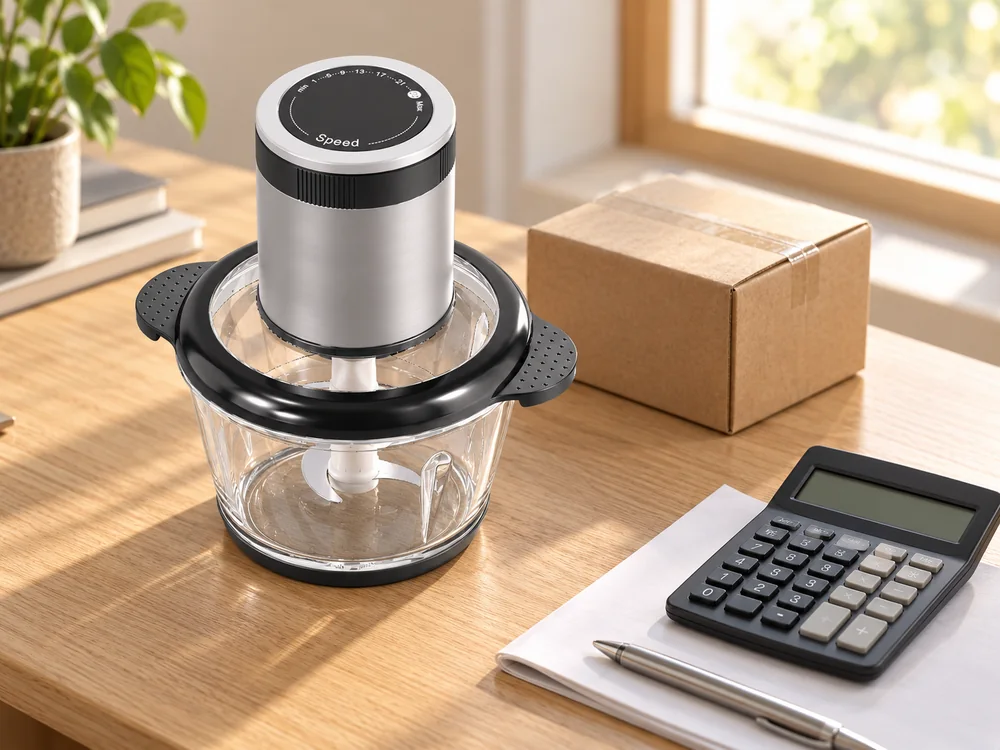
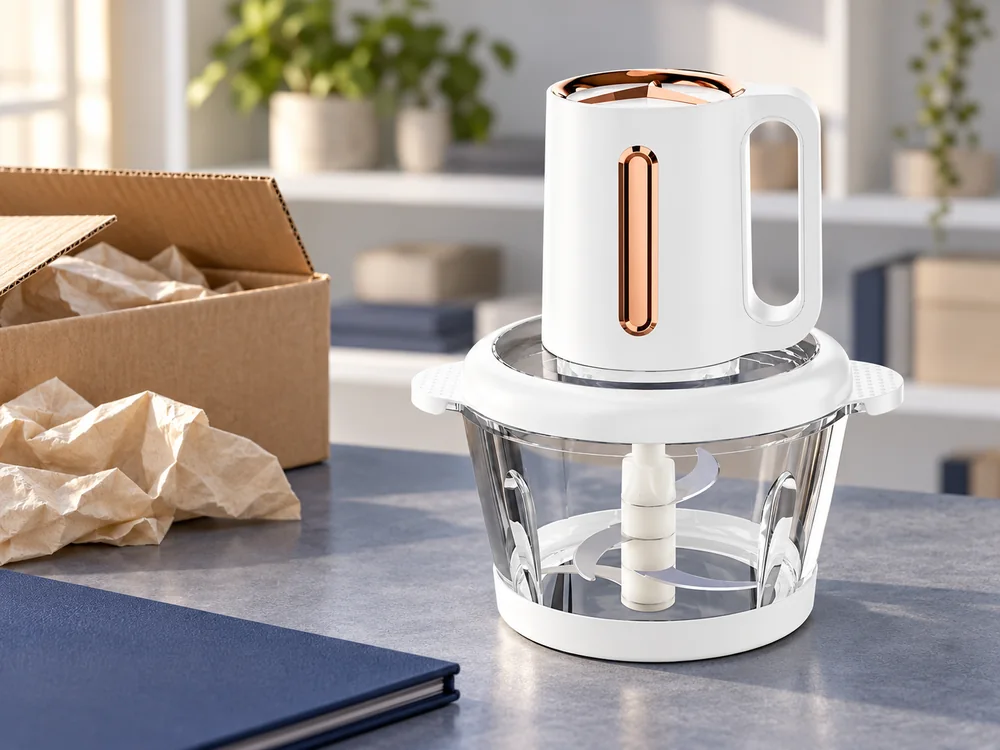
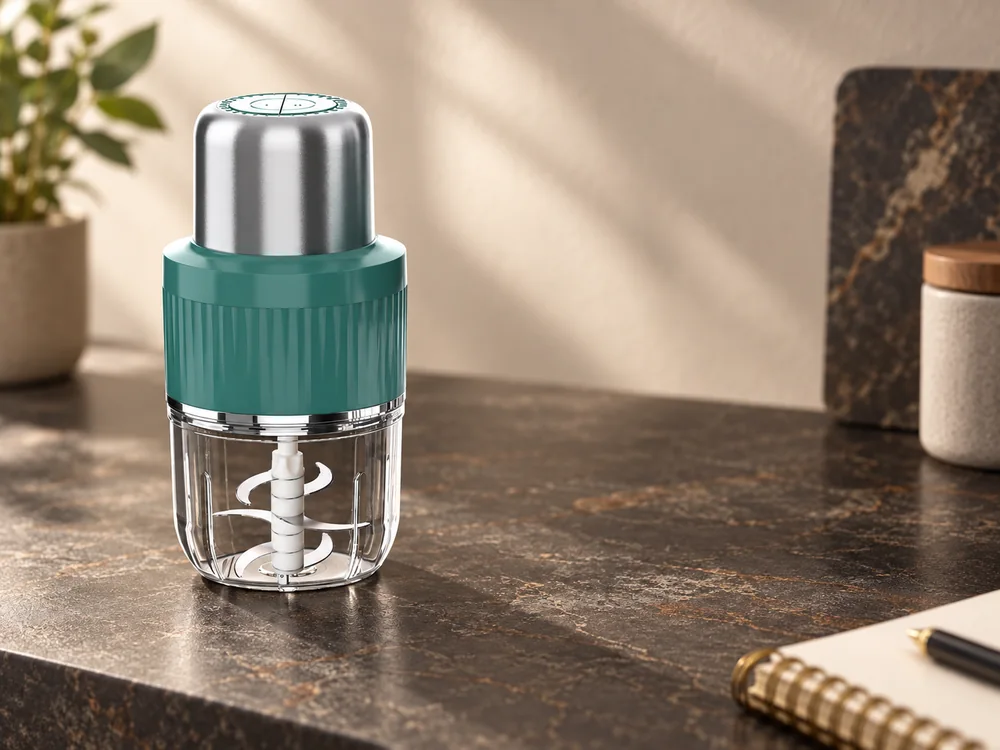
Check the complete model reference against the product images. A supplier may illustrate the motor fitted to the large bowl in one view and to the small arrangement in another. Read those as operating configurations unless the supplied-items description says otherwise. For the quoted ZD arrangement, the head count remains one.
Request a separate contents description for each bowl assembly and a shared-items description for the set. This makes the role of a lid, cutting assembly or connection component easier to understand. It also prevents a purchasing team from counting a shared part twice or assuming that a necessary second part is included when it has not been identified.
Keep the listed material attached to the relevant quotation and request clarification if a component's material matters to the buying decision. A glass-bowl description does not identify every seal, cover or other contact part. It also does not establish a universal cleaning, temperature or impact-resistance claim for the complete set.
The resulting inquiry should identify a configuration, not just its largest number: selected ZD reference, one head, both nominal capacities, agreed assemblies and target electrical version. Add the required presentation separately. That is enough to start a useful product discussion without pretending every detail has already been approved.
Give each capacity a reason to be in the retail set
Describe two actual customer tasks that the set is expected to support. The smaller arrangement may be considered for a different preparation quantity, while the larger bowl answers another part of the customer's routine. Establish those tasks with the supplier's model-specific information rather than assuming a small cup automatically performs better with every small amount.
Ask what currently makes the customer's task inconvenient. Is a large container unnecessary for an ordinary preparation? Does the customer want one coordinated product instead of storing two independent appliances? Or is the second bowl mainly being added because a competitor's box shows more items? The last reason needs a stronger commercial case before it becomes a purchase.
Keep ingredient claims separate from the two-size proposition. A small cup should not be called a spice grinder, baby-food maker or nut mill solely because its shape suggests one. If one of those tasks defines the retailer's offer, obtain the relevant product scope and evidence before adopting that description. Otherwise, keep the public promise narrower.
Compare the complete routine, not only the powered interval. The user has to prepare the permitted ingredients, fit the relevant assembly, remove the result and clean the parts as instructed. A second cup creates value when that overall routine suits the customer. A short attractive demonstration cannot establish how much work is saved across the entire task.
Consider the frequency of the smaller task. An accessory used regularly can support a different buying decision from one included for an occasional hypothetical recipe. Use the retailer's knowledge or an explicitly provisional customer brief. Do not manufacture a claim about consumer demand simply because the extra part is available.
Avoid promising hygiene benefits from having two containers alone. Dedicated bowls do not remove the need for appropriate cleaning and handling, and other components may still be shared. Keep any separation practice within the product instructions and relevant guidance for the actual use. The safe retail explanation is the supported product arrangement, not an invented guarantee that foods can never mix.
If only one bowl answers a genuine need, ask whether another confirmed single-bowl offer would be more suitable. Do not assume the two-bowl quotation can simply have an item removed at an estimated saving. Compare the supplier's actual alternative and decide whether the simpler purchase better serves the channel.
Evaluate both arrangements and the change between them
Request a sample that represents the complete selected configuration. A sample containing only the large bowl cannot settle the smaller arrangement's fit, handling or operation. Identify any missing item before planning the review so the team does not mistake a partial sample for a complete set.
Have the supplier explain the permitted fitting and removal sequence for each arrangement. Follow that sequence; do not improvise a connection because the parts appear to fit. Keep protective parts in place and leave any disassembly outside user instructions to the responsible technical team.
Ask for the relevant operating limits separately for each cup. A shared motor head does not make the permitted loads or operating method identical. Keep the selected food, starting condition and quantity attached to any demonstration. Successful use of the large bowl is not evidence that the small arrangement has answered its assigned task.
For a purchasing comparison, record observations against each intended result. Was the task completed within the permitted method? Was the full result available to inspect? What preparation and cleanup were needed? Avoid creating a performance score whose appearance suggests a controlled test when the conditions were not comparable.
Observe the changeover between bowls without treating it as a speed contest. Where does the removed assembly rest? How does the user identify the correct parts for the next task? Can the instructions be followed without relying on the person who demonstrated the sample? These questions concern a usable customer routine, not an unverified time-saving claim.
Include storage in the review. Ask for the actual stored arrangement and dimensions where the channel needs them. Do not assume the small cup nests inside the large bowl or that sharp parts can be stored together in any convenient way. A composed marketing image is not a storage instruction.
Use JINJIE's quality and testing information to discuss the review that resolves the open question. Keep a visible fit issue, a missing item and an unsatisfactory permitted result distinct in the findings. They call for different responses and should not be collapsed into a vague judgment that the set is good or bad.
If the smaller arrangement remains unresolved, decide whether it is essential to the purchase. A core selling point needs an adequate answer before approval. An optional idea can be removed from the project only through a revised supported offer, with the retail description and price changed accordingly.
Explain one complete SKU without suggesting two machines
The main product description should state the shared-head arrangement plainly. Show each supported setup where it helps the customer understand the product, then provide an accurate included-items view. A page can use several operating views without implying that every visible copy of a motor head is supplied.
Separate the two nominal capacities in the specification. Label the large bowl and small cup clearly, using the accepted product terminology. Do not total the figures to create a larger headline capacity, and do not place the large bowl's value beside the small-cup photograph. Both mistakes can make a technically accurate number describe the wrong offer.
Choose photographs from the selected model and finish. Combining a large bowl from one version with a small assembly from another creates an apparent set that the supplier may never have offered. Keep the model and image references together when handing files to a designer, particularly where several similar color variants exist.
The customer should be able to identify the supplied parts after opening the box. Agree names that distinguish the two assemblies without requiring the user to know internal component codes. Use those names consistently in the contents list, instructions and product page. A shared term such as lid needs qualification if the set contains more than one different part with that name.
Discuss OEM and ODM presentation options around the confirmed combination. A branded box can make the product easier to explain, but it cannot supply missing product information. Decide the complete offer before artwork uses an extra accessory or an unsupported function to make the package look more versatile.
If the channel also sells a single-bowl version, show the difference where customers choose between them. Identify the additional confirmed assembly and its supported role. Do not rely only on a higher function count or a different color, and do not describe the single-bowl product as incomplete when it is a complete offer in its own right.
Quote and support the set as one sellable product
Request the complete-set price, including the selected electrical version, both working arrangements, instructions and agreed packaging. A price for the motor head or large bowl alone is not comparable with a complete retail set. Keep optional items outside the main line until their inclusion and conditions are decided.
|
Set-level purchasing point |
Information to obtain |
Decision it supports |
|---|---|---|
|
Supplied quantity |
One head and identified parts for both arrangements |
Whether the quotation matches the retail promise |
|
Package protection |
Actual placement and protection for the selected components |
Whether the complete set can be packed appropriately |
|
Freight comparison |
Measured packed dimensions, weight and carton quantity |
Actual delivered-cost comparison with another offer |
|
Later component support |
Confirmed compatibility, supply basis and remedy |
What the retailer can promise after sale |
|
Repeat order |
Current contents and version compared with the retained reference |
Whether the same SKU description still applies |
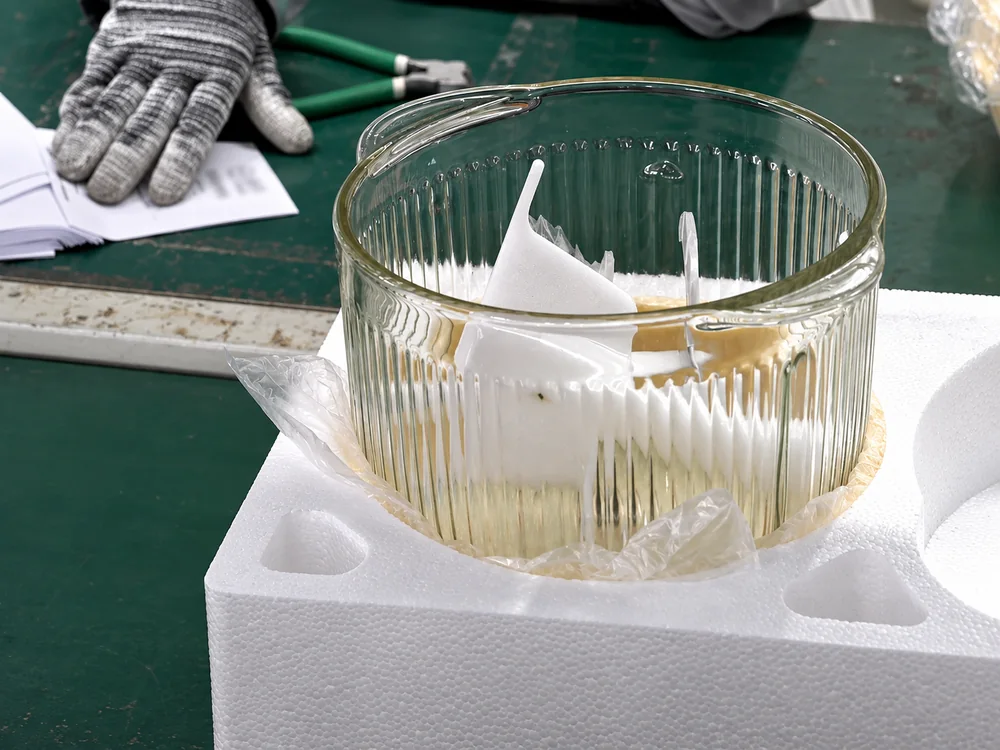
Review the packed sample as a combination. Two vessels and their related components need an identified placement, not an assumption that the second cup can be added wherever space remains. Ask for the relevant packing assessment and final measured information. Do not borrow carton data from a large-bowl-only offer.
For customer support, clarify what happens if one assembly is missing or damaged. Ask whether an identified component can be supplied separately and on what basis. Its inclusion in the original set is not a promise of unrestricted accessory sales. If separate supply is unavailable, agree a practical alternative before advertising individual replacements.
Keep service stock distinct from complete saleable sets. Taking a component from a retail box to resolve a customer issue leaves that box incomplete. The warehouse needs to identify that status rather than return it to ordinary stock. A correct count of motor heads does not establish a correct count of complete sets.
On a later order, compare the current proposal with both assembly references. A familiar housing or unchanged model name may not answer whether the small cup, supplied tools or presentation have changed. Assess the actual difference against the customer's reason for buying the two-bowl product before approving a substitution.
Request the complete two-bowl proposal
Contact JINJIE with the preferred ZD reference, the customer tasks behind both capacities, destination market and intended order quantity. Request the matched contents, operating information and packed offer. Select the set when both arrangements contribute to a supported retail proposition, rather than because two vessels make the main image look fuller.
FAQ
Can both bowls operate at the same time?
Not as two independent appliances when the confirmed set has one shared motor head. Use each supported arrangement according to its instructions. If simultaneous independent preparation is essential, request a different complete-appliance proposal rather than describing a shared-head set as meeting that requirement.
Does the small cup need its own preparation demonstration?
Yes, when its intended result determines the purchase and existing information does not answer that question. Identify the arrangement and permitted method. A demonstration using the larger bowl cannot establish the smaller cup's result merely because the motor head is shared.
Can the retailer order only the small cup later?
That needs a separate compatibility and supply confirmation. Establish which associated parts are required and which existing version the proposal fits. Do not turn the original complete-set contents into a standing promise that every component is available separately for later customers.
What if the product page shows two heads but the quotation lists one?
Clarify whether the picture illustrates two working arrangements or a different supplied set. Use the agreed contents to correct the public presentation before sale. The customer should not have to discover after delivery that a duplicated motor in the image was only a demonstration of alternative use.