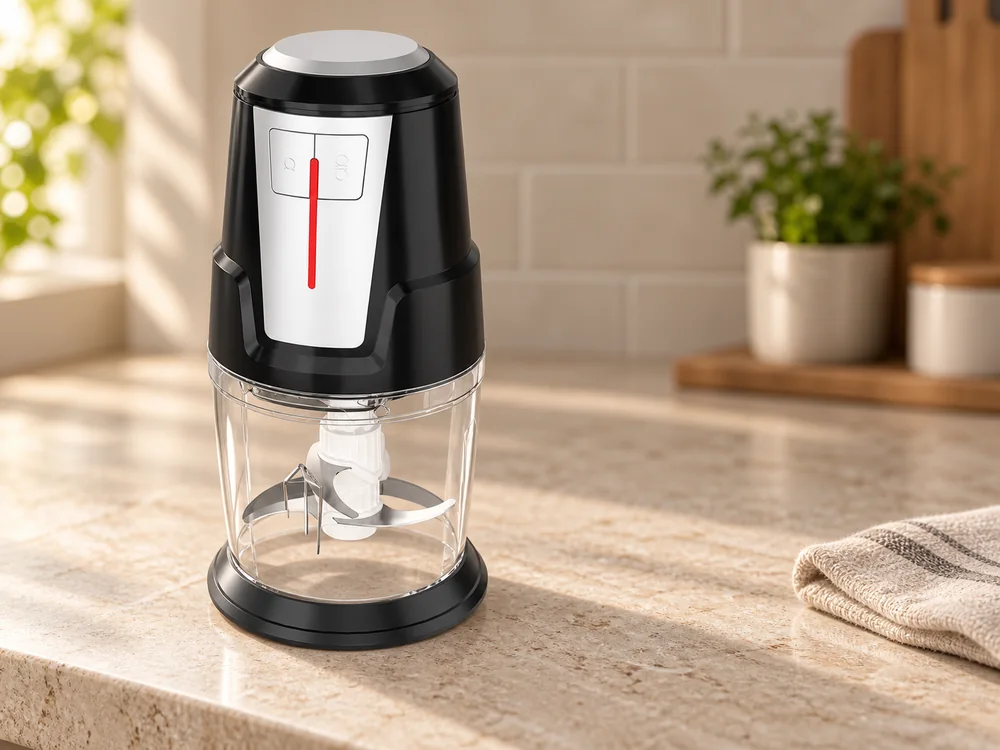
A plastic bowl food chopper wholesale proposal should identify more than a transparent container. The buyer needs to know which material description belongs to which part, what the complete appliance includes and which customer-facing claims the supplier can support for that version. Clear plastic and glass can look similar in a product image, while two clear plastic parts need not have the same material specification.
For a retail brand, this is a product-definition decision before it is a price negotiation. A vague material line can become an inaccurate listing attribute, an unapproved substitution or a customer-support promise that the supplied product does not justify. Resolve the material scope while the selected configuration is still easy to identify.
This guide concerns household electric bowl choppers with a quoted plastic container. It does not cover manual pull-cord cutters, loose replacement bowls or industrial processing equipment. It also does not assume that a plastic-bowl appliance is unbreakable, dishwasher-safe or supported by a particular chemical claim.
Confirm the complete electric appliance behind the material label
Begin with the required mechanism. A plastic container appears in many kinds of chopper, including hand-operated products. If the purchase is an electric appliance, state that clearly and request its motor, controls, bowl, lid and cutting assembly as a complete proposal. Similar container material does not make two different mechanisms comparable.
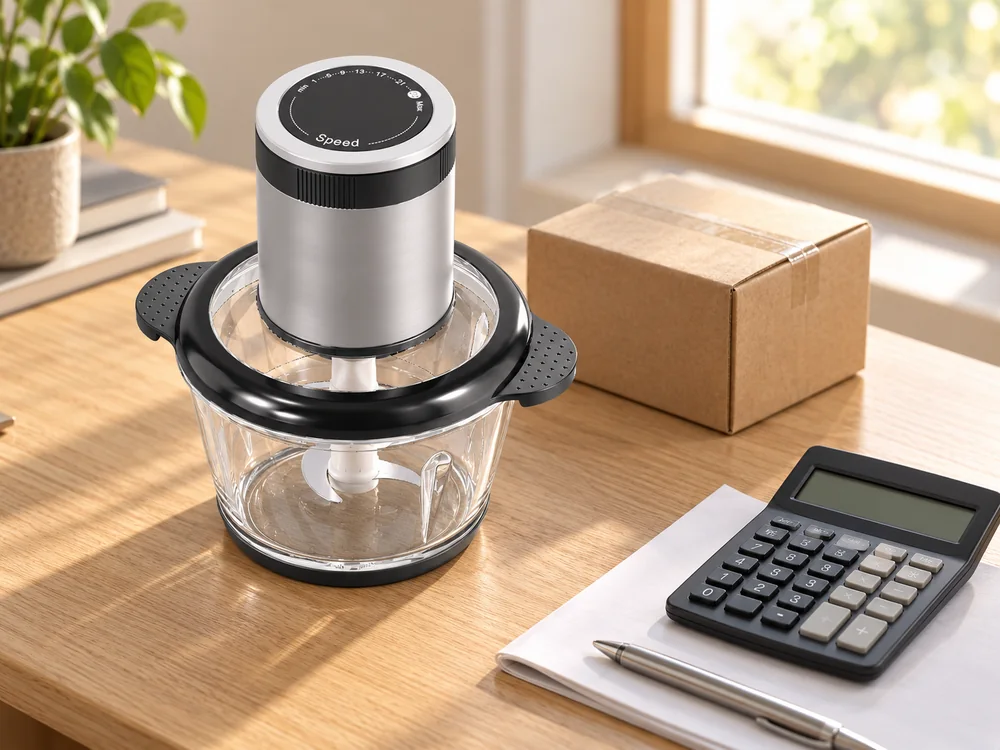
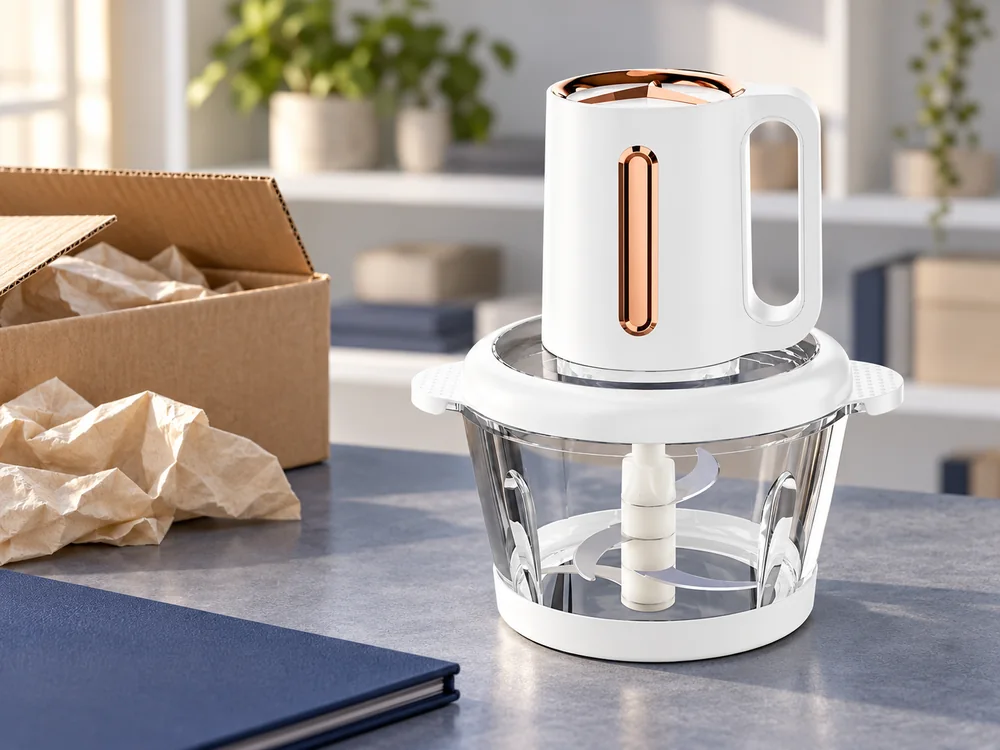
JINJIE's current quotation lists TY-05 with a nominal 1.2 L AS bowl, 400 W and two speeds. CO2061 is listed with nominal 1.2 L AS, 400 W and one speed, while CP2061 is listed with nominal 0.8 L AS, 400 W and one speed. These entries provide identifiable products for an inquiry; they do not establish a performance or durability ranking.
Identify each proposal by its model code: TY-05, CO2061 or CP2061. Keep that code beside the material, electrical version and complete configuration instead of describing it as the small clear one. This gives the supplier an identifiable starting point when two similar-looking products enter the same price discussion.
The two 1.2 L entries illustrate why a material filter is only a starting point. Their control arrangements differ, and the complete physical designs still need to be considered. A buyer may prefer one interface or appearance, but that preference should not be rewritten as superior chopping performance without relevant evidence.
Browse the JINJIE electric chopper range to identify the available platform before requesting changes. If the retailer wants a different bowl material on a familiar housing, treat that as a proposed configuration, not an automatic substitution. The matched lid, support and cutting assembly must remain part of the discussion.
Keep nominal bowl volume separate from loading. A 1.2 L container description is not permission to process that quantity of any food. Obtain the applicable instructions for the intended preparation task. Material selection should not obscure the basic question of whether the complete product answers the customer's requirement.
Attach each material description to a named component
Ask what the quotation's material field describes. For the cited entries, AS is listed as the cup material. That field should not silently become the specification for the lid, blade support, motor housing or every other part in the appliance. The buyer needs an answer tied to the component that matters to the decision.
Use a short component map when more detail is necessary. It can connect the supplier's part identity, the material description provided and the public statement the buyer intends to make. It is not an invitation to guess every material from appearance. Unconfirmed entries should remain questions for the responsible product contact.
|
Part or description |
What to establish |
Copying error to avoid |
|---|---|---|
|
Quoted bowl |
Exact model and material designation supplied |
Replacing AS with another familiar plastic name |
|
Lid or cover |
Its own identification and relevant information |
Applying the bowl's material field to the lid automatically |
|
Cutting assembly support |
Which component the supplier's description refers to |
Calling the entire assembly metal because the cutting edges are metal |
|
Complete appliance |
Which parts a proposed claim covers |
Extending a component statement to the whole product |
|
Alternative bowl or finish |
Whether it is the same confirmed specification |
Treating a visually similar substitution as unchanged |
Keep technical names stable between the quotation, sample reference and product file. Do not rotate between plastic, acrylic, PC and another term simply to make the writing sound varied. If the supplier changes or clarifies the designation, obtain a consistent updated description before using it across the retail materials.
A photograph can help identify the physical part but cannot establish its exact material. Clear, tinted or glossy appearance is not enough. Where a supplier proposes an alternative material, ask for its identity and the consequences for the selected assembly and planned claims. Do not accept a general assurance that both versions look the same as the entire answer.
Request only the detail needed for the decision. A retailer with a specific material requirement needs the corresponding evidence. A purchasing team resolving whether a quotation describes the bowl or housing may first need a clearer component reference. These are different gaps, and they should not trigger the same indiscriminate request for every file in the factory archive.
Retain the material description with the dated proposal. This is useful when a later price revision offers another container. The commercial team can compare what changed instead of assuming that a familiar model photograph means an identical material specification.
Review the transparent sample under ordinary viewing conditions
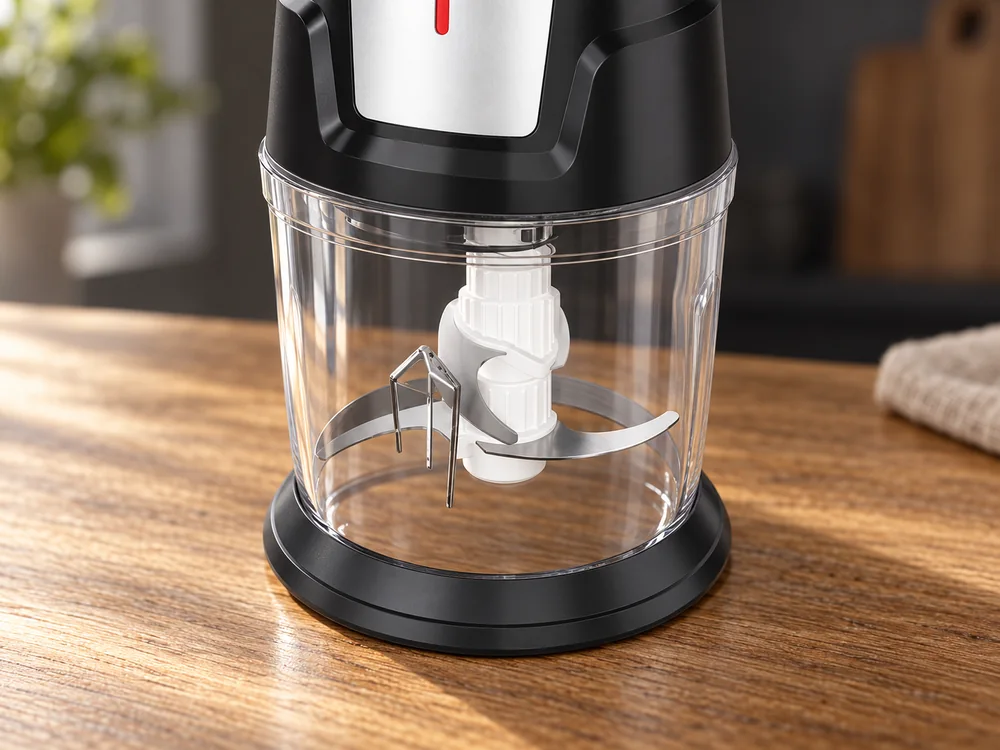
Treat the sample's appearance as part of the retail offer. Observe the actual bowl and lid under consistent ordinary lighting, using the selected color and finish. A bright studio image can make a transparent part appear different from the item a customer sees on a shelf or kitchen counter.
If visual clarity or tint matters to the brand, define the acceptance reference with the supplier. Use the identified physical sample or another agreed reference rather than an edited marketing image. A rendering with brighter reflections is not a reliable standard for the appearance of delivered goods.
Keep the observation specific. Record where an apparent mark, cloudiness or color difference is visible and under what viewing conditions. Ask the supplier to assess the finding against the agreed reference. Do not assign a material defect or manufacturing cause from one photograph before the responsible team has reviewed the actual issue.
Distinguish the container's appearance from what is placed behind it. A dark motor housing, packing material or background can change how a clear bowl looks in a photograph. Compare samples against a consistent background when appearance drives the decision. This avoids approving a preferred photo treatment rather than a reproducible product finish.
Check how the customer will see the contents during permitted operation, without claiming a measured visibility advantage that has not been established. The motor, lid, reflections and bowl shape contribute to that view. A transparent material does not mean every part of the preparation is equally visible from every position.
Use the actual instructions for handling and cleaning the sample. Do not rub a part with an improvised abrasive or expose it to unconfirmed heat to see whether it survives. If resistance to a particular condition is important to the purchase, have the responsible product or test team define an appropriate evaluation and the conclusion it can support.
For color variants, compare the changed part rather than the complete picture alone. A different housing color may change the visual impression without changing the bowl. A changed bowl tint is a separate specification question. Identify which part the buyer wants altered so a design preference does not produce an unintended material proposal.
Match customer claims to the evidence actually available
Retail product fields can demand simple answers to questions that require a specific product basis. Before entering claims such as BPA-free, heat resistant or dishwasher safe, identify the proposed statement and ask what evidence applies to the selected part and version. A general plastic designation does not answer all of those questions.
Keep a component claim within its supported scope. Information concerning the bowl should not automatically describe every food-contact component or the complete appliance. Likewise, a statement about one configuration should not be reused for another simply because both appear in the same catalog category.
JINJIE's product-document review starts with the product identity, materials, electrical version and intended market. Use that route to request relevant existing information and identify any additional work. The presence of general product documents does not, by itself, verify every proposed material claim for TY-05 or another selected model.
Ask the retailer what it actually needs to establish. A requested material declaration, a specific test result and a marketing phrase are not interchangeable. Give the supplier the requirement in a clear form so the reply can address it. Where interpretation requires specialist review, involve the responsible market or testing adviser rather than resolving it through sales wording.
Separate an unsupported optional claim from an unmet mandatory requirement. If the brand merely likes the phrase unbreakable, leaving it out does not prevent an otherwise suitable offer from being considered. If the channel requires specific documentation before accepting the product, that missing evidence may stop the order. The buying decision should reflect that difference.
Use precise ordinary language when a stronger claim is unnecessary. A confirmed transparent AS bowl can be described without inventing a lifetime, an impact rating or a universal cleaning permission. The public explanation should help customers identify the actual product, not turn every material field into a performance promise.
Keep the evidence decision with the final version. If the material, component or intended claim changes, ask which earlier information remains relevant. Do not retain a convenient approved phrase while the physical basis behind it has been replaced during a later price discussion.
Make material changes visible before production and packing
When cost or appearance prompts an alternative proposal, ask what changes physically. A different tint, a different material designation and a different bowl shape are not the same request. Each may affect a different part of the buying decision, even if the supplier presents them under one broad customization option.
Use the OEM and ODM discussion to define the requested scope. State which properties or customer requirements must remain and which visual preferences may change. Let the supplier return the available complete proposal rather than asking the designer to make a rendered bowl look like a material that has not been offered.
Have the affected sample and product information follow the accepted change. If the bowl changes but the motor remains the same, retain both facts. The buyer should be able to tell which reference governs the new container without losing the identity of the complete appliance or confusing it with stock already received.
Discuss protection against the handling your distribution route involves. A transparent surface is part of the customer's first view, so the packed arrangement matters even when there is no obvious breakage. Ask what contact and movement the proposed protection is intended to address and which evaluation is appropriate. Do not assume plastic needs no protective packing.
Review a packed sample using the actual supplied contents. Check the placement of the motor, bowl and other components, and identify any observed rubbing or unexpected marks for the supplier to assess. An empty insert cannot show every contact point in a complete pack. The relevant reference is the selected assembled packing arrangement.
Avoid making the carton smaller by removing protection without an assessed alternative. If the channel requires another package size, request a revised arrangement and measured figures. A possible freight saving needs to be compared with the complete protected offer, not with a bare appliance placed in a smaller box.
Keep the final appearance reference available to receiving staff. A change accepted by the purchasing team can otherwise look like an unexplained difference to the warehouse. Give them the selected version and the scope of the agreed check, rather than a folder containing several unlabeled alternatives.
Compare complete offers and report receiving differences accurately
Request the selected model, material description, electrical version, supplied contents and presentation on the quotation. Compare offers on that complete basis. If a lower price depends on another bowl or finish, evaluate the difference openly instead of treating it as an unchanged appliance at a discount.
Do not assume the plastic-bowl version has a particular freight advantage. Obtain the actual packed weight, dimensions and units per carton, then price the intended transport route. The motor, protective arrangement and package shape also contribute to the delivered offer. Material alone is not a logistics calculation.
|
Observation or proposal |
Information needed |
Appropriate next decision |
|---|---|---|
|
Bowl appearance differs from the retained sample |
Same viewing conditions, model and current approved reference |
Ask whether the delivered version matches the accepted offer |
|
A mark may be on protective material |
Supplier's unpacking instructions and clear identification |
Establish the actual affected item without damaging it |
|
An alternative material is proposed |
Exact designation, part identity and affected claims |
Review the changed offer before accepting it |
|
Retailer requests a new material statement |
Exact wording and applicable product evidence |
Use a supported statement or obtain the missing review |
|
A replacement bowl is requested |
Sold version and confirmed compatible part proposal |
Decide whether a supported replacement can be supplied |
Follow the agreed receiving process before putting disputed goods into normal saleable stock. Record observable differences without guessing their cause. An outside carton mark, a surface appearance concern and a wrong component are different findings. Clear identification lets the supplier investigate the actual issue.
If a removable protective layer is present, follow the supplier's instructions rather than scraping or treating the bowl experimentally. Establish whether the observation concerns packaging, the product surface or another component. Do not tell customers to use an improvised treatment while that distinction remains unclear.
For later support, keep the sold model and container reference connected. A similar clear bowl is not a confirmed replacement. Ask about compatibility and actual separate supply before promising it. If the product version changes, preserve the earlier reference so new stock does not erase the identity needed to support older units.
Use receiving findings to improve the next proposal. A presentation misunderstanding may require clearer product information. A confirmed packing issue may require an assessed packing change. A material substitution requires a version decision. Respond to the observed problem rather than repeatedly requesting a larger batch of generic photographs.
Request an identified plastic-bowl appliance offer
Contact JINJIE with the preferred model, destination market, required material statements, estimated quantity and retail presentation. Identify any mandatory documentation or appearance reference. Ask for the complete version and the evidence relevant to those requirements before accepting the wholesale proposal.
FAQ
Can a clear-bowl photograph tell me whether the product uses glass or plastic?
Not reliably. Use the model-specific material description and confirm that the sample or image belongs to that configuration. Do not replace the quoted designation with another material name because a studio image creates a particular visual impression.
Does an AS bowl description establish a BPA-free claim for the whole appliance?
It does not establish a whole-appliance claim by itself. Define the statement and components it covers, then request the applicable product information. Keep unsupported wording out of the retail offer while a mandatory requirement is being reviewed.
Can a housing color change leave the bowl information unchanged?
Possibly, if the bowl and relevant configuration genuinely remain unchanged. Ask the supplier to identify the scope rather than assuming it. A change to the bowl's tint, material or shape is a different question from changing only the appearance of another component.
Should a minor appearance complaint trigger a new material choice?
First identify the affected product and compare the observation with the accepted reference under consistent conditions. Ask for the relevant investigation. A different material is a new proposal, not an automatic remedy for an unexplained photograph or a mark that may concern the packaging rather than the bowl.