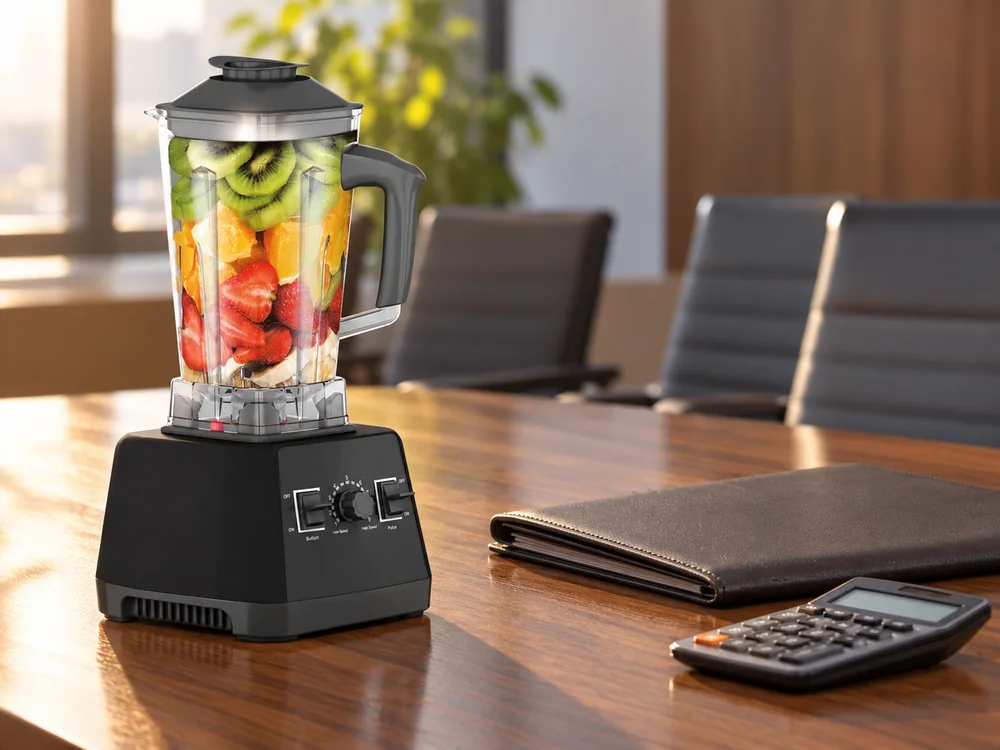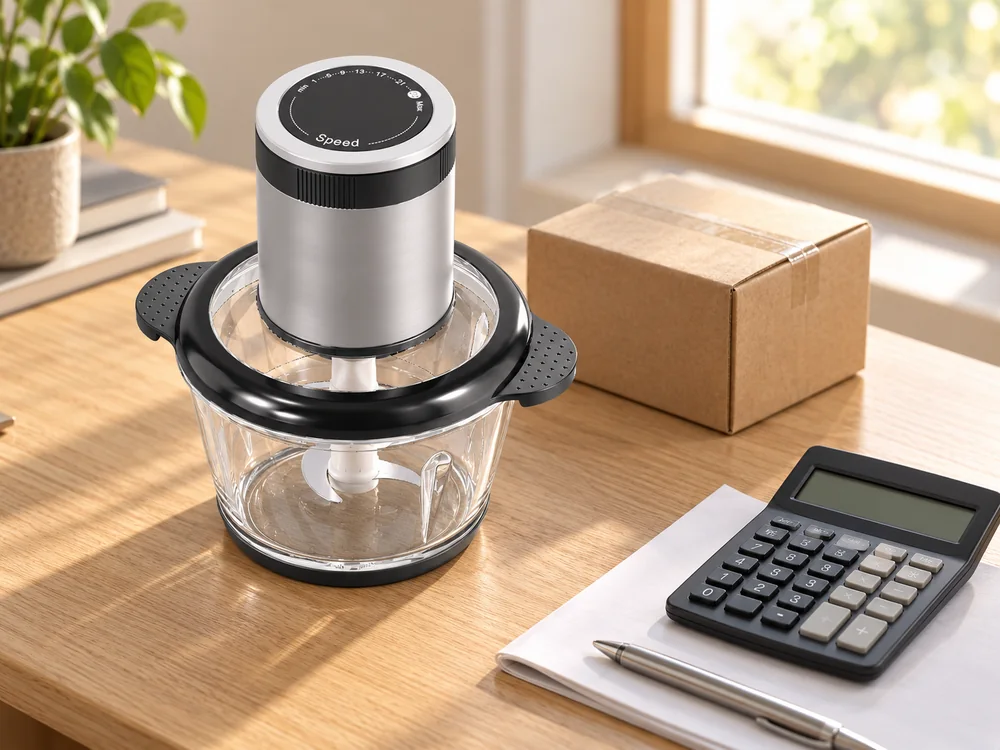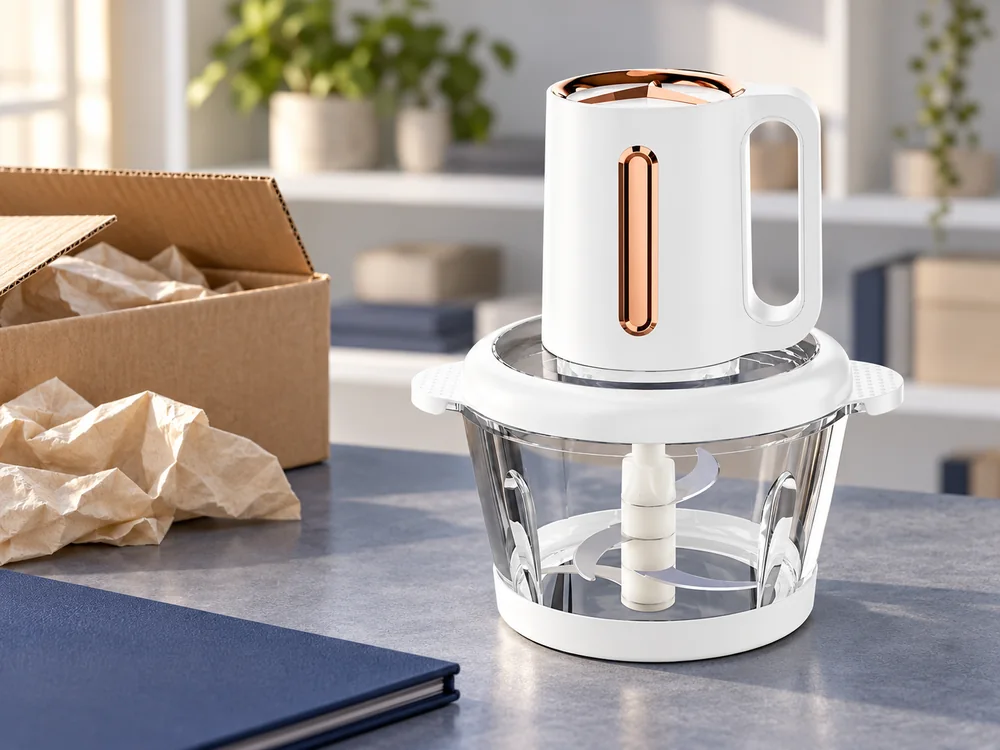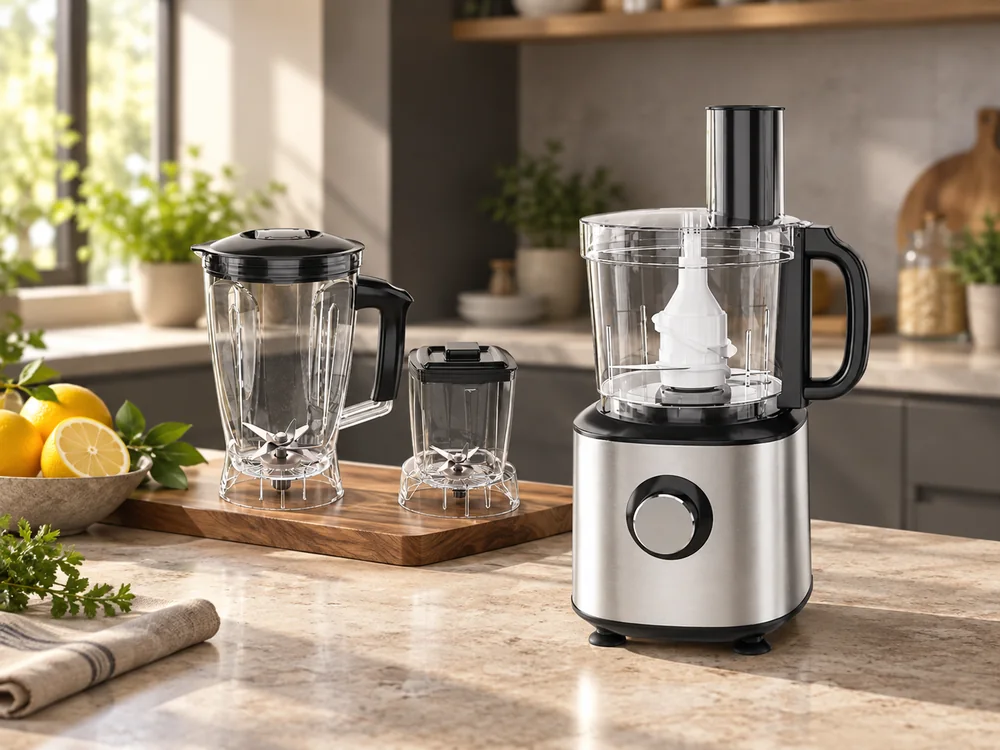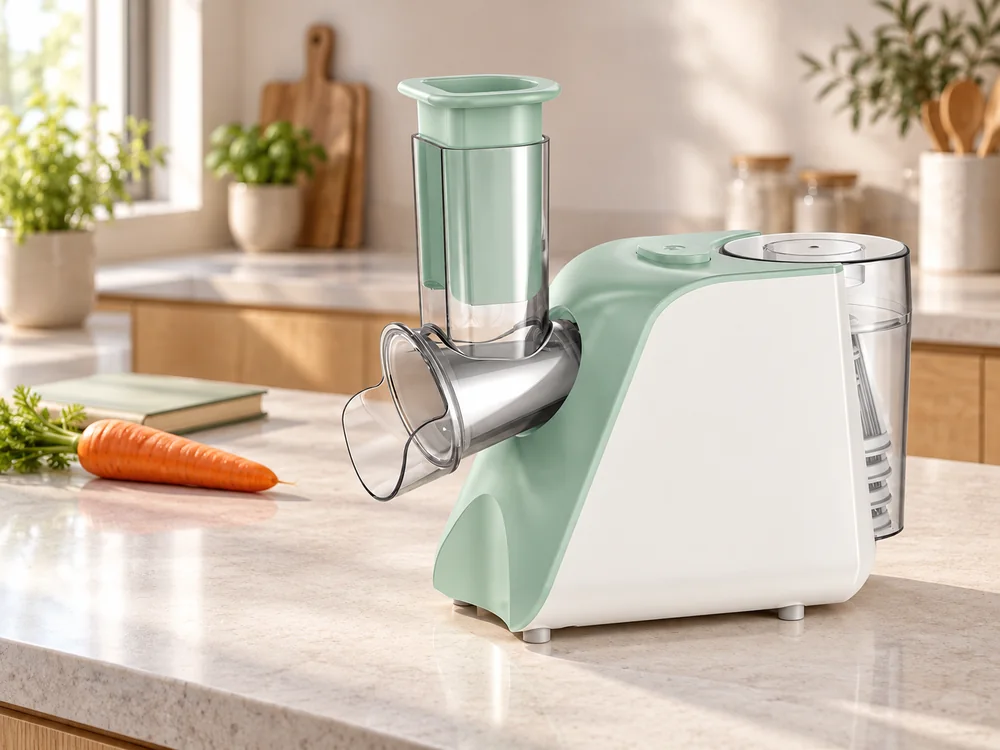
An electric salad maker supplier should be able to propose a complete household appliance for the preparation tasks your customers need. A collection of cutting-tool photographs is not the same offer. Before comparing prices, establish who supplies the machine, which tools belong with it and who will answer questions about the complete retail set.
The supplier decision is different from choosing the most attractive housing or the largest tool count. You need a source whose proposal fits the intended channel and whose responsibilities remain clear when a component, instruction or later order needs attention. A narrower confirmed offer can be more useful than a broad list with important details unresolved.
This article concerns household electric feed-through slicers and shredders for resale. It does not compare industrial vegetable-processing lines, manual cutters or salad spinners. Nor does it rank suppliers or assume that every function shown elsewhere in a catalog belongs to the selected appliance.
Look for an electric salad maker supplier that offers complete appliances
Describe the intended product before asking for a supplier recommendation. A request for salad equipment can lead to leaf-drying baskets, restaurant machines or hand-operated tools. If the buying brief is a household electric slicer and shredder, say so and identify the required preparation results. This prevents a broad catalog from appearing relevant merely because it contains vegetables.
Ask whether the proposed source supplies a complete working appliance or only cutting components. A tool specialist may be relevant to a component project without being the right source for a finished retail product. Conversely, a complete-appliance supplier may offer matched tools only as part of the set, rather than as unrestricted separate accessories.
Start with the JINJIE electric salad maker range to identify the housing, feed arrangement and cutting-set options under discussion. Use an actual product reference in the inquiry. The source should respond with a defined proposal rather than expect the buyer to build an appliance by choosing unrelated parts from photographs.
Name the customer and sales channel. A retailer seeking a focused household preparation product has different needs from a business asking for equipment to run through large quantities throughout the day. Do not treat a household appliance as professional equipment because the purchasing quantity is large. Wholesale describes the transaction, not the permitted operating duty.
Ask how the supplier will handle a requirement outside the current proposal. It may recommend another identified product, explain a limitation or describe further work. That response helps distinguish a useful source from one that simply agrees with every requested function. Keep essential tasks separate from optional ideas so the answer can be specific.
|
Source or proposal type |
Fit for a finished household product purchase |
Question that decides the next step |
|---|---|---|
|
Complete appliance with identified tools |
A possible match for resale |
Does the supplied configuration answer the required tasks? |
|
Loose cutting tools only |
Not a complete appliance offer |
Who supplies and confirms the matching machine? |
|
Industrial processing equipment |
A different purchase category |
Does the actual customer need this operating format? |
|
Manual cutter or salad spinner |
A different preparation mechanism |
Does it perform the task stated in the brief? |
|
Attractive product with an undefined set |
An incomplete proposal |
Can the supplier identify the complete supplied offer? |
Do not reject a source solely because its catalog uses a different category name. Compare the proposed mechanism and actual contents. The useful distinction is between a supplier answering your household appliance requirement and one offering a different product, not between two interchangeable marketing labels.
Ask for a complete set with identifiable cutting tools
A supplier should connect its function description to named tools and the appliance they fit. Five tools could mean several cutting results, while a photograph may show optional or alternative parts beside the machine. Ask for the selected set, including any holder, pusher or storage item required by that proposal.
JINJIE's quotation provides a concrete starting point in SLJ-01, with SM1101 as its secondary reference. It lists 150 W and five tools described as thick slicing, thin slicing, thick shredding, thin shredding and grinding, together with a knife box. Use the primary model and those named contents when discussing that entry.
The power figure does not establish output rate or unrestricted ingredient suitability. The tool names also need to be understood in the intended market. Ask what a term such as grinding means for the proposed food and result before making it a prominent retail promise. The supplier's reply should concern that product, not another machine with a similar photograph.
Keep the five-tool reference separate from entries describing other configurations. A separate dicing entry is not evidence that SLJ-01 dices. If dicing is essential to the purchase, ask for the specific mechanism, matching components and relevant result evidence. If it is not essential, a confirmed slicing and shredding proposal can be evaluated on its own merits.
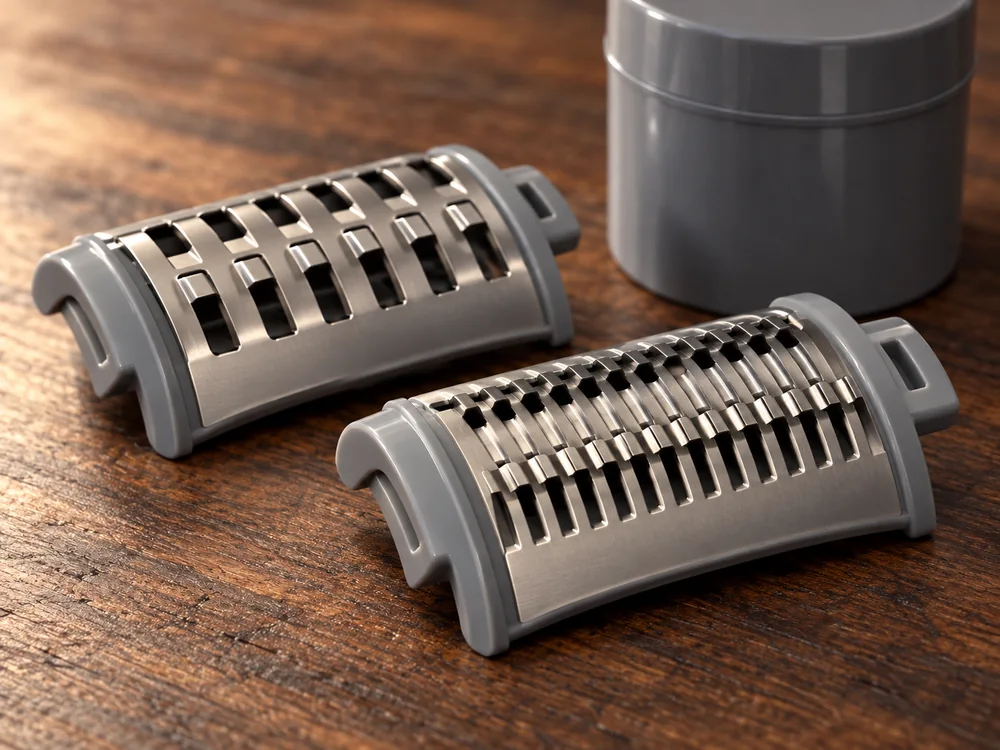
Ask the supplier to identify the whole supplied combination, including components less prominent in the main image. A pusher or tool holder can matter to whether the set is usable as intended, even when it contributes little to a marketing photograph. Do not reduce the buying record to the most visually striking metal parts.
A partial accessory close-up helps identify a shape or construction detail. It does not define everything included in one retail box. Keep the complete contents description beside the quotation, and use the relevant picture to resolve a particular question. This makes the supplier's answer usable without turning the inquiry into an image-counting exercise.
If you want a smaller tool selection, ask whether that exact combination is available. Removing tools from a proposed set may change packing or commercial conditions. It may also leave the buyer with a version that has not been defined by the supplier. Obtain the complete revised offer instead of simply subtracting assumed accessory prices.
Compare how suppliers answer the important product questions
Once a source has proposed a plausible appliance, ask the questions that could change your selection. For a slicing brief, that may be the relevant tool and permitted food preparation. For a compact-kitchen brief, it may be the actual working arrangement. The supplier should understand the purchasing purpose behind the request.
Evaluate whether the answer is specific enough to use. A relevant demonstration identifies the appliance, tool and conditions shown. A general claim that the product works well does not answer a particular requirement. Equally, a clear existing answer should not trigger another round of identical requests merely because the review has become habitual.
JINJIE's quality and testing information offers a starting point for discussing checks against the selected order. Ask which review would resolve your actual uncertainty. Keep any sample evaluation within the product's instructions and have the responsible product team determine the appropriate method.
Look at how the supplier distinguishes a product limitation from an incomplete explanation. If the required result is outside the proposed model's scope, the offer needs reconsideration. If the tool is suitable but its naming is unclear, a better reference may resolve the issue. These lead to different buying decisions.
Do not require a source to promise every possible ingredient before considering it. Define the intended customer task and establish that scope. A supplier able to state a useful boundary may give the retailer a more reliable proposition than one relying on an expansive list of recipes unsupported by the selected product.
When two proposals remain plausible, compare how much important work remains unresolved. One might have a clearly identified set while the other depends on a requested additional tool. That does not make the second source unsuitable for all projects. It means the current purchase has different preparation and decision requirements.
Preserve an unanswered essential question as a condition of selection. Missing detail about an optional color can be dealt with separately. Missing confirmation of the main cutting task is different. The buyer should be able to explain why it is proceeding, waiting for an answer or choosing another proposal.

Establish responsibility for the supplied retail product
Ask who is responsible for the complete appliance and its matched components. The supplier does not need to claim that every part is made internally to explain this. It should be able to identify how the proposed machine, cutting tools and instructions become one agreed retail offer.
If sales, manufacturing and technical support involve different contacts, ask how decisions move between them. You need a clear route for a question about a mismatched tool or changed version. A long contact list is not useful if none of those people can confirm the response to the buyer.
Keep supply responsibility separate from a general factory introduction. A building photograph establishes context, not the available production quantity for your order. Ask about the actual preparation and acceptance of the selected configuration. The answer should connect the supplier's process to what your customer will receive.
The instructions and retail description should use the same tool identities as the accepted set. If the buyer supplies translations, agree who checks the meaning against the physical product. A designer can reproduce a supplied phrase correctly while the phrase still names the wrong result or attachment.
Request one identifiable reference for the accepted offer. It should let the parties distinguish the chosen model and contents from optional alternatives. Keep the task practical: the record needs to support an order, a later question and a repeat proposal, not become a collection of documents with uncertain status.
Ask how an identified difference would be handled before it becomes a customer problem. Correcting a missing agreed item is different from suggesting another tool. The supplier should communicate the difference and obtain the relevant buying decision where the retail offer would change.
Do not assume a successful first exchange settles every later responsibility. Before placing the order, align the proposed support arrangement with what your own sales channel expects. A retailer promising individual replacement tools needs an actual supply basis for that service, not merely an image of tools available in some configuration.
Choose a customization scope that serves the order
Private-label work can involve the appearance and presentation of an existing product, or it can involve changes to the product itself. Describe which you need. A logo and box request should not be treated as the same proposal as a new feed arrangement or a different cutting connection.
Use JINJIE's OEM and ODM options to discuss branding around an identified model and cutting set. State the target market, electrical version and printed-material needs. Ask the supplier to identify the available route and what remains to be prepared for the specific order.
Keep decorative preferences separate from mandatory customer needs. A current color may be acceptable even if it is not the brand's first choice. A missing essential cutting result cannot be solved by changing the color. Decide which requirements justify further work before comparing preparation conditions.
Ask how minimum quantities apply to the proposed model, tool set and presentation. The category's stated approach is that minimums depend on those requirements. Obtain an actual quotation; do not assume one total quantity can be divided freely among several colors, packages or accessory combinations.
Compare the complete selected price with the work still needed. A lower preliminary figure may exclude the required packing or depend on a different set. Another offer may be more complete. Align the mandatory contents and commercial scope before deciding whether the difference is a meaningful saving.
Have optional changes priced separately where possible. That lets purchasing decide whether the benefit justifies the additional commitment. If an optional change delays readiness, consider whether the current product can meet the launch need. Keep a required product change unresolved until it has an adequate answer.
For a retailer-specific presentation, discuss unused printed materials and later reorders before committing. A dedicated design may fit the account, but it ties part of the purchase to that presentation. Understand the supplier's actual proposal rather than assuming those materials can be used for any future customer.
Agree a workable response to missing or changed components
The commercial proposal should explain how a reported difference can be raised and assessed. A customer may report a missing component, an unclear tool name or an operating concern. Those are not necessarily the same problem, and the response should begin with identifying the supplied product and reported issue.
If the proposed remedy involves a replacement component, confirm both compatibility and availability. Similar-looking cutters may use different connections or belong to another version. A photograph showing a close resemblance does not establish that it can be supplied and used with the customer's appliance.
|
Situation to discuss |
Supplier response to clarify |
Effect on the buying decision |
|---|---|---|
|
An agreed tool is missing |
Identification and the available corrective arrangement |
Whether the channel can restore the purchased offer |
|
A customer wants an additional tool |
A separate confirmed compatibility and supply proposal |
Whether an optional service can responsibly be offered |
|
Separate parts are not supplied |
An alternative agreed customer-support arrangement |
Whether the retail channel can work without loose-part stock |
|
A future set uses a revised component |
Identification of the difference before reorder |
Whether existing stock and retail information remain distinguishable |
|
An essential question remains unanswered |
Relevant product clarification or another proposal |
Whether selection can proceed at all |
Compare the practical cost of the response, not just the nominal part price. Identification, separate handling and delivery may affect the arrangement. A complete-unit remedy may also carry costs and require local stock. These are matters to agree between the parties, not default terms attached to the word supplier.
If separate tool supply is unconfirmed, decide whether it is essential to your channel. An agreed alternative may still support the purchase. If your customer proposition depends on stocking individual tools, settle that requirement before making the promise or committing to an offer that cannot support it.
For repeat orders, send the earlier accepted reference and request confirmation of the current proposal. Keep any change in tool set, housing or presentation visible. The supplier's new catalog image should not silently replace the description of stock already sold or waiting in your warehouse.
Select the source with the usable complete offer
Bring the decision back to the customer's preparation task and the supplier's actual proposal. The preferred source should identify a suitable complete appliance, answer the essential product questions and offer workable commercial and support arrangements. Avoid substituting a large catalog or broad capability claim for those answers.
Record the accepted trade-off. You may choose an existing presentation to keep the first offer straightforward, or wait for a necessary tool clarification because it defines the customer's reason to buy. Both can be reasonable decisions when the consequence is understood and the commercial proposal reflects it.
Send JINJIE your salad maker sourcing requirements with the intended foods and results, preferred product reference, market and estimated quantity. Describe the complete set and any mandatory support requirement. Ask for the nearest confirmed offer, with optional changes and unresolved questions kept visible.
FAQ
Can a supplier be shortlisted if it only shows individual cutters?
Only as a source needing further clarification for a complete-appliance purchase. Ask who supplies the matching machine and confirms the assembled offer. Individual cutter images can support a component discussion, but they do not establish a finished retail product or responsibility for the whole set.
Must a five-tool purchase wait for six-tool dicing information?
Not when the confirmed five-tool proposal answers the required task and dicing is outside the retail promise. Keep the separate configuration out of the offer. If dicing is essential, request evidence for that specific mechanism and product before deciding; the five-tool description cannot answer it.
What if a supplier proposes a different housing with the same tool count?
Ask for the complete revised proposal and the relevant differences. A matching count does not establish identical tools, connections or customer operation. Decide whether the alternative still answers the brief, then review its actual contents and commercial terms rather than accepting it solely as an equivalent-looking substitute.
Can the first order use standard presentation and a later order use private label?
Discuss that sequence with the supplier. Obtain the available conditions for the current offer and treat later branding as its own proposal. Keep the retail identities and remaining stock clear. An initial purchase does not reserve a future price, quantity condition or customization arrangement unless expressly agreed.