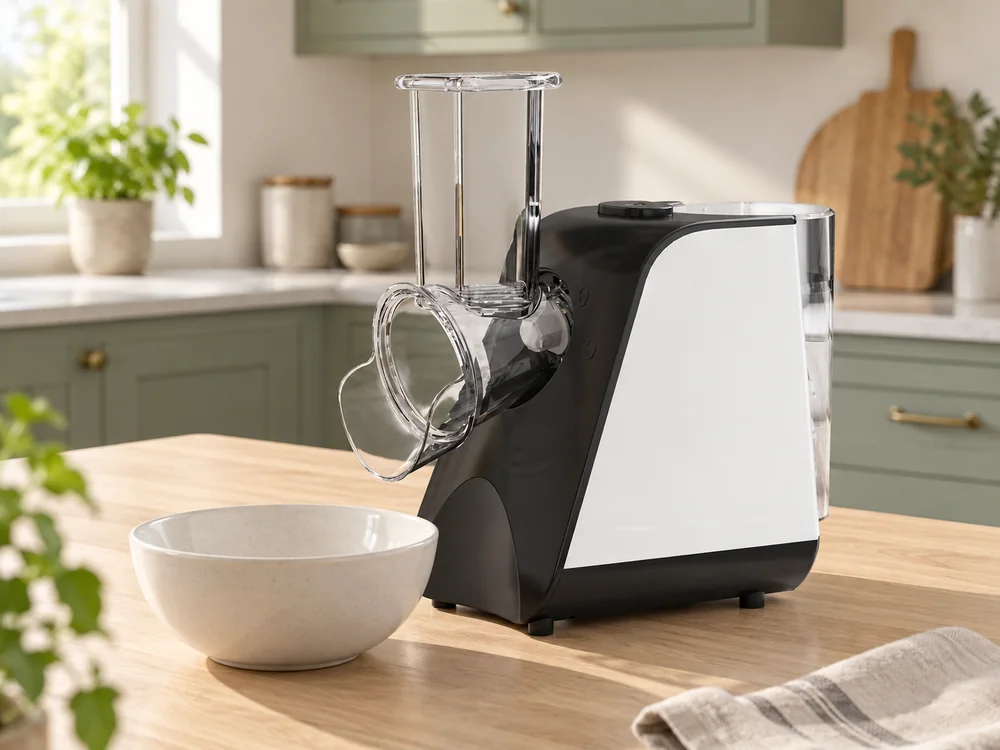
An electric salad maker wholesale purchase should specify the complete retail product and how many of each version the business can use. The lowest unit price is only one part of that decision. Tool contents, printed materials, carton quantities and the planned sales channel determine whether the order arrives as useful stock or a collection of versions that are difficult to sell together.
This guide starts after a household appliance has been identified as a plausible fit for your customers. It focuses on building the opening wholesale order, comparing its total commitment and preparing a practical reorder. It does not treat a larger purchasing quantity as evidence that a household slicer can handle restaurant or industrial workloads.
For JINJIE, the relevant product is an electric feed-through salad maker with its matched cutting tools. It is not a salad spinner, a commercial leaf dryer or a manual cutter. Keeping that product definition in the inquiry helps the supplier return a quotation for the appliance your channel actually intends to sell.
Define the sellable unit in your electric salad maker wholesale order
Start with one complete unit as the customer will receive it. Identify the appliance, required feeding components, matched cutting tools, any included storage item and printed material. A photograph can help explain the reference, but the written contents determine what the quoted retail set includes.
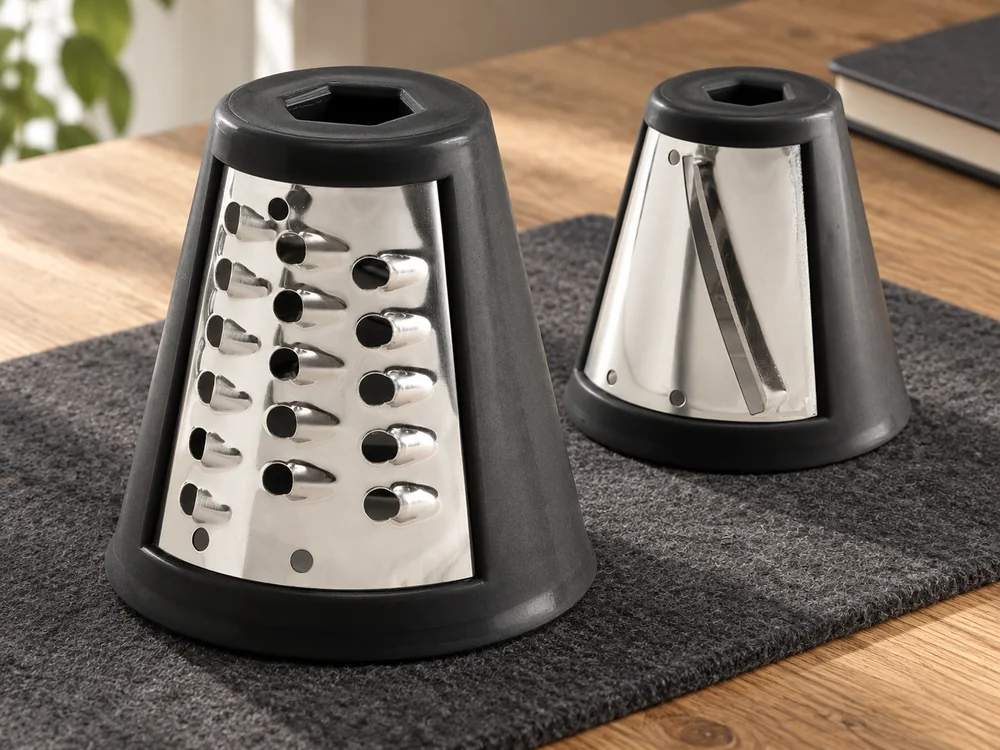
The JINJIE electric salad maker range provides current model references. For example, the quotation lists SLJ-01, with SM1101 as a secondary reference, at 150 W. Its five named tools cover thick slicing, thin slicing, thick shredding, thin shredding and grinding, with a knife box listed in the offer.
Use those descriptions as a starting point, then confirm the selected order contents. Do not add dicing simply because another entry or image shows a broader tool selection. A confirmed five-tool product can be purchased for the tasks it supports without waiting for an unrelated configuration to be resolved.
Keep the model separate from the retail SKU. Your business might use a channel-specific name or stock code, but the supplier still needs an identifiable appliance and configuration. Connect the two references so the warehouse and purchasing team can recognize what one ordered unit means.
If the intended offer excludes a listed tool or storage item, request a revised complete proposal. Do not create a lower-cost version by deducting an assumed accessory value yourself. The supplier needs to confirm whether the revised set is available and how its packing and commercial conditions change.
Avoid counting a demonstration product as saleable stock unless it remains complete and is handled under your channel's own policy. An opened set used for photography or buyer review may have a different purpose from an unopened customer unit. Include those needs deliberately in internal planning rather than discovering them after allocating every unit to sales.
State the electrical market in the same order description. A shared housing or tool set does not make versions for different markets interchangeable. The purchase should identify the proposed electrical configuration and corresponding product information before the business treats the whole quantity as one pool of stock.
Build the opening quantity around actual channel demand
Separate confirmed demand from a trial allocation. A retailer's accepted quantity is different from an optimistic estimate for a new online listing. Both can contribute to a purchase plan, but they should remain distinguishable when the business decides how much stock to commit to each version.
Begin with the configuration that serves the main account or channel. Additional colors, presentations or tool combinations should have their own reason to enter the opening order. A buyer does not need to launch every catalog option to establish a credible range, and the supplier should not have to infer the intended mix from one total quantity.
Write quantities by version. If two retailers require different boxes or languages, they may need separate order lines even where the appliance is otherwise the same. This makes it possible to ask which quantities can be combined commercially and which depend on their own preparation requirements.
Ask the supplier how minimum quantities apply to that proposed mix. The relevant answer concerns the model, appearance, electrical version and packaging you requested. A general statement about wholesale orders is not enough to establish that a total quantity can be divided freely among many variations.
Use the customer's buying reason to resolve a difficult minimum. Reducing an optional color choice may preserve the offer while simplifying the opening commitment. Removing the tool that performs the main promised task would change the product. These are different concessions, even if both reduce the number of items being discussed.
|
Opening-order choice |
What it can simplify |
What still needs an actual supplier response |
|---|---|---|
|
One established complete set |
Product and contents decisions |
Current price, quantity conditions and readiness |
|
Several colors of the same set |
A shared functional description |
Whether color quantities can be combined |
|
Different retailer boxes |
Channel-specific presentation |
Separate printing and packing conditions |
|
Different electrical markets |
A broader sales allocation |
Each market version and its associated information |
|
A smaller tool combination |
The proposed retail contents |
Whether that revised combination can be supplied |
Keep the first-order decision distinct from a future range idea. A possible second color can remain in discussion without being ordered now. Record the conditions under which it would become useful, such as a retailer's confirmed request or a later sales review, rather than adding it to the opening order solely to fill out a catalog.
Do not present an internal demand estimate as a supplier commitment. The manufacturer can quote the requested quantity and timing, but it cannot establish how quickly your particular retail channel will sell the stock. Use your own sales evidence and commercial judgment when choosing the opening mix.
Compare the complete order cost before choosing a price tier
Request a quotation that identifies the agreed appliance, cutting set and retail presentation. If the supplier offers price tiers, compare each against the same configuration. A lower figure based on different contents or standard packing is an alternative proposal, not a direct discount on the product already selected.
Look at the total stock commitment beside the unit price. A price reduction can require more units, additional printed material or a less flexible mix. The relevant question is whether the business can use that commitment, not whether the lower price looks attractive in isolation.
Separate recurring product cost from any identified preparation charge. Where the proposal includes artwork or sample work, ask what the charge covers and whether it applies again. Keep the supplier's answer visible instead of spreading the charge across an assumed long series of future orders.
If the business allocates a project charge across units for internal planning, label the calculation as its own assumption. Use the quantity it is prepared to purchase, not an optimistic future volume chosen to make the per-unit result look smaller. The original charge should remain available for comparison.
Obtain the packed details for the actual set. More tools, a storage box or a different presentation may alter the packing arrangement, but the current packed proposal should establish the difference. A retail box image alone does not supply the outside carton dimensions or shipment weight needed for a transport estimate.
Ask which costs are outside the quotation. Depending on the proposal, sample delivery, requested inspection, additional preparation or transport may need separate arrangements. An omitted item is an unresolved question, not a zero-cost service. Compare only confirmed inclusions on the supplier side and label your own estimates separately.
Use JINJIE's OEM and ODM information when the order includes branding. Keep an existing product with your presentation distinct from a requested change to its feeding arrangement or cutting connection. A wholesale order can involve either, but the work and commercial basis may differ.
If an optional change makes the opening order uneconomic, ask for the nearest existing alternative that preserves the core customer offer. Keep both proposals identifiable. This lets the buyer reconsider a preference without losing the relationship between the selected product and the price being evaluated.
Negotiate after the comparison basis is clear. A useful request identifies what must remain unchanged and asks whether quantity, presentation or another optional choice can improve the offer. A general demand for a cheaper product can otherwise produce a different set whose apparent saving has not been evaluated.

Turn retail quantities into a receiving and allocation plan
Confirm the units per master carton before finalizing the purchase quantity. If the supplier's pack arrangement creates a rounding difference, make that visible. The business should know whether the proposed order matches its desired unit count or includes additional units because of the agreed packing basis.
Consider an illustrative calculation. If a proposed carton contains six complete sets, 100 units do not make a whole number of those cartons. Sixteen cartons contain 96 units and seventeen contain 102. The actual supplier may propose another arrangement; six is an example, not a JINJIE carton specification.
Decide what to do with the difference rather than treating it as an accounting detail. Additional units might serve a legitimate internal purpose, or the order may need a different accepted quantity. Do not assume partial cartons or changed packing are available without asking the supplier.
For multiple versions, request a carton-level explanation of the agreed mix. Are cartons dedicated to one version, or is a mixed arrangement proposed? The receiving team needs to identify what is inside without opening every retail box. Keep carton descriptions connected to the order's actual version references.
Separate receiving allocation from retail presentation. Your warehouse may need a practical stock code while the customer sees a brand name and product description. Both should point to the same complete set. This is particularly important when two packages look similar but belong to different markets or retailer accounts.
Reserve any demonstration or service allocation in your own stock plan. Do not subtract those units silently from a quantity already committed to a retail customer. Where separately supplied service components are being discussed, keep them on their own line rather than counting loose tools as complete appliances.
Use the order's current contents reference for the relevant checks discussed through JINJIE's quality and testing information. A warehouse count establishes quantity, while the agreed review establishes what the selected set should contain. Neither should depend on remembering an early sample photograph.
Keep differences visible when goods are received. A missing agreed item, the wrong version and transport damage are different issues. Identify the affected product, quantity and observation before requesting a response. Clear information helps the parties resolve the actual order problem without treating every report as a general quality complaint.
Choose presentation and timing that fit the first shipment
A standard presentation may suit one opening order, while a retailer requires its own branded box for another. Choose based on the channel's real requirement and the supplier's available proposal. Standard presentation is not automatically available for every model, and private label does not automatically require changes to the appliance.
Identify which buyer files or decisions the supplier needs before preparing the requested version. Logo assets, approved wording and language material can have different owners within your business. Bring them together as one compatible request so the supplier is not choosing between conflicting instructions.
Review the customer promise against the supplied five-tool set or other confirmed configuration. The main product image should show the actual offer. Ordinary scene props can support the image, but they must not create the impression that extra tools, bowls or a second appliance come in the box.
When the proposed timing is important, ask what it depends on. The relevant date may rely on product details, printed-material approval or other preparation. A target selling period should produce a discussion of those dependencies, not an assumed delivery promise based on an introductory catalog.
Separate factory readiness from the date your warehouse needs stock. Transport and receiving work also belong in the business's plan. Obtain appropriate current estimates for the chosen route rather than treating the supplier's preparation period as a complete arrival schedule.
|
Timing problem |
Commercial option to discuss |
Trade-off to consider |
|---|---|---|
|
Optional artwork is unfinished |
An available existing presentation |
Whether it meets the channel's requirements |
|
One version is needed earlier |
A proposed split shipment |
Additional handling and delivery implications |
|
The opening mix is too fragmented |
Fewer initial variants |
Which customer demand can genuinely be deferred |
|
A mandatory product task is unresolved |
Further product clarification |
Whether the intended order can proceed at all |
|
The forecast changes before commitment |
An updated quantity proposal |
Current supplier conditions rather than assumed flexibility |
Evaluate a split shipment as a complete option. Ask which quantities, packing and costs change, and whether the earlier portion actually serves the intended customer. Sending a small quantity first is not inherently better if it creates an awkward assortment or leaves the main account short of its required version.
If a mandatory product question remains unanswered, do not let finished artwork create pressure to place the order. The printed materials are only useful when the appliance supports the intended offer. Optional presentation work can be deferred more easily than the reason customers are expected to buy the product.
Use first-order results to decide the next wholesale mix
Keep sales and support observations attached to the actual version sold. A combined total can hide an important difference between colors, packages or channels. The next order should reflect the business's observed demand, not simply repeat the original mix because the product name has stayed the same.
Distinguish a demand issue from a presentation issue. Customers may not understand the cutting functions shown on the product page, or a channel may have ordered more stock than it needed. Those findings call for different responses. Do not automatically add tools or change the appliance when clearer information would address the reported confusion.
Use specific support reports when requesting clarification. Identify the model, tool and issue rather than saying that customers do not like the product. If the proposed remedy involves separate parts, first confirm their supply and compatibility. A tool photographed with another model is not automatically suitable service stock.
Compare the repeat quotation with the earlier complete-set reference. Ask whether the contents, presentation or commercial conditions have changed. A reorder can be straightforward when the offer is unchanged, but its identity should not depend only on an old retail nickname.
Consider a new variant only when it answers a useful customer request and the supplier can define it. Keep any remaining earlier stock visible when planning a revised package. A new design should not make your team lose track of which instructions or components belong with units already sold.
Maintain a realistic distinction between a small initial test and an ongoing purchasing arrangement. A first order does not reserve indefinite pricing, a future minimum or continuous availability unless agreed. Obtain current terms for the next quantity and use the evidence from the opening order to make that request more precise.
Request an electric salad maker wholesale quotation
Contact JINJIE about your wholesale salad maker order with the preferred model, intended household tasks, destination market and quantities by version. Include the complete cutting set, presentation needs and required receiving date. Ask for current price, packing and preparation conditions for that defined offer, with optional changes quoted separately.
FAQ
Can one wholesale order include several colors?
Ask for conditions for the exact colors and quantities you want. A shared model does not establish that every mix is available under one minimum. Keep the accepted quantities and presentation attached to each version in the quotation.
Should we wait for dicing information before ordering a five-tool model?
Only if dicing is essential to the product you intend to sell. Otherwise, assess the confirmed slicing and shredding set on its own scope. Keep unconfirmed dicing claims out of the box and listing rather than delaying an unrelated offer or advertising an unsupported function.
What if the carton quantity does not match our retailer's order?
Discuss the available packing and quantity options with the supplier. Decide how any additional complete units will be allocated internally, or request another accepted order quantity. Do not assume that partial cartons can be supplied on unchanged terms.
Can a later order use the same appliance with new packaging?
Potentially, subject to the supplier's current proposal. Identify the packaging change, quantity and remaining earlier stock. Confirm which product information stays the same, and keep the two retail versions distinguishable for receiving and customer support.