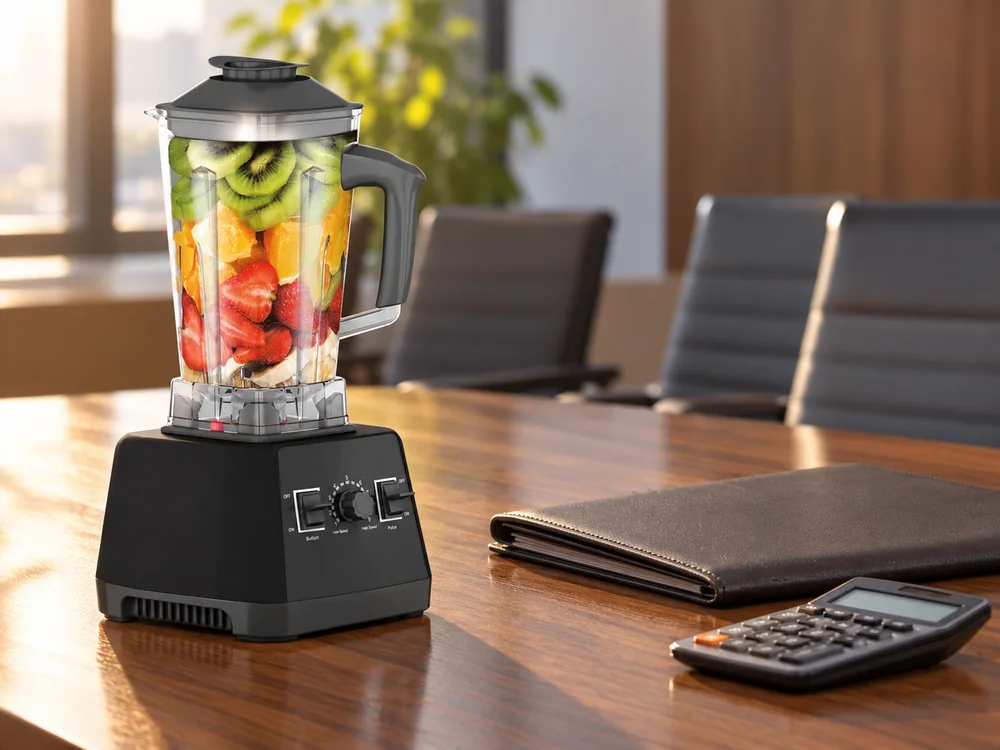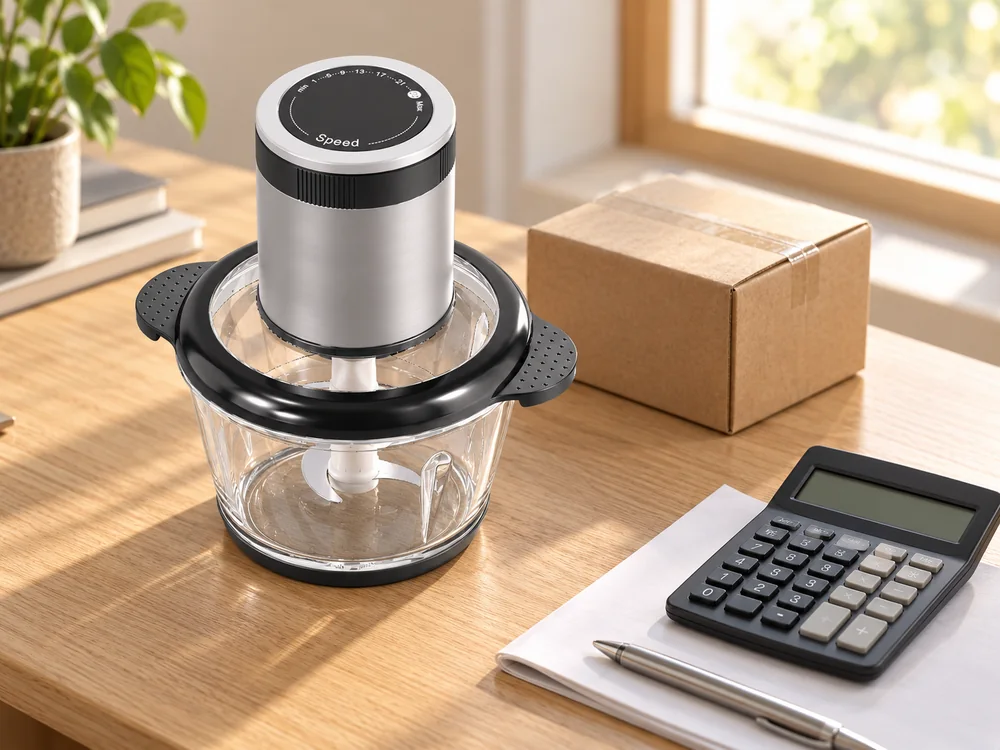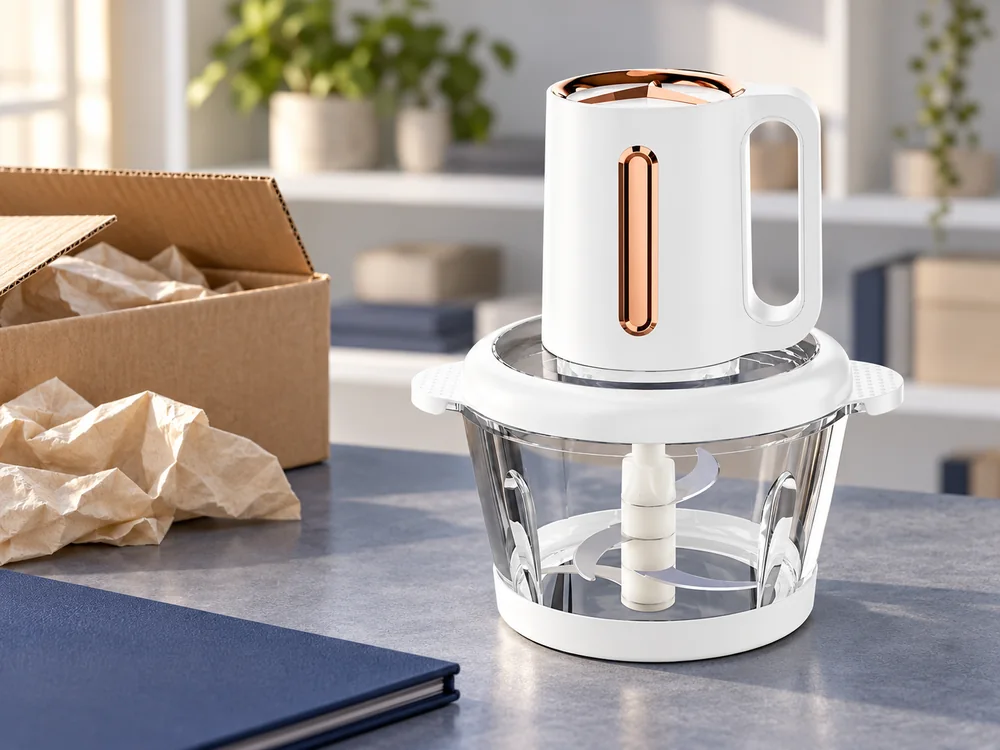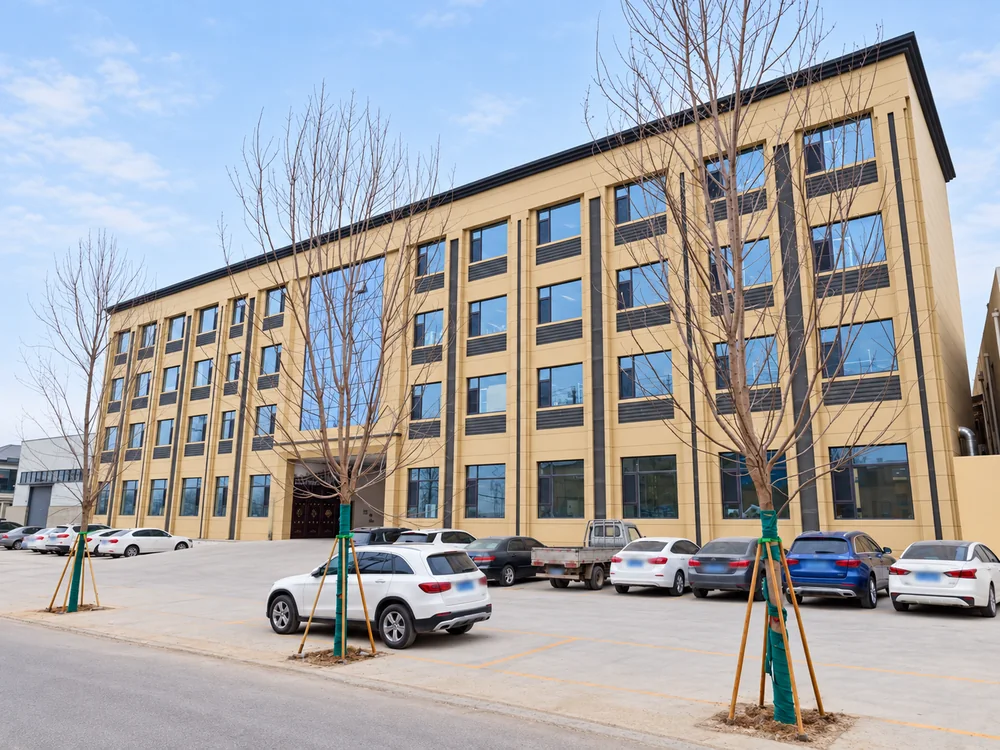
A food chopper factory is a suitable choice when its manufacturing arrangement fits the product you need to buy. That means more than having an assembly line. The factory must be able to explain how the chosen parts become the agreed appliance, how different versions are kept clear and what preparation your order requires.
For a private-label buyer, the useful comparison is between manufacturing proposals for the same household product. One proposal may use a current configuration with new artwork. Another may depend on a changed part or additional preparation. Compare those actual commitments before treating either as ready for production.
This article covers household electric bowl choppers with the motor above the container. It does not evaluate industrial bowl cutters, commercial continuous-processing machinery or manual dicers. It helps buyers judge the factory's fit for an order, rather than conduct a full site audit or redesign the appliance.
Describe the order before choosing a food chopper factory
Give each factory a product reference and explain what you need supplied. Include the bowl format, controls, supplied components and destination-market version. A photograph helps identify the appearance, but the proposal also needs a written description of the complete product. The manufacturing task is different when that photograph represents an existing model rather than a design request.
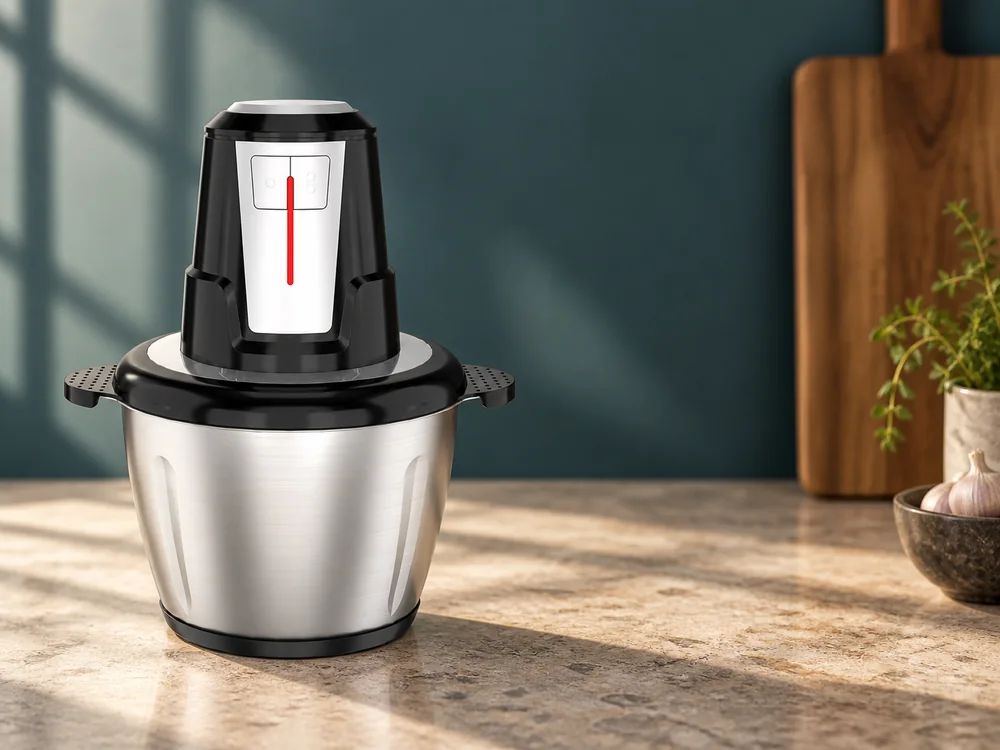
Start with the nearest available configuration in the JINJIE electric meat chopper range. Identify what can remain unchanged. This gives the factory a concrete starting point and allows it to explain any requested departure from that product. An open request for every available feature makes the manufacturing comparison unnecessarily difficult.
The SD entries illustrate why the full combination matters. SD-01 is listed with a 3 L stainless-steel bowl and 500 W, while SD-02 is listed at 2 L and 400 W with a stainless-steel bowl. Choosing between them changes the identified appliance. It is not permission to move a bowl or motor between versions.
State how many versions the order would contain. One configuration with one printed presentation is a different preparation task from several electrical versions, colors and retail packs. The total quantity alone hides that complexity. Ask the factory to respond to the proposed split, not merely the largest number on the inquiry.
Explain which requirements are essential for the first release. If a particular finish is optional but the electrical version is fixed, say so. This helps distinguish an acceptable current option from a project that depends on unresolved work. A factory cannot propose a sensible alternative if every preference appears equally mandatory.
Include the intended customer use without prescribing unsupported engineering. Describe the ingredients, batch expectations and retail purpose that the product needs to address. Let the responsible technical team identify suitable configurations and any checks needed. Power and nominal bowl capacity should remain specification fields, not assumed proof that the task will be met.
The response should tell you whether the factory is proposing an existing appliance, an existing appliance with defined changes, or further development. Keep those routes separate when comparing price and readiness. Otherwise a supplier that has honestly included preparation work can appear less attractive than one whose proposal leaves the same work unnamed.
Ask how the complete appliance is made and coordinated
A complete bowl chopper brings together the motor unit, controls, bowl, lid, blade assembly and packed presentation. Ask which relevant work the factory performs and which inputs come from other sources. You do not need every supplier's confidential details, but you do need to understand who specifies, receives and accepts the parts used for your product.
Do not assume that a good factory makes every component internally. The important question is whether it can control the combination it proposes. A bought-in bowl still needs to match the selected lid and blade arrangement. An externally supplied printed box still needs to describe the right product. Responsibility for the finished appliance cannot be inferred from where one part was made.
JINJIE's manufacturing process describes component preparation, assembly, inspection and finished-goods staging. Use those stages to discuss your order. Ask where the agreed product information enters the process and how the relevant parts and printed materials are prepared together. The answer should make the actual manufacturing route understandable.
The following comparison separates useful manufacturing questions from broad claims that need more evidence.
|
Manufacturing area |
Question for the proposed product |
What the answer helps you decide |
|---|---|---|
|
Component preparation |
Who specifies and accepts the required bowl, lid and motor-related parts? |
Whether the complete combination has a responsible owner |
|
Assembly |
Which operations apply to this configuration? |
Whether the proposed route is relevant to the actual appliance |
|
External inputs |
How are supplied parts checked against the agreed version? |
Whether outside sourcing is managed rather than left implicit |
|
Inspection |
Which checks address the product's relevant assembly and operation? |
Whether the control plan follows the selected product |
|
Packing |
How do contents, instructions and printed materials reach the right set? |
Whether the retail offer remains complete after assembly |
Ask for an explanation of one important interface. For example, how is the selected bowl-and-lid combination identified before the motor unit is matched with it? The answer may use part references, a sample or a work instruction. You are evaluating whether the relationship is clear, not requiring the factory to adopt your preferred software or paperwork format.
Keep a distinction between visible work and wider claims. A photograph of motor assembly supports a discussion of the activity shown. It does not establish that every motor is made at that station or that all catalog products share the same route. Ask the factory to identify what applies to your proposal and what is only general background.
Where a requested part comes from outside the factory, discuss the effect of changing it. Who evaluates fit? Who checks the incoming version? Who tells the buyer if the proposal must change? A clear coordination route can be more valuable than a vague claim of complete in-house production that leaves those questions unanswered.
Match the factory's preparation to your version mix
Several versions can look almost identical on the workbench. A different plug, rating label or instruction language may be less obvious than a different bowl material. Tell the factory which distinctions matter in your order and ask how those distinctions remain visible through preparation and packing.
Start with the complete order split. Show the model and quantity for each destination or retail pack, including any shared features. The factory can then explain which materials can be prepared together and which require separate handling. Do not assume that visually related models use interchangeable components or can be combined into one undifferentiated production quantity.
For glass and steel bowl options, ask how the matching assemblies are identified. The commercial attraction of offering both materials does not settle the manufacturing relationship between them. A different bowl can require its own lid, blade or protective packing. Keep the actual combination clear without deciding from appearance that the factory should treat the options as identical.
Printed materials deserve the same attention. An appliance with the correct hardware can still arrive in the wrong retail presentation. Ask how a selected manual, nameplate and box version are connected to the order. If the buyer provides artwork, establish which file represents the accepted version before it enters preparation.
Consider the scale of the version mix relative to your opening order. Several small variants may create more separate preparation than your channel needs. Ask the factory what each split changes in its proposal. You can then compare fewer versions, an existing finish or a staged introduction without assuming that the original split is either impossible or cost-free.
JINJIE's OEM and ODM preparation distinguishes current-product branding from design changes and new development. Use that distinction when selecting the manufacturing arrangement. A factory ready to prepare a branded current model has not automatically confirmed a new bowl interface or control design. The additional task needs its own technical answer.
Avoid solving every preparation problem by reducing the product scope. If a particular configuration is central to the customer offer, retain it and compare the actual manufacturing proposal. Simplification is useful when it removes unnecessary variation. It is harmful when it quietly removes the feature the buyer needed in the first place.
Read the production proposal as a set of dependencies
A factory's general size or daily activity does not tell you when your specific order can be completed. Ask which product decisions, components and packaging must be ready before the proposed work can proceed. The schedule should follow the defined order, including any outstanding buyer approvals.
Distinguish material readiness from assembly readiness. The visible availability of motor housings does not establish that the selected bowls, electrical parts or printed materials are ready. Ask about the complete configuration. A single unresolved input can affect what can be built or packed, even when much of the product is already available.
JINJIE describes production scheduling as dependent on the model, quantity, component availability, packaging readiness and requested shipment date. That provides a useful basis for an order discussion. It is not a fixed lead-time promise. Give the factory the actual scope and ask it to identify the dependencies behind its proposed dates.
Ask whether the proposal includes a preparation or first-unit review before the main quantity proceeds. Its purpose is to check the selected version at the start of the work, not to replace every later inspection. Establish what is being compared and how an identified difference would affect the next activity. Avoid demanding a universal procedure that ignores the product.
When comparing two factories, keep equivalent milestones together. A date for completing assembly is not necessarily the date when packed goods are ready for collection. A date for producing a sample is not the start of volume production. Ask each factory to state what its date delivers and which work remains afterward.
The table below helps turn schedule differences into a purchasing choice. The alternatives are discussion options, not assumed JINJIE production arrangements.
|
Situation in the proposal |
Question to resolve |
Possible buying response |
|---|---|---|
|
Product details remain open |
Which decision prevents preparation? |
Close the required decision or revise the affected scope |
|
Printed materials are not ready |
Can any agreed work proceed without them? |
Coordinate artwork while preserving the correct packed version |
|
One variant has a different readiness date |
Can it be handled separately on acceptable terms? |
Compare one delivery with a specifically agreed split |
|
A requested change adds preparation |
Which work and review does the change require? |
Retain, defer or remove the change according to customer need |
|
The proposed date lacks a defined milestone |
Does it mean assembled, packed or ready for collection? |
Clarify the milestone before making a channel commitment |
Be explicit about work on your side. Retailer feedback, translations and artwork decisions can affect readiness. Give the factory a realistic response route instead of expecting its schedule to absorb an undefined approval period. If a buyer decision changes, ask for the affected timing to be updated rather than continuing to quote the earlier date internally.
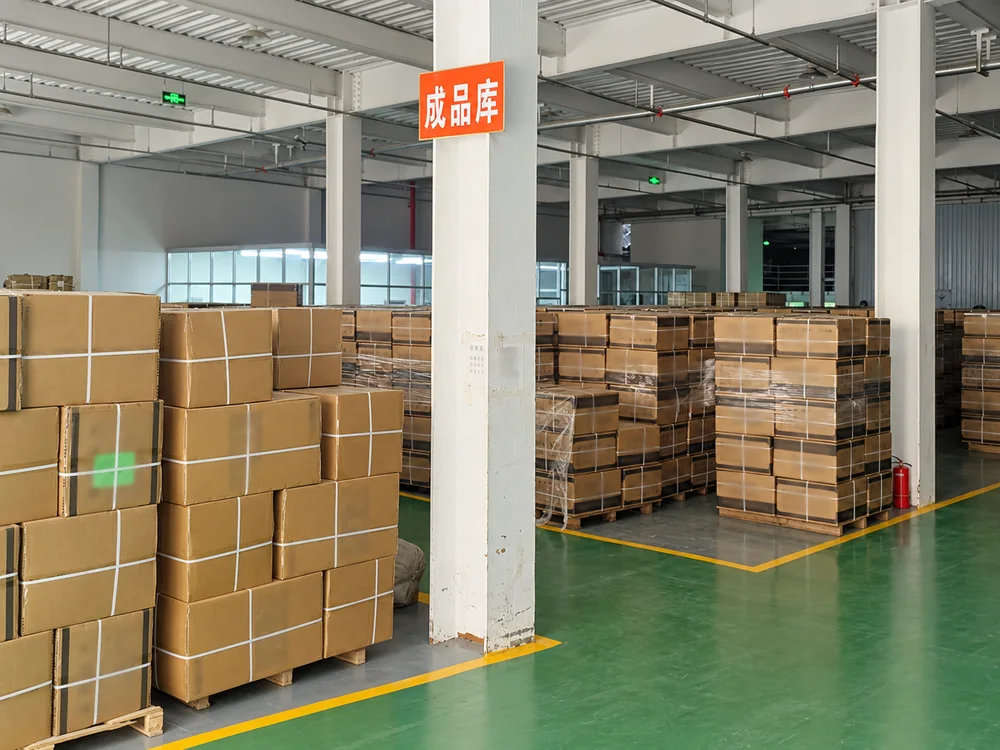
Do not infer available capacity from the number of cartons visible during a visit. Those goods may belong to another product or order. Ask for the current proposal for your quantity and mix. If the required window cannot be supported, compare a different scope or source without turning that scheduling mismatch into a claim that the factory lacks manufacturing capability altogether.
Look for a technical response when production does not match the plan
Manufacturing fit includes the ability to deal with a difference, not merely describe the intended route. Ask how a mismatch in appearance, component identity or assembly is identified and brought to the responsible team. The answer should connect the affected product to a decision about the next work.
JINJIE's quality and testing information describes checks across relevant production stages. For your proposal, discuss the checks that address its actual risks. A control-layout difference needs a different response from a missing printed item. Collecting every available test name does not help if the relevant version remains unclear.
Separate correcting a build error from changing the product. If a unit differs from the agreed configuration, the factory needs to explain the correction. If the proposed solution uses a different component or changes the customer offer, the buyer may need to review a new version. Calling both situations a small adjustment can conceal an important purchasing decision.
Ask how affected material is handled while the issue is being resolved. The question is whether it can remain identifiable and avoid being confused with accepted work. Do not prescribe a particular colored label or storage layout without a reason. A clear, usable method is what matters for the proposed route.
Look for a response that addresses the cause of a recurring difference. Replacing one wrong item can correct that unit, while leaving the identification problem that produced it unchanged. Ask what will prevent the same mismatch in the remaining work. Keep the request tied to the observed issue rather than making unsupported claims about the entire batch.
For a technical question outside your team's competence, use the responsible product specialist or a suitable independent service. Buyers can define the commercial requirement and identify a discrepancy. They should not invent test procedures, bypass protective features or approve a component substitution through appearance alone.
The factory's response also tells you how much coordination your team will need. A clear explanation can support progress even when some work remains. An unanswered question affecting a mandatory requirement should remain open. Decide whether the proposal can move forward on a narrower agreed scope or whether that specific gap prevents selection.
Choose the manufacturing proposal that fits the whole order
Bring the findings back to the order you described. Compare the identified product, relevant manufacturing route, external-input responsibility, version preparation and schedule dependencies. A factory with a broad catalog may be a poor fit for a tightly defined change. Another with fewer suitable options may be able to explain the required work clearly.
Keep price comparisons connected to the included work. If one proposal includes preparation that another leaves to the buyer, the unit prices alone are incomplete. Ask what the difference covers. The aim is to understand the manufacturing offer, not to assign value to unconfirmed claims about automation, factory size or the number of staff.
Identify the decisions still needed before committing. Some gaps only affect an optional finish; others concern a required component or market version. Use that distinction to keep a viable proposal moving without accepting an essential unknown. A missing capacity figure does not automatically disqualify a factory if the actual order schedule can be assessed.
Finish with a selected manufacturing route and the next defined step. That might be a product response, a targeted sample or a preparation discussion for an agreed version. Avoid ending with a larger collection of factory photographs and no decision about the actual order.
Send a manufacturing brief that can be answered
Discuss your food chopper manufacturing requirements with JINJIE. Include the selected product, version split, market, quantity and required timing. State which features must remain and which changes are still being considered. Ask for the relevant production route, preparation work and unresolved decisions so your team can compare a real manufacturing proposal.
FAQ
Must the factory make the bowl and motor itself?
Not necessarily. Ask how those inputs are specified, checked and matched in the finished product. If in-house manufacture of a particular part is an essential requirement for your project, state it and verify that activity. Otherwise, assess the factory's control of the complete offered appliance rather than assuming ownership of every process.
What if my order contains very small quantities of several versions?
Ask for the preparation and quantity conditions for the actual split. Compare fewer versions or a staged introduction where those alternatives preserve the customer offer. Do not assume the total quantity can be divided freely, or accept a simplified version that no longer meets a mandatory requirement.
Does an automated line always make a factory the better choice?
The equipment must be relevant to the proposed product and work. Ask what the line does for your configuration and how its output is checked. Automation alone does not answer questions about matching parts, selected versions or the complete order. Compare the manufacturing result and responsibility, not the visual impression of machinery.
Can I select a factory before every optional change is settled?
Yes, if the confirmed scope meets the core need and the remaining ideas are explicitly outside that commitment. Define which work is authorized and which remains under discussion. If an unresolved change is essential to the product's purpose, obtain the technical answer before treating that proposal as suitable for the order.