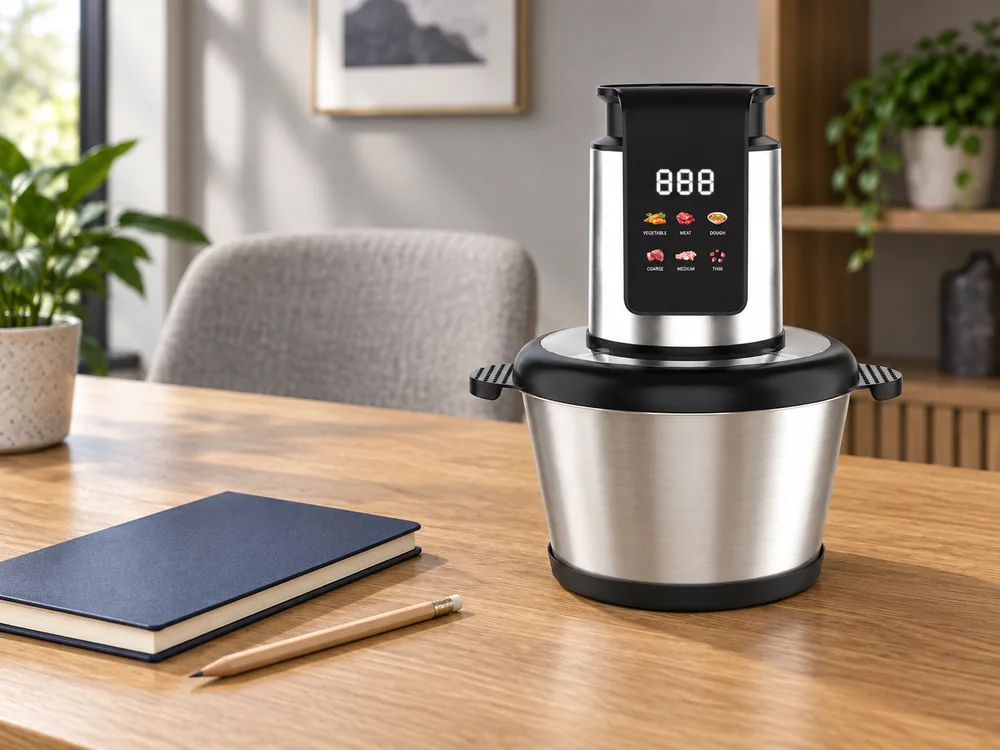
A food chopper supplier needs to do more than send an attractive sample. For a retail business, the harder question is whether the supplier can keep supplying the selected product, explain proposed changes and take responsibility when an order needs attention. Those responsibilities should be clear before the first shipment becomes a permanent listing.
Begin with the complete household electric bowl chopper you intend to sell. Identify the company making the offer, the product version and the support included. Then compare how each supplier would handle a repeat purchase, a delayed item or a reported problem. A useful answer gives your team a next action and someone responsible for it.
This guide concerns the motor-over-bowl household format. Manual vegetable dicers, industrial bowl cutters and screw-fed meat grinders require different product comparisons. The objective here is a workable supply relationship for retailers, importers and private-label buyers, not a ranking of suppliers by catalog size or the lowest advertised price.
Establish what a food chopper supplier is actually offering
Ask for a small selection against your intended product, rather than an unrestricted catalog. State the preferred bowl material and size, the customer's preparation needs and the destination market. Include the quantity you are considering and any branding requirements. The response should identify a complete appliance that the supplier can discuss on those terms.
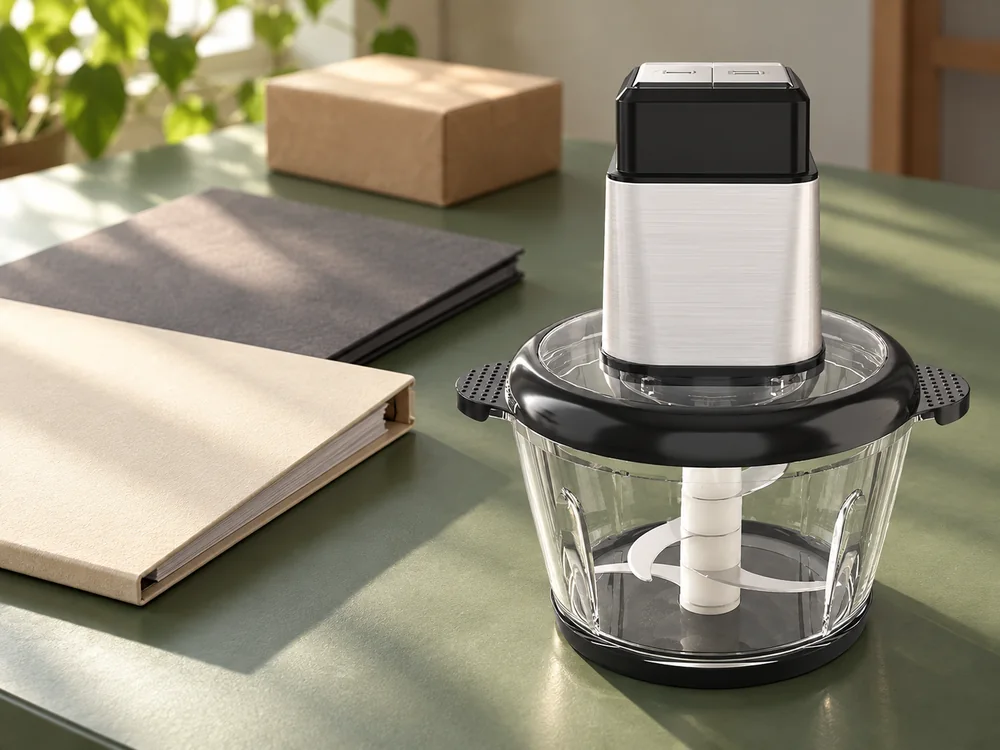
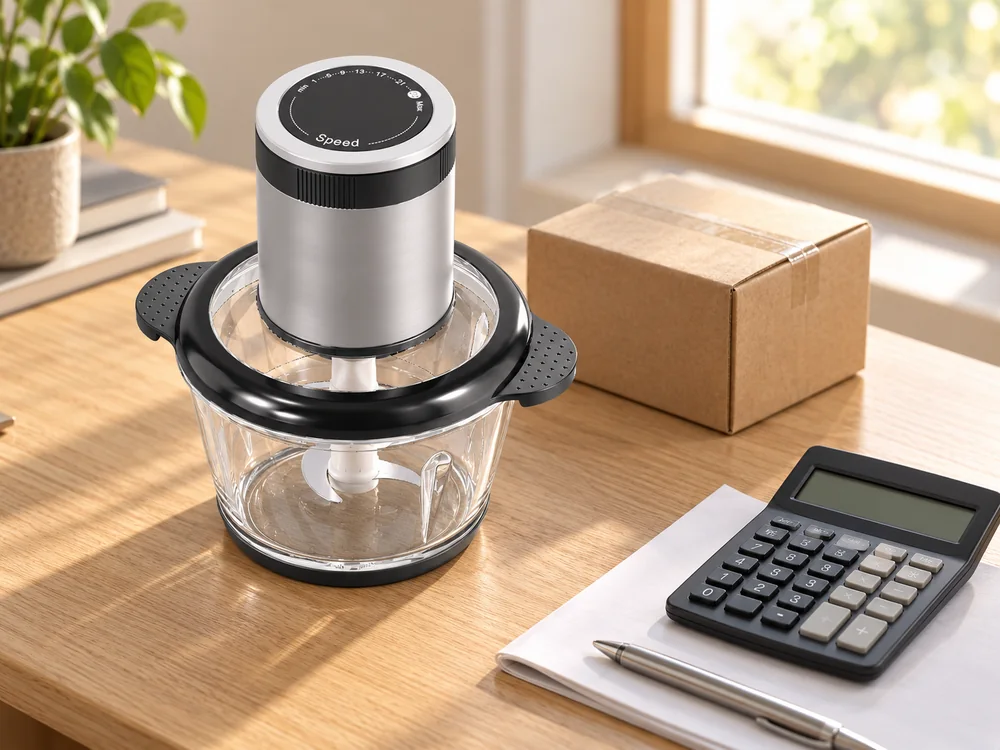
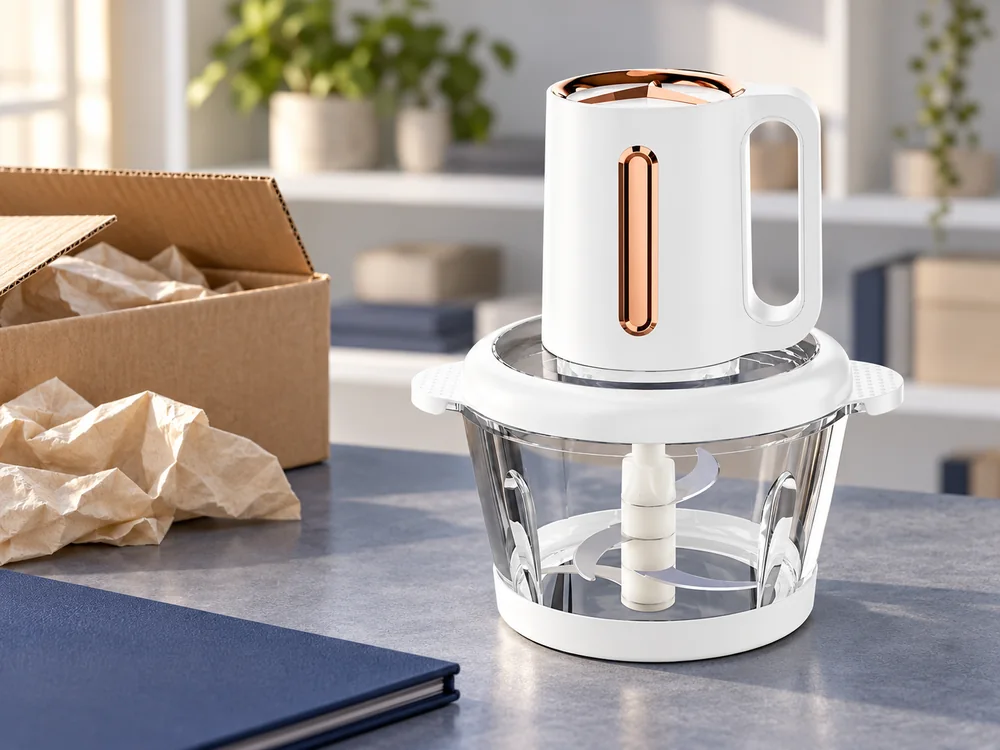
Separate a current proposal from a photograph used to illustrate a possibility. A supplier may show a similar housing while checking the required bowl or control option. That can be useful during an inquiry, provided the difference is explicit. It is not yet the product on which to base a retail description, order quantity or sample comparison.
JINJIE's electric meat chopper range includes different bowl materials, capacities and control formats. Choose a named reference when requesting an offer. For example, the configuration reference lists SD-01 with a 3 L stainless-steel bowl and 500 W, while SD-02 is a 2 L stainless-steel version at 400 W. These are distinct listed combinations.
The model distinction is useful commercially because it stops a supplier response from drifting between versions. It does not establish which appliance performs better for your task. Ask the relevant product questions separately, including permitted ingredients and loading. Nominal capacity and power cannot substitute for the operating information for the selected appliance.
Clarify the supply format. Are you discussing complete branded goods, a private-label version of an existing product, or a product requiring development? An exporter offering finished goods may provide a different service from a factory preparing new artwork and electrical details. Compare the scope you need, without assuming that one business description automatically makes a proposal better.
Do the same for requested extras. A spare bowl, alternative lid or additional blade assembly needs its own availability and compatibility answer. Do not interpret an image showing several parts as a promise that each is sold separately. If separate service items are essential to your business, include them in the supply discussion from the beginning.
End this stage with one identifiable proposal per supplier. Keep unavailable preferences visible, but outside the current offer. That makes the next comparison manageable: which company can supply this product on acceptable terms, and what work remains before the buyer can commit?
Find out who owns each order responsibility
The company answering the inquiry, the manufacturing site and the party issuing the commercial documents may not be described in the same way. Ask the supplier to explain those roles for your proposed transaction. You need a coherent account of who supplies the goods and who coordinates the work, not an assumption based on a factory photograph.
Start with the named commercial contact. Ask who can answer questions about the proposed version, production preparation and a shipment problem. One contact can coordinate all of them, but should be able to obtain answers from the relevant people. Repeatedly forwarding an unresolved question without identifying its owner makes an order difficult to manage.
Use the following responsibility comparison when reviewing proposals. The roles may sit within one business or involve several parties. What matters is that the arrangement is explained for your order and that no important task disappears between them.
|
Order responsibility |
Answer to obtain |
Why the buyer needs it |
|---|---|---|
|
Commercial offer |
Named supplying party and contact for the agreed terms |
Keeps the quotation and later order discussion connected |
|
Product questions |
Person or team able to resolve the selected configuration |
Prevents a sales description from replacing a technical answer |
|
Preparation and delivery updates |
Contact who can explain actual readiness and dependencies |
Allows the buyer to act on a delay or missing approval |
|
Reported order problems |
Agreed route for review, response and remedy discussion |
Avoids a handoff with no one responsible for closing the issue |
|
Repeat supply |
Contact able to identify the earlier product and proposed changes |
Helps preserve a stable retail offer between purchases |
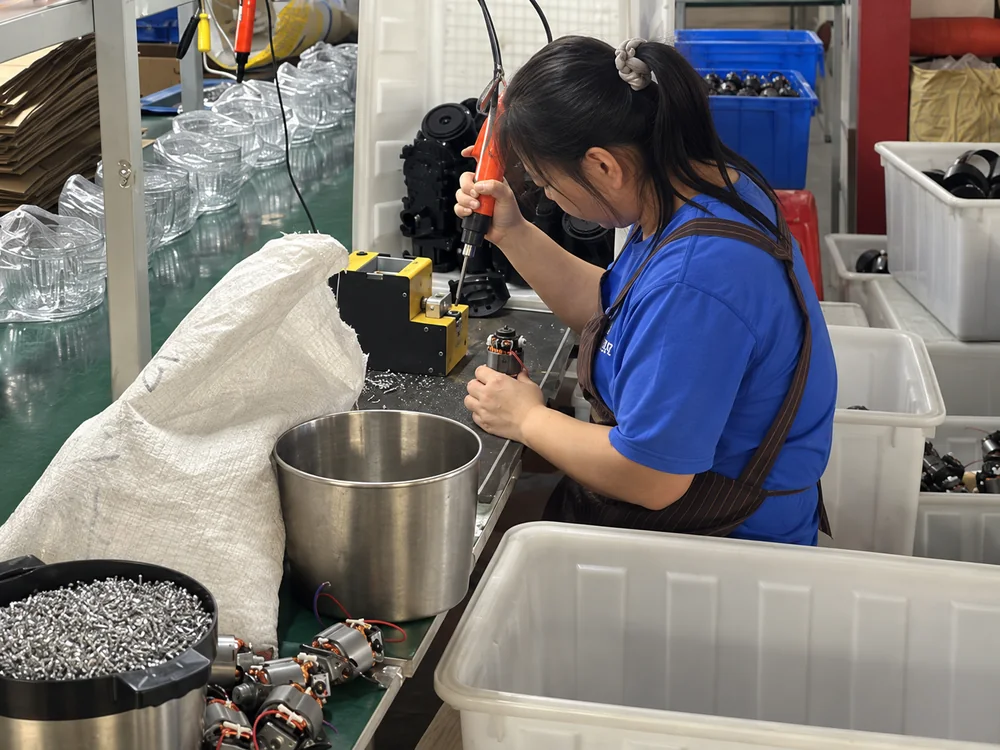
JINJIE's manufacturing information describes preparation, assembly, inspection and packing around agreed product details. Use that route to ask where your order questions will be resolved. A general process description helps locate a responsibility; it does not by itself confirm a production slot, current capacity or the completion of your goods.
Ask how commercial and technical answers are reconciled. If a sales proposal includes a bowl option that needs further checking, who confirms whether it can be supplied and updates the offer? The buyer should not have to decide which of two conflicting replies is authoritative. A corrected proposal is more useful than leaving both versions in circulation.
Check your own communication route as well. Nominate who can approve the buying decision and who can request a technical clarification without changing the order. Multiple members of your team can participate, but contradictory instructions create avoidable uncertainty. A supplier relationship works better when both sides know which answer represents the agreed position.
Define the delivery service being offered. Ask which movement of the goods is included, where your own logistics provider takes over and who supplies the information needed for that handover. A complete-product quotation and a delivered-stock proposal can leave different work with the buyer. Compare the stated scope rather than assuming that the word delivery includes every stage to your warehouse.
If your forwarder is arranging collection, identify the contact for readiness updates and carton information. If the supplier is proposing transport, ask what the estimate includes and which details could change it. This is also useful when an order is split: each party needs to know which goods and documents belong to each movement. Resolve the arrangement before either side treats an expected shipment as booked.
Do not confuse a fast initial response with complete order support. Speed matters when a deadline is approaching, but the response must resolve the actual question. An honest answer identifying the outstanding work gives you something to plan around. A reassuring message with no product reference or next action leaves the same uncertainty in place.
Keep the repeat product identifiable without freezing every detail forever
An established retail listing creates expectations. Customers see a particular bowl, controls, supplied contents and product description. When placing another order, the buyer needs to know whether the supplier is offering that version again or proposing something different. A repeated model name is a starting point, not the entire answer.
Retain the selected product reference and the agreed complete configuration with the order. For a bowl chopper, that includes its matching motor unit, bowl, lid and blade assembly, together with the electrical and packed version. The purpose is to make the next purchase unambiguous. It is not to collect every possible document regardless of relevance.
Ask the supplier how a proposed substitution will reach you. A different finish may affect photography and customer expectations. A changed component can require a technical response. A packaging revision may affect a retailer's receiving process. The response should identify the change and the part of your business that needs to consider it.
Avoid demanding that nothing ever changes. Components and available options can change over time, and a request for permanent availability may be unrealistic. The practical requirement is advance communication and a decision on the affected offer before it is supplied. A change can be acceptable when its implications are understood and the resulting product remains suitable.
For an existing platform with your branding, JINJIE's OEM and ODM options cover matters such as finish, electrical version, instructions and packaging. Keep those buyer-specific choices connected to the product reference. Otherwise the supplier may correctly identify the appliance while overlooking which retail presentation your order requires.
Do not treat a substitute as equivalent because it fits the same price point. Ask whether the customer-facing purpose, supplied items and permitted use remain appropriate. If it is a genuinely different product, introduce it as such in the range rather than silently using it to fill an old listing. The supplier's proposal and the buyer's selling decision are separate responsibilities.
Keep the process proportionate on unchanged reorders. Repeating the entire first-sample discussion wastes time when the relevant details remain the same. Confirm the earlier reference, current offer and any differences. Spend additional review effort on what has changed or what the first order revealed, rather than recreating the original project.
Compare replenishment terms against your sales pattern
A first order can be feasible while its likely replenishment pattern is not. Ask for the terms under which you would buy the same configuration again, including any quantity conditions for color, packaging or the selected version. Do not assume that an opening-order arrangement automatically applies to every later purchase.
Describe the pattern your business expects. A regular retail line may need periodic replenishment, while a promotion may end after a defined allocation. These are different supply requirements. Give the supplier your current estimate without presenting it as a firm order, and ask which elements would need reconfirmation when the next purchase is placed.
Discuss what must be ready before timing can be confirmed. Product decisions, printed materials and requested changes can affect preparation. Ask for an order-specific schedule once the proposal is defined. A date quoted for another buyer's appliance or an uncustomized version is not a reliable basis for your own launch commitment.
Consider whether a mixed order helps or complicates replenishment. Two bowl versions may sell at different rates. If they require separate quantity commitments, an attractive total opening quantity can leave you with a difficult second order. Compare the actual conditions for the slower-moving version rather than assuming it can always be included in small numbers.
Account for buyer-specific packaging that may remain between orders. Ask whether extra printed material is part of the proposal, who owns it and what happens if the artwork changes. Do not assume that a supplier will hold material indefinitely or that unused packaging has no cost. The agreed handling should fit the forecast's level of certainty.
Keep a researched alternative separate from an interchangeable backup. A second supplier may offer a suitable chopper, but that does not make its bowls, blades or finished units replacements for the original version. If continuity requires an alternative source, assess the complete alternative product and the work needed to introduce it to customers.
Revisit the supply arrangement when actual demand differs from the forecast. A slower start may call for a later reorder or fewer options, not a cheaper component. A stronger response may justify discussing a larger repeat purchase, but should not be described internally as confirmed capacity until the supplier has answered the actual proposal.

Agree a workable response when an order has a problem
Order problems need different responses depending on what has happened. A short shipment, the wrong printed box and a reported operating fault are not the same issue. Agree how to report them, what information helps the supplier investigate and who will coordinate the answer. Keep the procedure simple enough for the people receiving goods to use.
The buyer's first task is to identify the affected order and product. Useful information might include the model, carton reference, quantity affected and clear photographs of the visible issue. For an operating concern, follow the agreed reporting route and leave technical testing to competent personnel. Do not ask warehouse staff to improvise unsafe demonstrations.
The following examples show how the discussion changes with the problem. They are planning situations, not JINJIE warranty terms or reports of actual defects.
|
Reported situation |
Immediate buying question |
Arrangement to discuss |
|---|---|---|
|
Quantity received differs from the order |
Which shipment and items are affected? |
Reconciliation, response owner and the agreed commercial remedy |
|
Retail presentation differs |
Can the affected stock serve the intended channel? |
Review of the difference and a workable correction route |
|
A matched assembly is damaged |
Is a confirmed replacement obtainable? |
Assembly supply or another explicitly agreed response |
|
An operating issue is reported |
Which version and conditions require investigation? |
Product review, communication and handling of affected stock |
|
A replacement version is proposed |
Does it still meet the retail commitment? |
Buyer review before accepting it as a substitute |
Discuss the customer response separately from settlement between businesses. The retailer may need an answer before the supplier's investigation is complete. Decide who communicates with that customer and what can responsibly be said. A future credit does not by itself resolve the buyer's immediate need to manage returned or unavailable stock.
Check the practical cost of a proposed remedy. Sending one loose assembly can involve identification, packing and transport. Replacing a whole unit has different stock consequences. Ask which route is available and appropriate for the case instead of assuming that the lowest component price produces the simplest outcome.
Keep issue records factual. Describe what was received or reported, the affected reference and the response agreed. Do not turn one unclear report into a claim that an entire batch has the same fault. Equally, do not close a recurring concern merely because an individual customer received a replacement. The purchasing team needs enough detail to decide what should change.
Use the first order to judge the relationship
The first order gives evidence about how the supplier works with your business. Review whether the selected offer stayed identifiable, whether updates explained the real situation and whether open questions reached the right people. These observations are more useful for a repeat decision than a general impression of friendly communication.
Separate a correctable delay from a persistent failure of responsibility. If an artwork decision on your side held up preparation, record that honestly. If the supplier could not identify who would resolve a product question, record that too. A balanced review helps both sides improve the next order and prevents the same disagreement from returning.
Decide what has to improve before placing the next purchase. A clearer update contact may be enough for one issue. A configuration change may need product work. A mandatory requirement that remains unanswered can prevent a reorder. State the action and its effect on the next decision instead of assigning an unexplained overall score.
Retain useful parts of the relationship even when the range changes. A supplier may no longer suit one product but remain relevant to another confirmed offer. Conversely, a good experience on one appliance does not approve every item in the catalog. Continue to connect the supply decision to the actual product and commercial requirement.
Discuss the supply arrangement behind your next order
Send JINJIE your food chopper sourcing requirements with the preferred model, target market, opening quantity and expected repeat-order pattern. Include the support arrangement your channel needs. Ask for a complete proposal and a clear route for product questions, order updates and reported issues before deciding whether the offer fits your business.
FAQ
Should a trading supplier be rejected because it does not own the factory?
Not on that fact alone. Establish its supply role, access to product answers and responsibility for the offer. Compare those services with your requirements. If direct manufacturing involvement is essential to the project, make that condition explicit rather than relying on a company label to establish it.
What if the sales contact changes between orders?
Send the agreed product and previous order reference to the new contact and confirm who now owns open actions. Check that the current proposal matches your intended repeat purchase. The handover should preserve the product and commercial context without requiring your team to reconstruct it from scattered messages.
Can I promise my retailer permanent availability of the same chopper?
Do not make that promise from an initial quotation. Discuss the supply period your retailer needs and the notice or alternative arrangements the supplier can actually offer. Keep the retailer's commitment within that confirmed scope, and revisit it when the product or commercial arrangement changes.
When should an alternative supplier move beyond the research stage?
When the unresolved supply risk justifies the cost of evaluating a complete alternative. Identify the product, customer impact and work needed to introduce it. A second catalog contact is not an operational backup until its actual offer has been assessed against the requirement you need to protect.