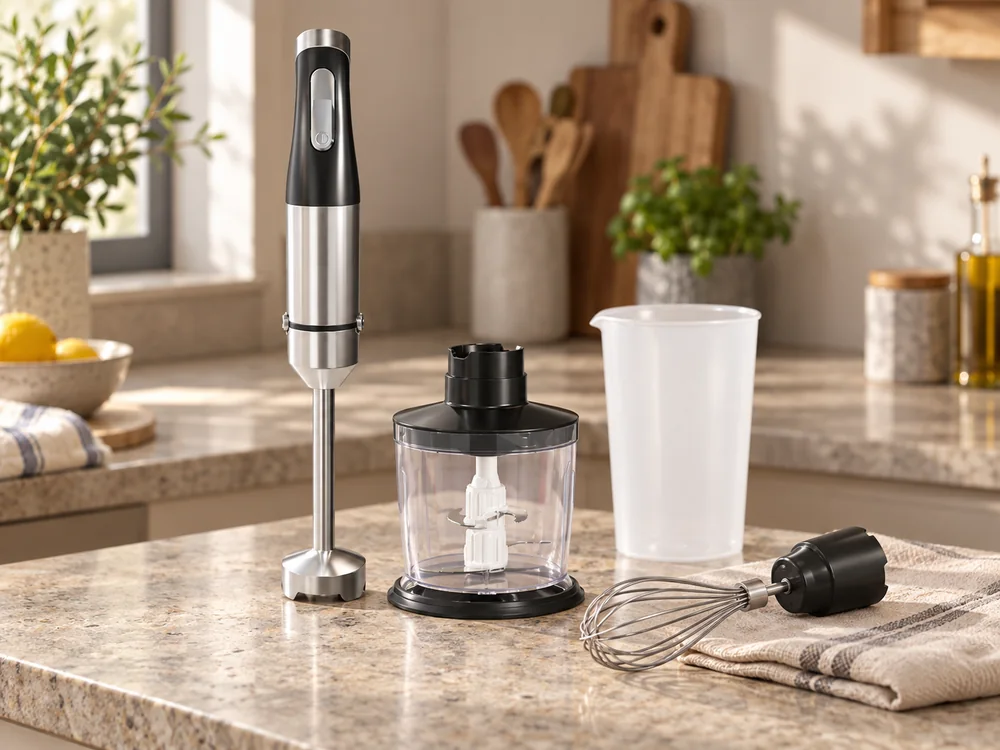
A standalone hand blender and a fuller accessory set can serve different retail customers. For immersion blender wholesale purchasing, choose the customer and the complete offer first. Then decide whether the additional tasks, packed cost and service responsibilities justify stocking the set, the standalone version or both.
The decision goes beyond counting accessories. In JINJIE's configuration reference, HB1361 appears as a 300 W standalone entry and a separate 400 W four-in-one entry with a 0.8 L capacity field. The set cannot be priced as though it were necessarily the identical motor with a few loose parts added.
This article concerns household products for resale through retailers, distributors and private-label brands. It does not cover long-shaft commercial immersion equipment or establish a standalone parts-wholesale service. Its purpose is to help buyers choose a retail offer they can explain, purchase and support, using actual configuration distinctions rather than the largest function count.
Choose the customer before the accessory package
Start with the job the customer wants the hand blender to do. Someone seeking a straightforward blending tool may already own other kitchen equipment. A buyer putting together a broader household preparation set may value compatible whisking and chopping attachments. The fuller package earns its place when those additional supported tasks matter to that customer.
Avoid assuming that a first-time household buyer always needs the largest set or that a price-sensitive customer always prefers the bare unit. Those are hypotheses to test with the sales channel. Ask the retailer which customer question the proposed package answers and what competing equipment the customer is likely to own.
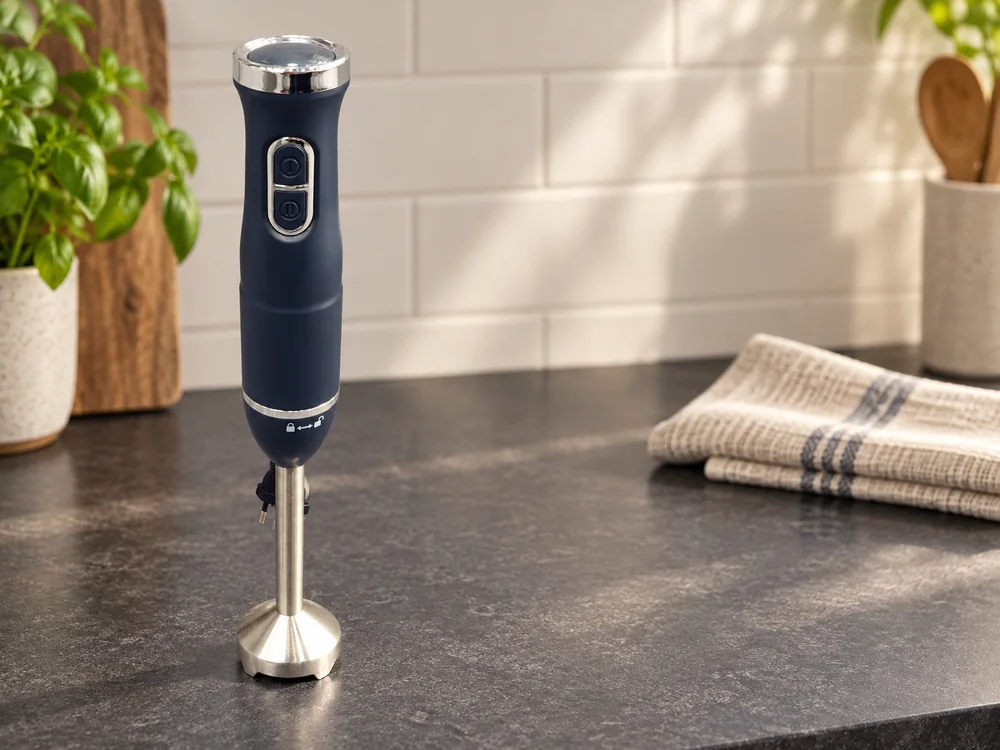
For a standalone offer, the retail explanation should remain complete without referring to accessories that are absent. Show the actual supplied hand blender and its supported use. A main photograph dominated by a whisk and chopping bowl will create the wrong expectation if the box contains only the standalone configuration.
For a set, identify the additional customer tasks before discussing a promotional function badge. The package should offer a coherent reason to buy the components together. If an attachment is included only because the picture looks sparse without it, revisit the bundle. The customer still has to store, identify and use what arrives.
JINJIE's immersion blender range includes standalone products and multi-piece sets with matched attachments. Use those actual options to frame the inquiry. Ask for the closest available configuration rather than designing an unsupported combination from several attractive catalog photographs.
The buyer's intended applications also define the limits of the comparison. Establish the permitted ingredients, vessels and operating method for the proposed model. Do not infer hot-liquid use, heavy mixtures or prolonged operation from the general term hand blender. A retail proposition depending on one of those applications needs an answer for that appliance before it can be selected.
Consider where the product will be stored. A compact motor does not describe the space occupied by a complete set. The relevant question is whether the customer has a practical place for the supplied assemblies and can retrieve the one needed. Judge that on an actual set or reliable dimensions, not a photograph scaled to fit a square tile.
Compare the complete versions on the quotation
Two lines bearing HB1361 illustrate why the exact offer matters. The standalone entry records 300 W and stainless steel in the material field. The four-in-one entry records 400 W, stainless steel plus PET and a 0.8 L capacity field. Keep those as distinct proposals when asking for prices and samples.
The power difference does not establish a performance advantage by itself. Nor does the repeated model code establish that both versions use identical motors, controls or supported operating conditions. The supplier should identify the offered version and its supplied assemblies. Purchasing can then compare the customer value of each complete product.
The 0.8 L entry belongs to a container in the set. It is not a capacity rating for the handheld motor or every attachment. Have that container identified before the figure appears on the retail page. A correct number attached to the wrong object can still misdescribe the product.
Ask for both proposals on the same destination-market basis. Voltage, frequency and plug should match the intended purchase. If one offer requires a different electrical version, keep the resulting work visible. Comparing a ready reference with an unresolved market version can make the apparent price difference difficult to interpret.
JINJIE's OEM and ODM scope provides a route for discussing branding, instructions and packaging around the selected product. Keep those requests separate from changes to the motor unit or attachment connection. A retail finish choice and a structural change do not carry the same preparation questions.
Never calculate a standalone price by subtracting assumed accessory values from a set price. The actual offer may use a different base configuration, different packing or different quantity conditions. Request the standalone quotation. Likewise, adding a catalog whisk price to a motor price does not establish a complete, compatible retail-set offer.
For commercial comparison, make the product difference explicit before comparing the totals. State what the customer receives, which version supports the price and what remains optional. You do not need a long technical report at this point, but the selected proposal must be identifiable enough that the supplier and retail team mean the same product.
Give each price tier a reason to exist
A second SKU should answer a customer need that the first one leaves open. It might offer additional supported preparation tasks within a coordinated set. The price step should pay for value the customer expects to use, rather than merely create a fuller photograph beside an entry product.
The following comparison helps decide which format belongs in the range. It describes possible retail roles, not a prescribed JINJIE assortment or a forecast of sales.
|
Proposed offer |
Customer reason to consider it |
Commercial trade-off |
|---|---|---|
|
Standalone configuration |
Wants the core blending tool without a broader accessory package |
A focused explanation, with the actual standalone version and packing priced separately |
|
Confirmed multi-piece set |
Wants the additional supported tasks from matched attachments |
More included assemblies to explain, pack and support |
|
Standalone and set together |
Serves distinct customer requirements within one channel |
Separate stock commitments need a credible reason for both versions |
|
Set for a defined promotion |
A temporary offer has a clear customer and campaign purpose |
Residual stock and future support still need an agreed route |
Check the price step against the customer's next alternative. If the set duplicates equipment already included in another product sold to the same audience, the extra attachments may add little to the range. If it provides a useful combination the customer would otherwise buy separately, the bundle has a clearer role. Use the channel's actual assortment to make that judgment.
Avoid calling every fuller set premium. More parts increase the scope of the offer, but they do not automatically improve the motor, finish or each task's result. Describe the specific benefit that has been established. A customer should be able to choose between the versions without believing that the simpler one is defective or incomplete.
Product presentation can test whether the distinction works. Draft a short description and choose the actual product image for each proposed SKU. Ask whether a colleague can identify who should buy it and what is included. If the two pages would differ mainly in the accessory count badge, reconsider the price-tier explanation before committing to both.
For a store display, decide whether the accessories need to be shown alongside the main unit and how their purpose will be explained. For online retail, use clear views of the real assemblies and avoid repeating the motor unit in a way that suggests several appliances are included. The selected image should support the offer without requiring a footnote to reverse its main message.
Packaging and instructions contribute to the price step as well. A set that takes more explanation may need a clearer first-use presentation. That is a buying responsibility, not a reason to make unsupported ease-of-use claims. Ask for the proposed complete presentation and review whether it fits the customer, including any language requirements.
Select an immersion blender wholesale combination your channel can carry
Once each retail role is clear, ask for quantity conditions for the proposed standalone and set versions. Establish whether minimums apply separately to the model, configuration, color or printed packaging. A total inquiry quantity does not tell you how the supplier will divide those commitments.
JINJIE states that order minimums depend on the standalone or set format and customization requirements. Obtain the conditions for your actual proposal. If a split assortment exceeds what your business can carry, consider one available version first rather than assuming the factory can divide the same minimum across every requested option.
Choose opening quantities from the channel's ability to sell each offer. Keep confirmed retailer allocations separate from an internal forecast. An equal split can be convenient on paper while having no connection to demand. A wider set is not automatically the one that deserves the larger share simply because its unit value is higher.
Ask whether a staged introduction is commercially workable. The first order can establish one retail position while a later proposal addresses another customer group. Confirm the later offer when it is needed rather than treating an early discussion as a reserved price or production slot. Staging limits the initial assortment, but it does not guarantee future availability.
Include the packed offer in the buying comparison. An attachment's price alone does not describe its effect on protective materials, outer-carton arrangement or delivery estimates. Obtain packing information for the selected configuration. Do not assume that removing one attachment reduces the carton or that every fuller set must require a larger one.
Consider a channel-specific box carefully. If the same appliance is proposed for several retailers, a broadly usable presentation may reduce the amount of stock tied to one account, provided it meets each channel's requirements. A retailer-specific pack can still be worthwhile when the commitment and ownership of unused materials are understood.
For a promotion, state the end of the campaign and the intended treatment of remaining stock. A temporary package may need a different replenishment decision from a regular line. Confirm whether the offer will remain available, be replaced with another identified version or end after the agreed order. Avoid leaving the sales team to infer that from the photograph.
Have the buying team state what it will change if the opening proposal is too large. Fewer optional colors, one retail format or a later second launch may preserve the core customer offer. Removing a required assembly to achieve an arbitrary price can undermine it. Request a revised complete proposal for the chosen alternative.
Agree how the set will be supported after sale
A customer missing one attachment has a different problem from a customer reporting a fault in the motor unit. Before ordering, decide who receives those reports and which response the parties can actually provide. A fuller set increases the number of items that may need identifying, even when it is the correct choice for the customer.
Possible arrangements include supplying an agreed replacement assembly, replacing the complete retail unit or settling an issue through an agreed credit process. These are options to negotiate. They are not default JINJIE terms or evidence that every accessory is sold separately.
Use the comparison below to discuss the practical response. Select the arrangement from the supplier's confirmed offer and your own service resources.
|
Possible response |
What needs agreement |
Purchasing consequence |
|---|---|---|
|
Replace a confirmed assembly |
Availability, exact version, handling and delivery basis |
Can preserve the rest of the set when the matching item is obtainable |
|
Replace the complete set |
When this applies and who carries the cost |
Requires a workable supply of replacement retail units |
|
Hold agreed service items locally |
Item identity, quantity, storage and compatibility |
Commits cash and warehouse effort beyond saleable stock |
|
Use an agreed credit route |
Evidence, review responsibility and settlement process |
Resolves supplier-side accounting but still leaves the buyer's customer response to manage |
The least expensive loose component is not necessarily the least expensive remedy. Identification, separate packing and delivery can change the cost. A whole-set replacement may be easier operationally, but it uses a complete unit and may leave the buyer handling the returned product. Compare the response your team can carry out, not only the part price.
JINJIE's quality and testing information can support discussion of completeness and relevant product checks. Those checks address what is supplied. After-sales handling requires a separate agreement on what happens when a problem is reported, including who assesses the information and who communicates the answer to the customer.
If standalone accessory supply is unconfirmed, the entire wholesale discussion need not stop. Keep that service promise out of the retail offer and ask which alternative arrangement is available. Stop the purchase only when the unresolved support requirement is mandatory for your channel and no acceptable response has been agreed.
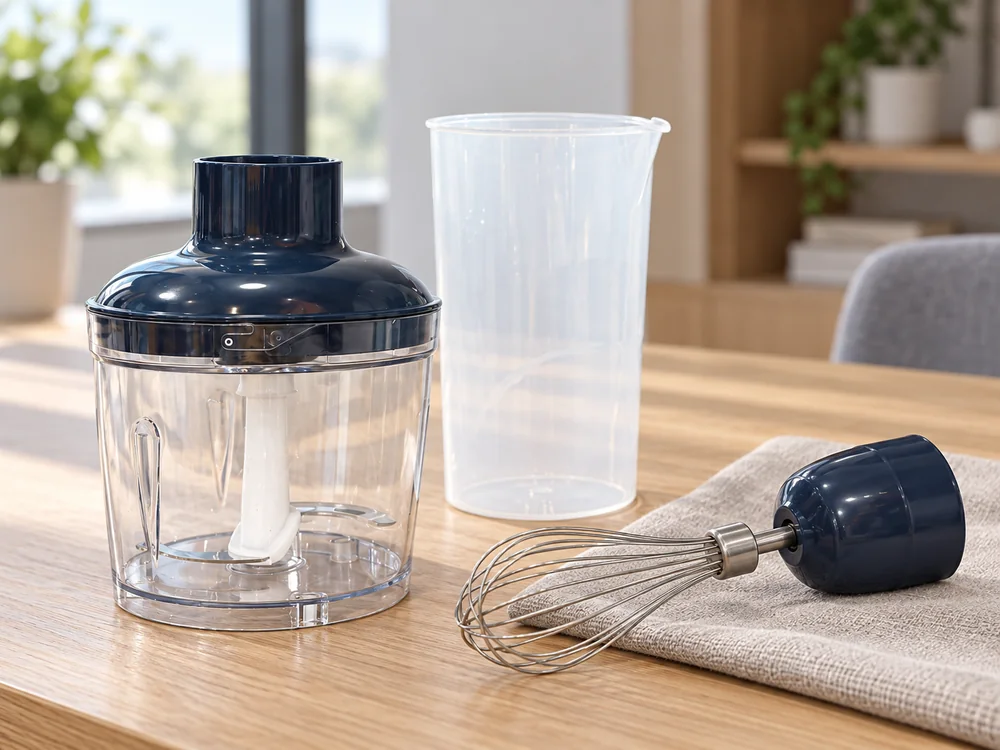
The customer-facing model and set description should be useful to support staff. Retain the exact configuration purchased so an inquiry about a beaker or lid can be tied to the right version. Do not advise a customer to buy a similar-looking accessory from another platform. Availability and compatibility must both be established.
Separate operational responsibility from the cost settlement. The supplier may investigate an issue while the buyer handles its customer. Agree how information will be exchanged without making the customer repeat the entire story to several parties. A commercial remedy that cannot be explained or carried out is a weak basis for launching the range.
Commit to the selected offer and its next purchase
Close the buying decision with one identified offer for each selected retail role. Record the complete version, agreed presentation and commercial conditions. Keep unselected alternatives outside the current order, even if they remain attractive options for a future extension.
Before accepting a later change, ask whether the retail reason for buying still holds. A different attachment, control version or packed presentation can alter what the customer expects. The question is not simply whether the new item has a similar name. It is whether the selected offer still answers the same customer need on acceptable terms.
For a reorder, review actual channel feedback by topic. A request for fewer included items points toward the range decision. Confusion about a supplied adapter may point toward instructions or presentation. A reported operating issue belongs with the responsible product review. These different responses should not all be treated as a reason to add more accessories.
Use that feedback to decide whether to repeat the offer, adjust it or introduce another version. Keep changes proportionate. If the existing product is working for the channel, a new catalog photograph alone is not a reason to replace it. If the original price-tier distinction never became clear to customers, expanding the range may make the problem larger.
Request the standalone and set proposals you need
Send JINJIE your immersion blender wholesale requirements with the intended customer, preferred format, target market and estimated quantity. Ask for the actual standalone or set version, complete commercial offer and available support arrangement. This gives the supplier a purchasing decision to answer rather than an open request for the largest accessory package.
FAQ
Can I split a complete set to sell a cheaper standalone unit?
Do not assume the resulting product is the quoted standalone offer. Its version, instructions and packaging may differ. Ask for a separately defined standalone proposal and review the effect on your customer description. Dividing an existing set also leaves the remaining assemblies and their intended handling to resolve.
How should I compare prices when one model name covers two power entries?
Request identified offers for each complete version. Keep the recorded power, electrical specification and supplied format visible beside the price. Ask what differs in the proposed appliances before attributing the whole price gap to accessories. A shared model name does not supply that explanation.
Can the first order proceed before separate accessory supply is confirmed?
Yes, if your channel can work with another explicitly agreed support arrangement. Keep separate accessory availability unpromised. If your business requires that service to launch the set, settle it first or select a different supported offer. The decision depends on your actual customer commitment.
Should a promotional gift set become a permanent SKU?
Only when there is a continuing customer reason and a workable repeat-order proposal. Review the campaign's actual response, remaining stock and support needs. A package that suits a short promotion does not automatically deserve permanent shelf space. Decide its future deliberately rather than allowing a temporary offer to become a standing promise.