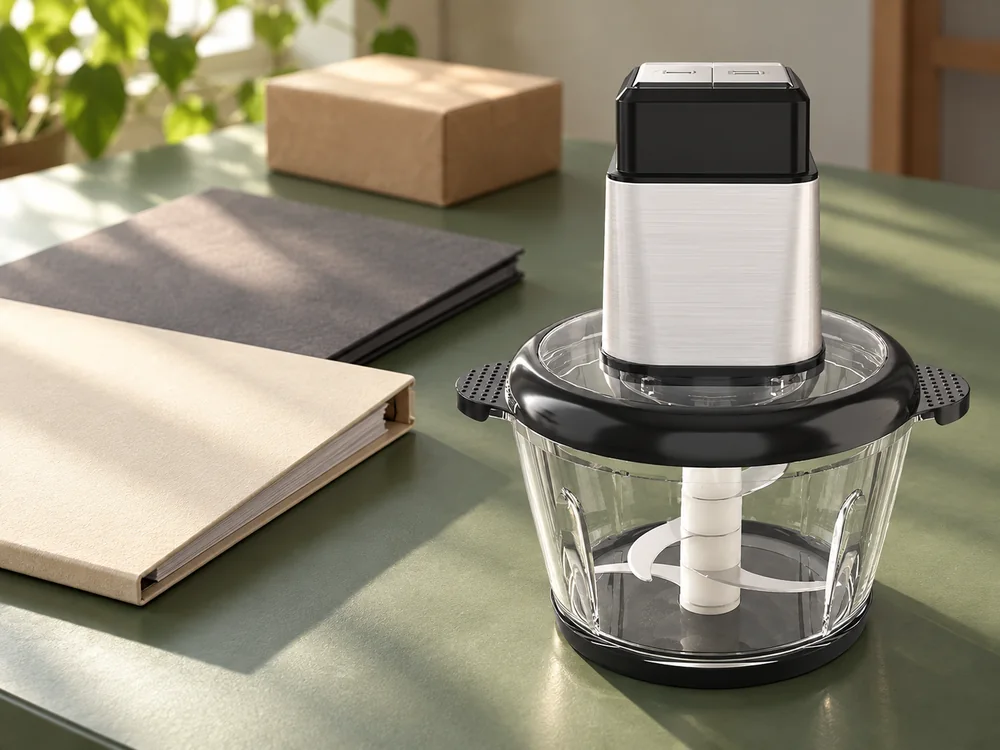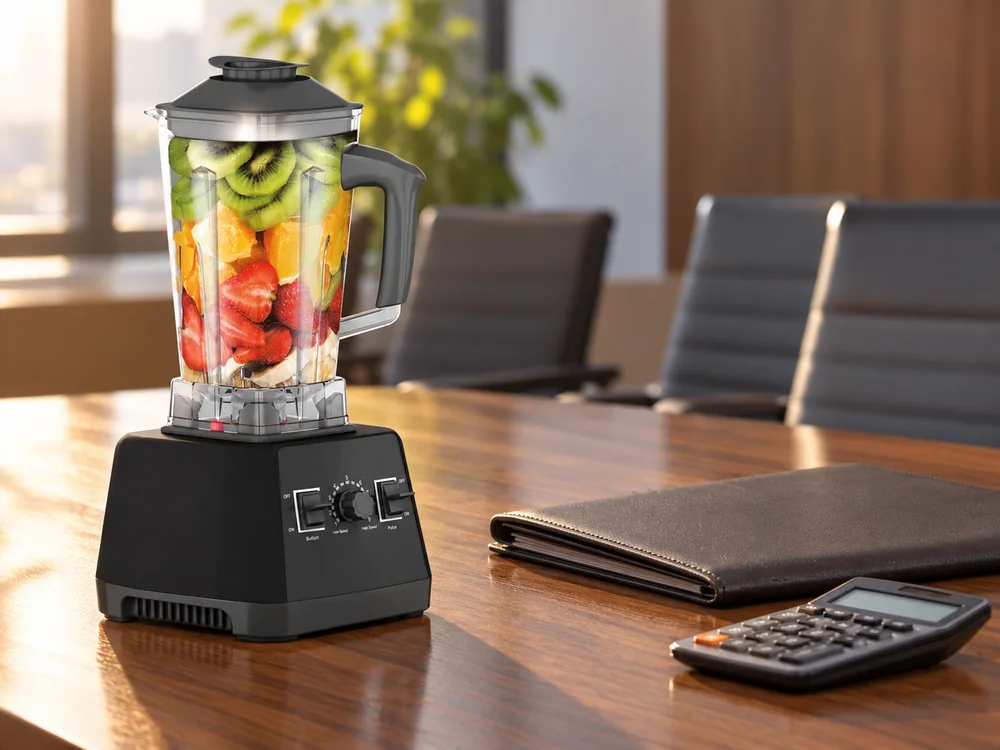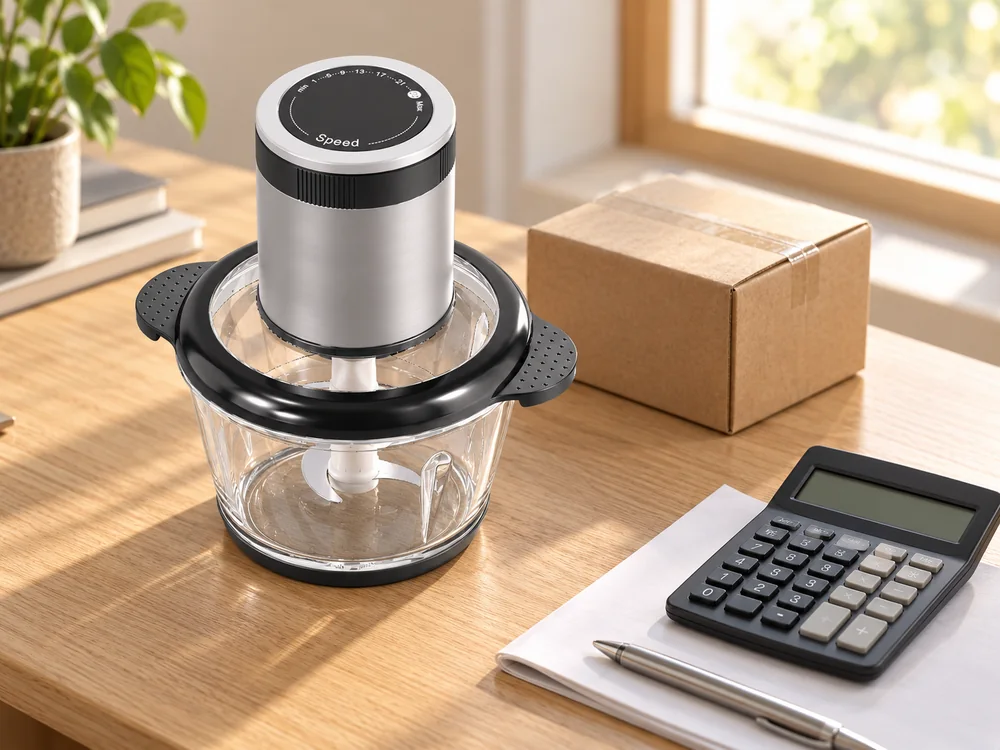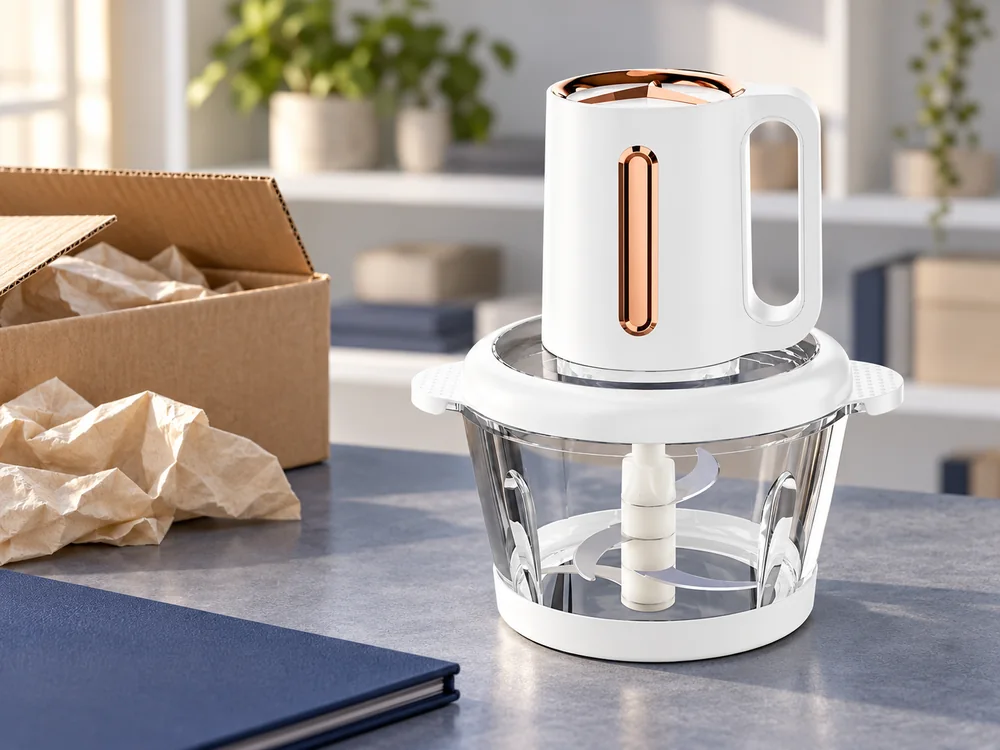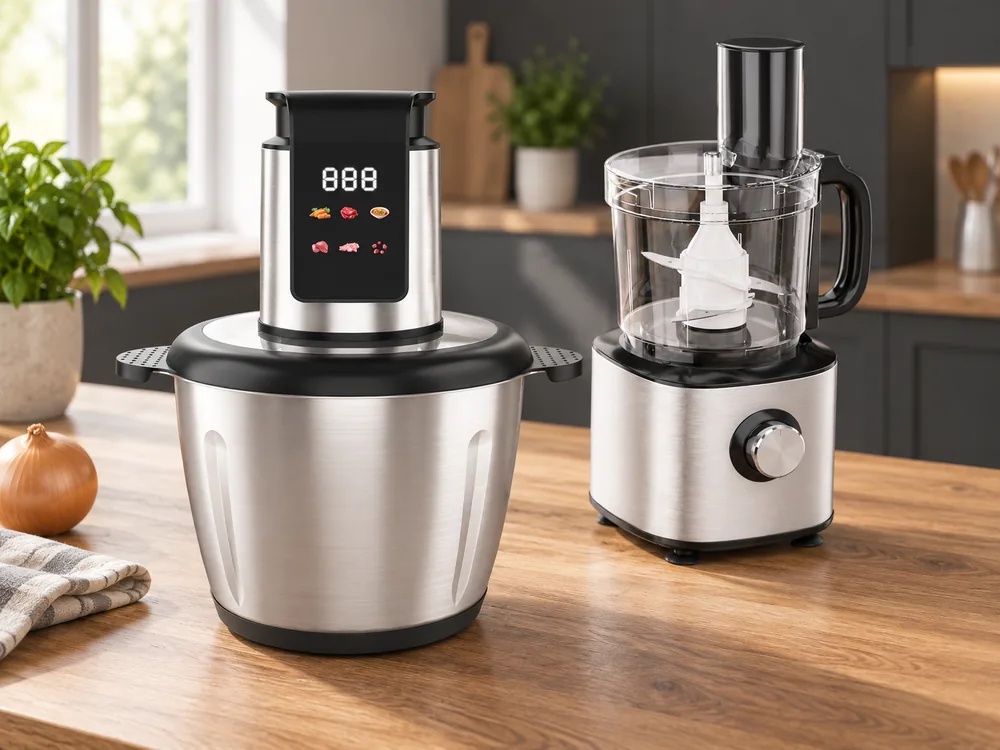
A bowl-style food chopper is a sensible starting point when customers mainly need chopped ingredients. A food processor becomes more relevant when the offer depends on additional preparation tasks and the tools needed to perform them. For an importer comparing food chopper vs food processor options, the useful question is what customers will actually get in the box and do with it at home.
The names alone leave room for confusion. A large chopping bowl can hold more than a smaller processor bowl. A multifunction base may accept a chopping bowl, blender jar and grinder container, while a basic package contains fewer of those items. Neither bowl size nor the number of functions in a headline tells you whether two quotations cover equivalent products.
This comparison focuses on household electric appliances for retail and private-label purchasing. It explains the differences in working mechanisms, how to compare the tasks that matter, and how to turn that comparison into a complete offer. Industrial processing equipment and screw-feed meat grinders require a different assessment.
Start with the working mechanism
A bowl-style chopper cuts ingredients with a rotating knife inside its bowl. The user loads a batch, fits the required components and operates the machine according to its instructions. The result depends on the ingredient, starting pieces, loading and operation. Chopping an onion into smaller pieces is a different task from producing slices of a specified thickness.
A processor equipped with a feed tube and suitable cutting discs can address slicing or shredding through that assembly. Some processors also use an in-bowl knife for chopping. Dicing, dough preparation and other functions depend on the particular model and attachments. Treat these as separate capabilities when comparing products, even if the retailer groups them under one category name.
There are also multifunction configurations that cross familiar category boundaries. JINJIE's MFP-01 product materials show a processor-bowl assembly, a separate blender jar and a small grinder container using a shared motor base. The quotation lists the model at 2.5 L and 1000 W, with separate chopping and blender knife descriptions. That is a configuration to examine, not a reason to assume that every advertised function uses the same container or comes in every quotation.
Ask the supplier to connect each proposed task to the assembly that performs it. A useful reply identifies the container, fitted tool and required lid or feed components together. “Seven functions” without that connection leaves the buyer unable to tell which parts are essential and which are optional.
Use the following distinctions to narrow the comparison before ordering samples.
|
Required result |
Mechanism to investigate |
What the buying decision depends on |
|---|---|---|
|
Chopped ingredients |
A bowl and its matching rotating knife |
The permitted ingredient, practical batch and acceptable texture |
|
Slices or shreds |
A feed arrangement with the corresponding cutting tool |
The actual tool supplied and the cut it produces |
|
A blended drink |
A suitable blending assembly |
The included jar, permitted recipe and usable liquid quantity |
|
An additional specialist task |
The model-specific attachment and instructions |
Whether the function justifies another component in the retail set |
This prevents an expensive category mistake. If slicing is essential, compare the relevant cutting assemblies first. A bigger chopper or a higher wattage does not answer that requirement. If customers mainly need chopped ingredients, a broad multifunction package may add storage and explanation without solving another frequent task.
Compare food chopper vs food processor by finished task
Write the required output in terms a customer would recognize. “Vegetable preparation” is too broad. Chopped onion for a filling, carrot slices for a salad and a blended vegetable mixture call for different results. A supplier can demonstrate an attractive outcome that still misses the reason the buyer chose the product.
Give each proposed task a place in the offer. Some tasks are essential to the main product promise. Others are occasional benefits that make sense only if the necessary attachment is included at an acceptable cost. A feature that requires customers to buy a separate tool belongs in the optional-accessory explanation, not among the capabilities of the base package.
When both machines can perform a chopping task, compare usable output. Look at the whole batch rather than selected pieces placed at the front of a photograph. Record any material left in the bowl, oversized pieces needing another pass and unwanted fine material. The acceptable balance depends on the intended recipe. A coarse filling and a smooth mixture should not share one unexplained pass criterion.
Preparation effort belongs in the comparison too. If one machine requires more trimming or smaller starting pieces, include that work in the observed routine. A short motor run can look efficient while hiding time spent preparing ingredients. Conversely, a machine that takes longer to operate may require fewer interruptions for the particular task. Record what happens instead of assigning a speed advantage from the product name.
Do not make both samples perform an unsuitable task merely to create a head-to-head result. If an assembly is not intended for slicing, mark slicing outside its proposed scope and compare its chopping performance separately. That is useful information for the retail offer, rather than a failed test to conceal or a reason to improvise an attachment.
At the end of this stage, the buyer should be able to explain the main difference without saying only “more powerful” or “more versatile.” One product may cover the customer's routine chopping requirement. Another may justify its extra components because a second, clearly identified task matters to that customer.
Separate bowl capacity from usable batch size
Capacity is not a reliable dividing line between the categories. JINJIE's SD-01 quotation lists a 3 L stainless steel bowl and 500 W, while the MFP-01 listing gives 2.5 L and 1000 W. These figures identify the quoted configurations. They do not establish how much of a particular ingredient either machine can process in one permitted run.
For the bowl-style food chopper range, start with the required ingredient and output, then identify a suitable working quantity. Keep nominal bowl capacity separate from a recipe load in the comparison sheet. Where a multifunction appliance uses several containers, attach each capacity and working limit to the correct container. A single large number beside a photograph of the complete set can otherwise mislead the buying team.
Check both ends of the expected workload. A product selected for larger preparation tasks may also need to handle the smaller amount a customer uses on an ordinary weekday. Include that smaller permitted batch in the sample brief. Do not assume that choosing the largest bowl automatically covers every smaller task equally well.
Repeated batches create another question. How many loading, emptying and cleaning steps does the planned quantity require? Use the operating and rest limits given for that model. Counting several short batches as one uninterrupted run would change the use conditions. This is especially important when buyers describe a household product using words such as heavy-duty or professional.
Wattage remains a specification, not an output score. The two JINJIE examples have different configurations as well as different stated power. To choose between them, compare the permitted work you need completed, including the preparation and handling around it. If the task cannot be defined clearly enough to do that, the purchasing brief is still too broad.
Examine the complete set in the customer's kitchen
For a multifunction appliance, the assembled height and base footprint describe only part of its space requirement. Put every included container and accessory on the table. Then consider where the unused items will be stored while the customer performs the main task. A compact motor base does not make a collection of jars, lids and tools disappear.
The MFP-01 configuration shown here illustrates that distinction: the processor assembly, blender jar and small container are visibly different items. Review the selected set against the JINJIE blender and multifunction range, then request the exact contents for the proposed order. The complete-set photograph should match that offer, including which assemblies are supplied rather than merely available elsewhere in the range.
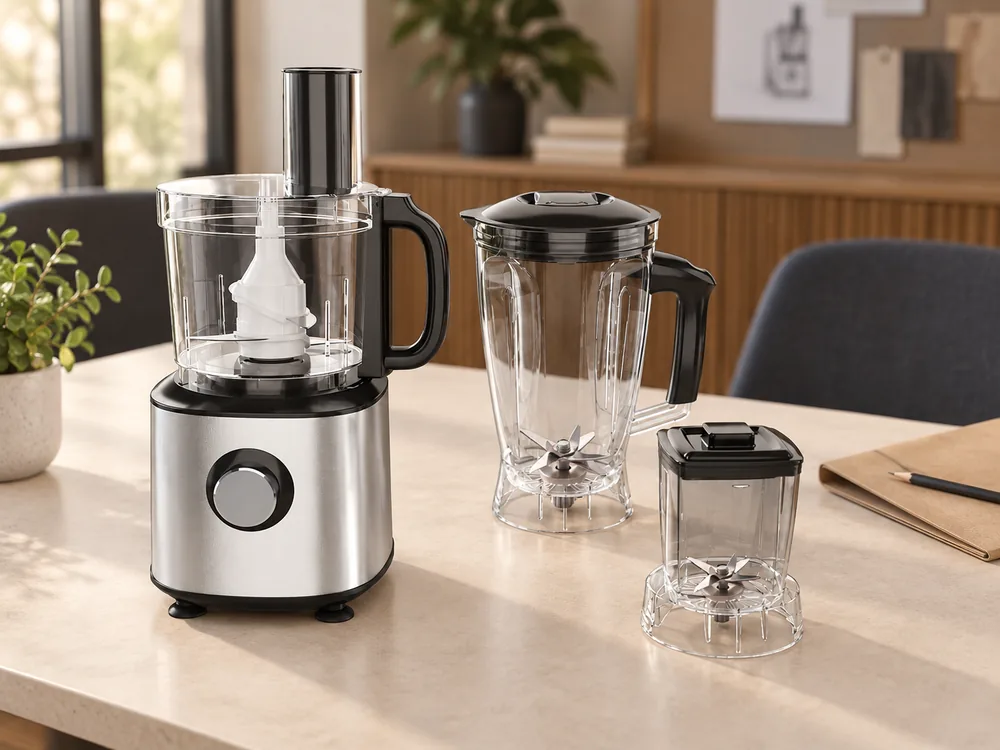
Follow one routine through the set. Where does the removed lid go? Can the user lift out the container as instructed without moving nearby objects? Is there room above a feed tube for the intended operation? These observations are more useful than a staged photograph with no surrounding constraints. Measure the sample in its assembled and stored states when space is part of the sales promise.
Changing functions can also change what must be handled and washed. Review the transition between the main tasks with the actual instructions. Separate the parts the user may remove for cleaning from components that must remain assembled. Keep the motor unit out of any washing demonstration unless its instructions expressly permit that treatment. A metal finish or removable part is not evidence of dishwasher suitability.
Include drying and storage in the demonstration. A set that fits on a shelf when fully assembled may need more room while washed components dry. Check whether the customer has a practical place for sharp tools and whether the provided storage arrangement protects them as intended. Do not assume accessories can be stacked inside a bowl simply because they fit in a promotional photograph.
Finally, ask someone unfamiliar with the set to identify the components for its main task using the proposed instructions. Note where the person hesitates. The answer may be clearer illustrations or a simpler package. Treat that as a specific improvement to the offer, rather than adding another claim about ease of use.
Use samples to settle the unresolved comparison
Sampling is most useful after the category-level questions have been narrowed. If slicing is essential and one proposal includes no slicing assembly, a general demonstration of its chopping function will not settle the choice. Direct the sample work toward the uncertainties that remain between suitable proposals.
Give both suppliers the same intended task, ingredient condition, desired output and target market. Ask each to state the permitted starting preparation and load for its proposed configuration. Comparable testing does not mean forcing two different machines to use an identical load that one is not designed to accept. Where their permitted conditions differ, retain that difference in the record and evaluate its practical consequence.
Agree on the observation before the run. For chopping, a buyer might need a particular balance of coarse and fine pieces for the intended application. For a cutting tool, the question may concern the usable cut and material left unprocessed. These are proposed evaluation questions, not claims that a JINJIE model has already achieved a specific result.
Use a short record that follows the task through the sample.
|
Sample step |
Record |
How to use the observation |
|---|---|---|
|
Identify the assembly |
Model, container, tool and electrical version |
Keep each result attached to the configuration actually tested |
|
Prepare the ingredient |
Starting condition, preparation and permitted quantity |
Explain differences in effort before operation |
|
Complete the task |
Operating sequence, interruptions and complete output |
Judge the result against the intended customer use |
|
Change or clean components |
Required handling, instructions and observed difficulty |
Identify an impractical set or unclear customer guidance |
|
Review an exception |
What differed from the brief and what needs another run |
Decide whether to narrow the claim, change the set or retest |
Keep an unresolved task unresolved. A successful chopping demonstration does not complete a proposed slicing or dough-preparation assessment. If a secondary function is untested, either finish the relevant work or remove that function from the launch promise. The offer can remain useful without advertising every function mentioned in a broad catalogue.
Component consistency matters when that sample becomes an order. Keep photographs of the assembly and identify its parts well enough to compare the production set. JINJIE's quality and testing information provides a starting point for discussing product checks. A factory component-check photograph supplies context, but the buying decision still needs records linked to the selected configuration.
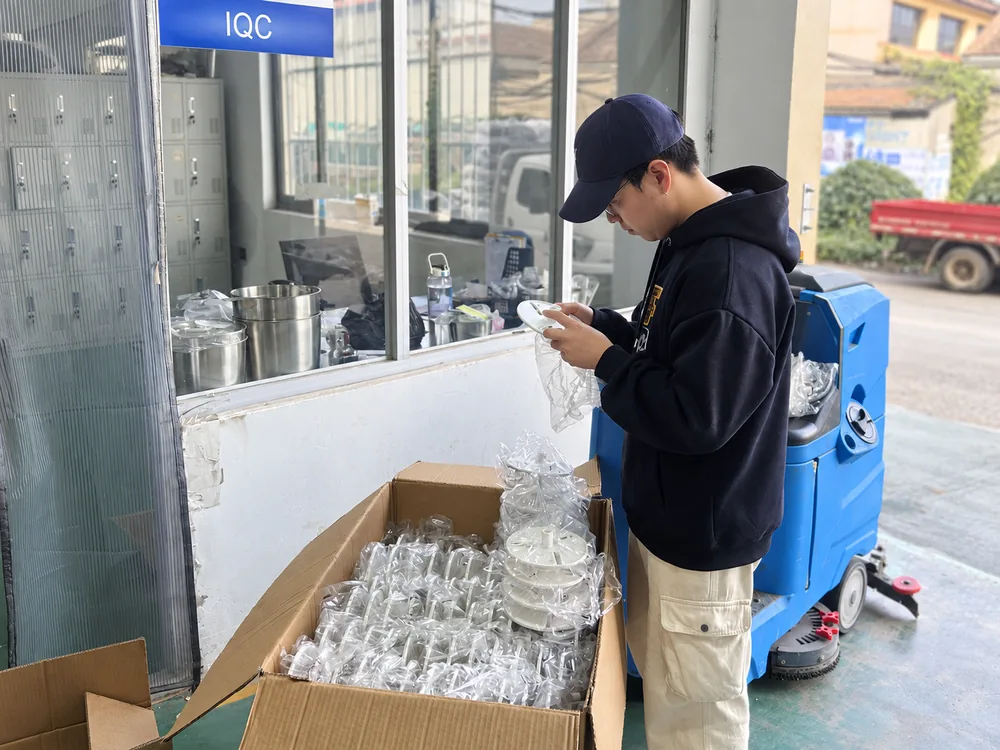
If a result is disappointing, identify the reason before choosing a response. An unclear instruction can call for a better explanation. The wrong included tool calls for a corrected set. A core task that remains unsuitable calls for a different configuration or product. Repeating the demonstration with easier ingredients would answer a different question.
Compare the commercial offers without losing the product difference
Once the task comparison is clear, price the package the customer will receive. A processor base with one bowl and a base with several working assemblies are different offers. A price comparison that leaves out the extra jar, cutting tool or protective packing can make a broader package look less expensive than it will be at the agreed scope.
Ask for one complete price and a clear breakdown of optional additions. Keep the primary task intact when considering a lower-cost set. Removing an accessory is sensible if it serves a low-priority function. Removing the assembly needed for the headline benefit creates a product-page promise the delivered box cannot meet. The same logic applies when a distributor proposes a special promotional bundle.
Review order commitment at the selected configuration level. Ask whether the available quantity or minimum order applies to a model, color, electrical version or complete set. Do not assume that all items under one multifunction model name can be combined into a single minimum. If the supplier permits a mix, retain the permitted combinations in the quotation so the purchasing and packing teams work from the same offer.
Packaging deserves attention where the configurations differ. Additional containers need protection and clear identification, and may change the box or carton arrangement. Compare confirmed packed dimensions and quantities for the actual sets before estimating transport cost. There is no need to turn this selection into a full shipping exercise, but an unpriced second container should not be treated as commercially invisible.
Retail presentation then has a specific job: make the purchased difference understandable. Show the bowl chopper performing its intended role and show the processor with the tools included in that SKU. Keep optional accessories separate in the product-page layout. A customer should not need to inspect a small-print packing list to discover that the illustrated blender jar is excluded.
If both products enter the range, give each a distinct reason to exist. Use the task comparison to write the difference in plain language, supported by the chosen set. Avoid presenting the processor simply as the superior version of the chopper. Some customers will value the additional tasks, while others will prefer the set that covers their routine with fewer components to handle.
Take a defined comparison into the next enquiry
Bring JINJIE the main preparation task, expected batch, destination market and proposed box contents. Include any additional function that genuinely affects the buying decision, and identify what the sample still needs to demonstrate. The next conversation can then compare suitable configurations and complete prices through the JINJIE enquiry page.
That request gives the supplier something concrete to answer. It also gives the buying team a way to reject an irrelevant upgrade: if another attachment, larger container or broader claim does not improve the agreed customer task, it needs a separate reason to enter the offer.
Frequently asked questions
Can we sell a multifunction set with one attachment removed
Potentially, but first establish that the remaining set is a valid offered configuration. Ask for its complete price, contents and packing arrangement. Revise the instructions and product images to match. If the removed attachment performs a function named in the headline, remove that promise too. Do not assume a supplier can split a standard set at the same unit economics or minimum order.
What if the retail buyer uses food processor as a broad category label
Keep the retailer's navigation label separate from the product's actual description. State the working format and included functions where customers choose the SKU. A bowl chopper placed in a broad food-processor department still needs accurate chopping claims. Category placement does not add slicing, shredding or another capability to the product, and it should not determine the sample test by itself.
Can a later shipment use a similar-looking replacement attachment
Treat the replacement as a configuration question before accepting it. Ask whether it changes fit, intended function, instructions or the selected retail set. Where a change affects the task that justified the purchase, repeat the relevant comparison. Keep the original and replacement identities in the order record. Visual similarity alone is insufficient for assuming that containers, tools and drive connections are interchangeable.
What should we do when two suppliers demonstrate different recipes
Use those demonstrations to understand the proposals, but do not rank performance directly from them. Send a common intended task and ask each supplier to declare the permitted conditions for its sample. If a recipe is outside one model's scope, retain that boundary in the comparison. You can then compare suitable work, or decide that only one proposal addresses the required task.