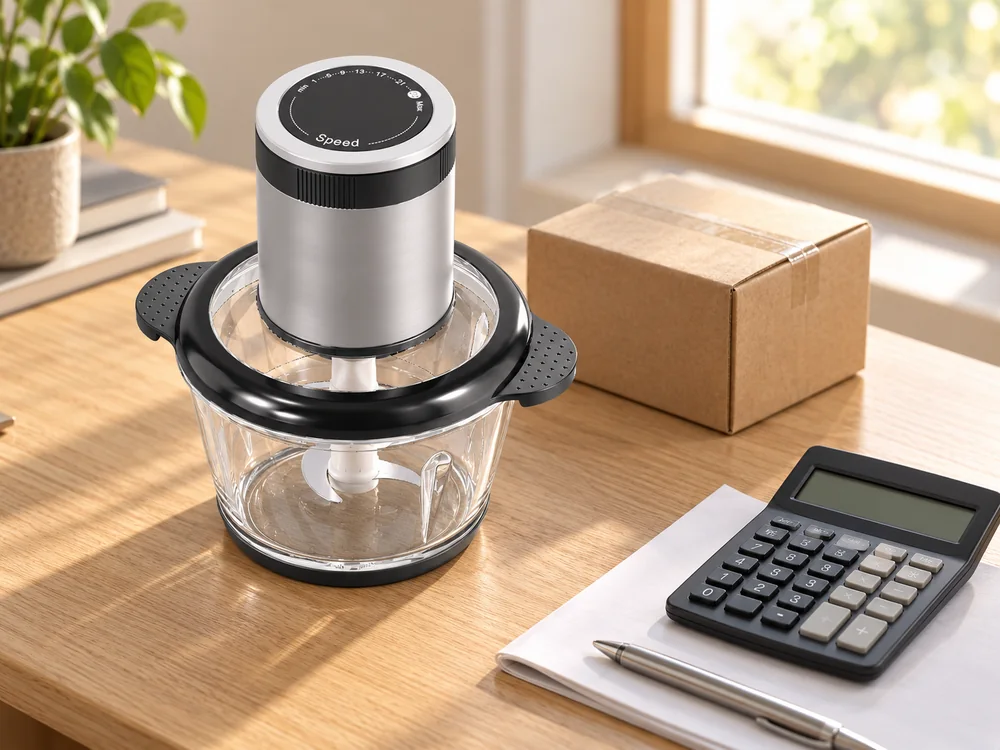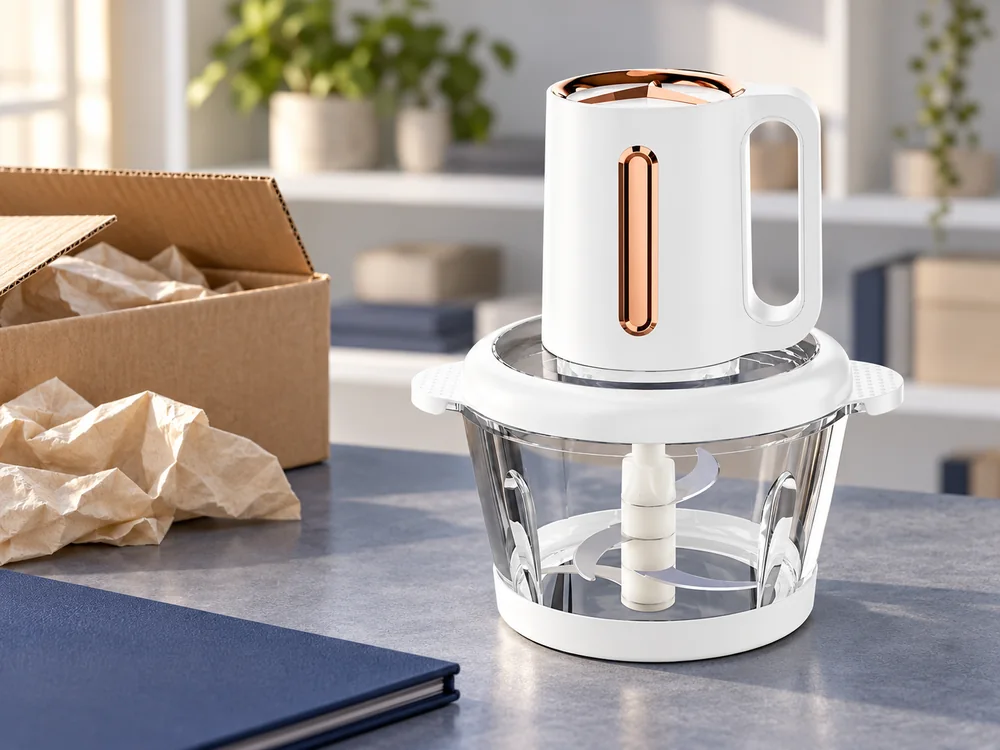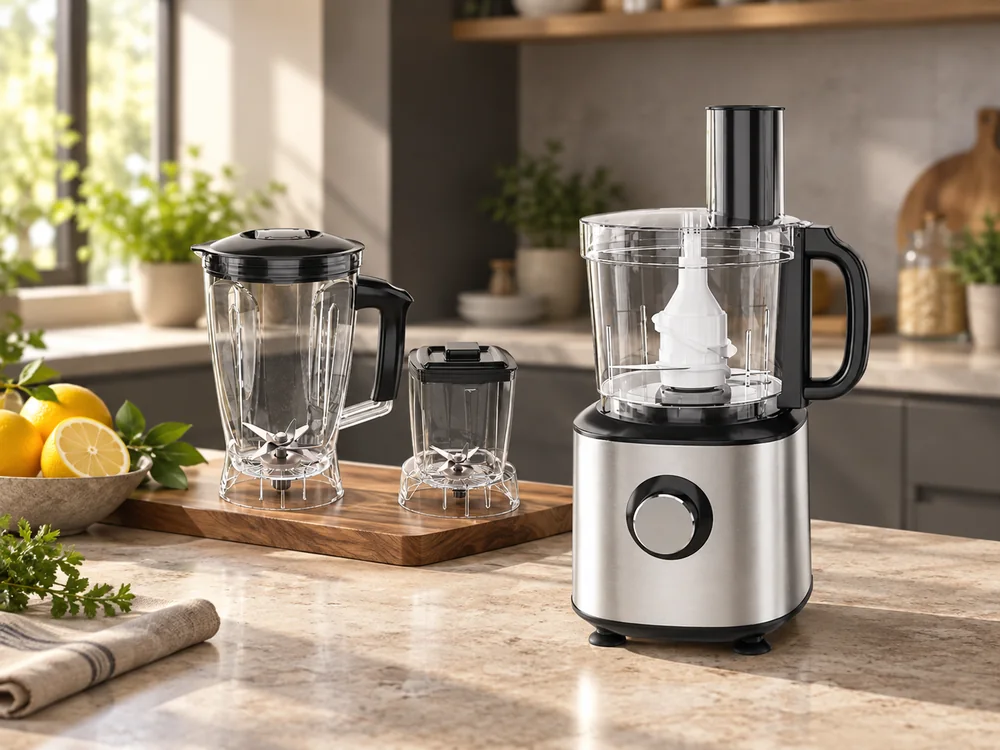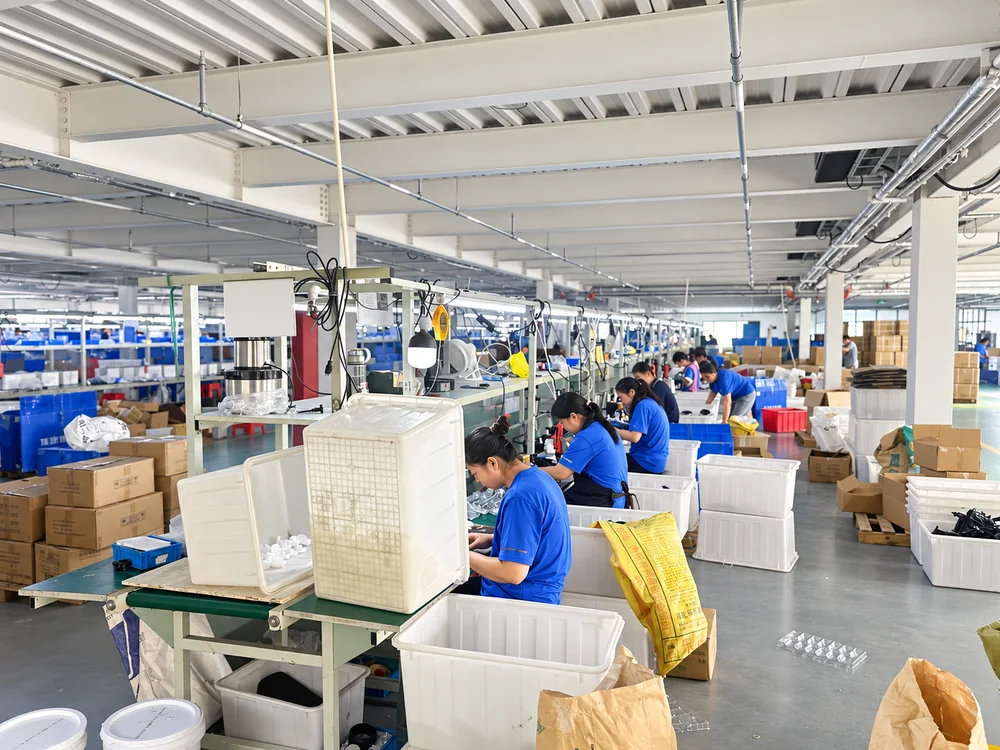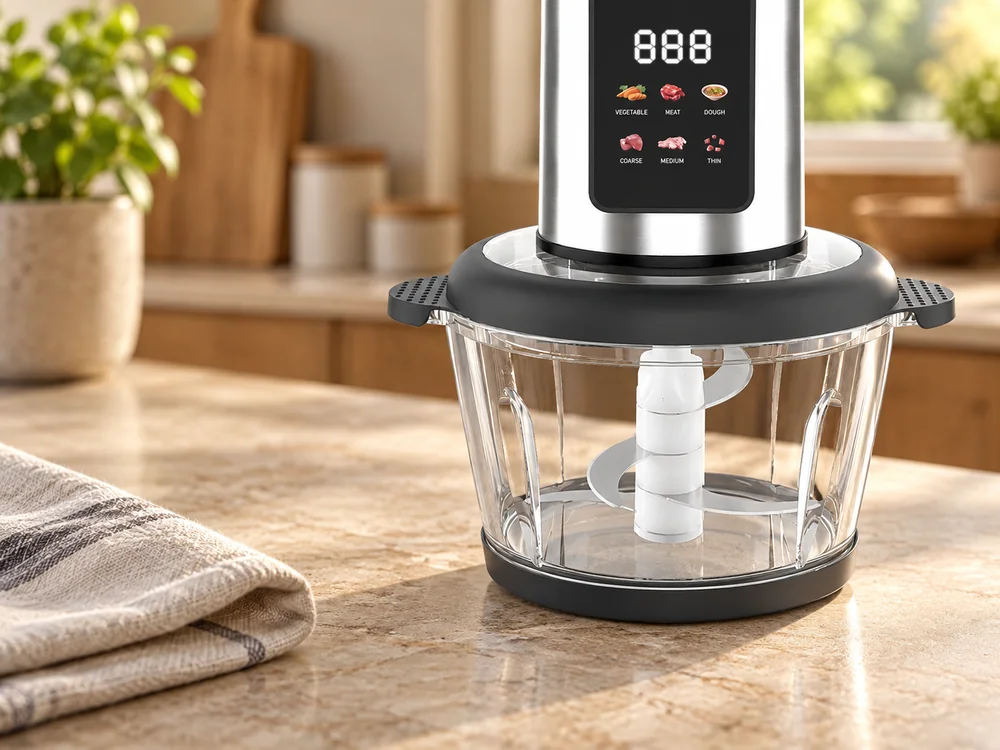
A glass food chopper wholesale purchase is a purchase of complete appliances, not simply a choice of bowl material. The glass bowl must belong to the quoted motor, lid and cutting assembly, survive the agreed distribution process in its supplied packing, and remain identifiable if a customer later needs support. Those requirements belong in the buying decision alongside the unit price.
This guide is for importers and retail brands sourcing household electric bowl choppers. It does not cover manual push choppers, industrial glass-processing equipment or loose glass containers sold without a matched appliance. Make that product definition explicit when sending inquiries, because several very different products can appear under the same short search phrase.
Once glass is the intended direction, the next question is whether the proposed complete offer fits the channel. There is no need to reopen a general glass-versus-steel comparison at every stage. Concentrate on the actual model, packing, delivered quantity and support arrangements you would be buying.
Define the complete glass-bowl appliance you intend to sell
Start with a current model in the JINJIE electric meat chopper range. The quotation identifies SD-03, with CC1048 as a secondary reference, as a 3 L glass-bowl model at 500 W. SD-04, with CD1048 as a secondary reference, is listed at 2 L and 400 W. These references distinguish the proposed products; the stated bowl volume is not a promise of permitted food load.
Keep the model and its quoted configuration together. A similar-looking picture does not establish the bowl volume or electrical specification. If a file name, sample label and quotation disagree, obtain one corrected reference before the product enters your catalog. Do not resolve the disagreement by choosing whichever description looks commercially preferable.
List the entire saleable unit. Include the motor unit, matched bowl, lid, cutting assembly and any other confirmed supplied pieces, plus the retail presentation. If an optional component is shown in a photograph, establish whether it is included in the proposal. An attractive product image does not define the contents of the box.
Choose the version for its place in your range. A smaller nominal bowl and a larger one may serve different customer needs, but that difference has to survive the complete buying comparison. Consider the finished appliance's handling, storage and packed form, not just the number printed beside capacity.
If you want to offer both sizes, give each a clear customer role. Do not create two stock lines merely because both appear in the quotation. Separate quantities, retail content and support references need a commercial reason. One clearly explained offer can be a stronger opening purchase than two versions whose differences your sales team cannot describe.
Confirm the destination electrical version at the same time as the product. A glass bowl does not make otherwise different appliances one interchangeable stock item. The buyer's purchase reference should connect the motor version, complete set and intended market, rather than identify the order only by bowl material.
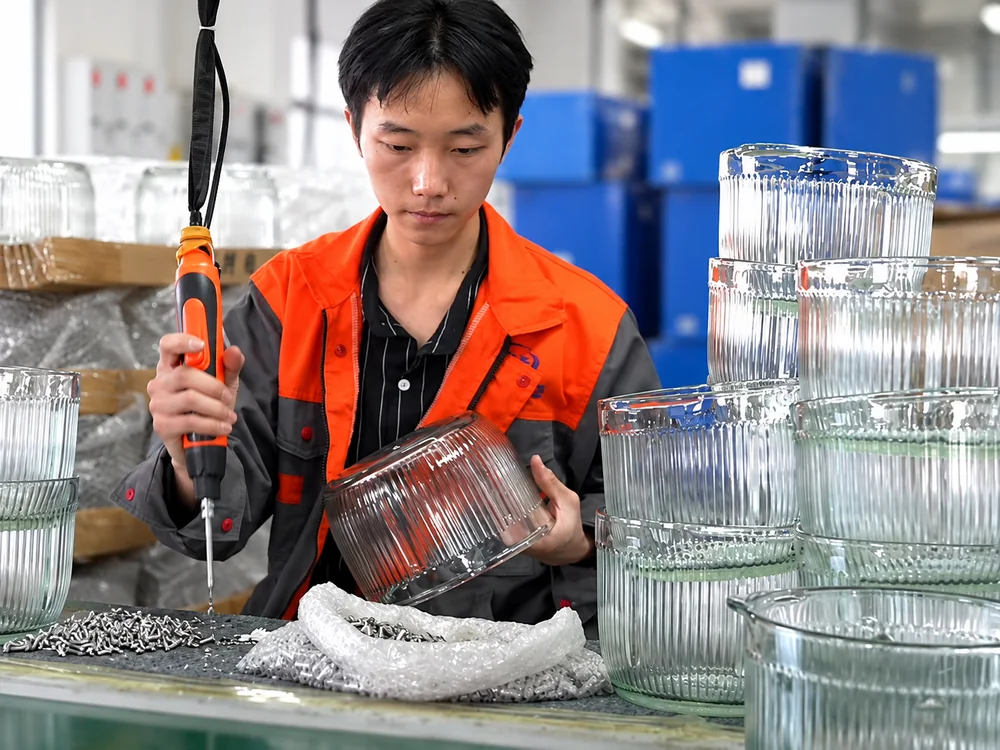
Check the bowl as part of a matched set
Review the sample as a complete appliance before treating the bowl as a purchasing specification. The relevant question is whether the supplied bowl, lid, cutting assembly and motor belong together. A loose replacement container with a similar diameter is not an adequate substitute for the confirmed combination.
Ask for the material description that actually applies to the bowl. If the quotation says glass, do not expand that into borosilicate glass, heat resistance or a particular treatment without supporting information. The same restraint applies to claims about the lid or other food-contact parts: a glass bowl does not make the whole appliance an all-glass product.
Look at handling in the intended retail context. How will the customer move, empty and store the complete set according to its instructions? Keep the motor's handling separate from the bowl's handling. A supplier demonstration should show the permitted approach, not encourage the buyer to improvise a way to lift an assembled appliance by an unsuitable part.
Record the actual contents when evaluating a sample. If your buyer sample arrives with an extra tool or another lid, ask whether that reflects the offered set or a sample-only addition. Resolving this early prevents a useful evaluation piece from quietly becoming an unpriced retail promise.
Use sample observations to make a specific decision. An unexplained mismatch between bowl and lid needs clarification. A request for a different appearance may be optional. A missing instruction about an intended use may prevent that use from being advertised without necessarily preventing purchase for another confirmed task.
|
Difference found |
Why it affects the offer |
Purchasing action |
|---|---|---|
|
Sample and quotation show different bowl sizes |
The customer offer and packing reference may be different |
Establish the exact model before comparing prices |
|
An extra accessory appears only in the sample |
The saleable contents are unclear |
Obtain an explicit inclusion or exclusion |
|
Bowl material has a more detailed marketing description than the quotation |
The proposed claim lacks a matched source |
Use the supported description or obtain evidence |
|
A replacement bowl looks similar but has no confirmed reference |
Compatibility and supply are unresolved |
Request a matched component proposal |
|
The chosen task is absent from the applicable instructions |
The retail promise may exceed the supplied product |
Resolve the task or narrow the customer offer |
Do not turn this review into an informal performance certification. Observing one sample can reveal questions and guide product selection, but it does not establish a batch-wide breakage rate, lifetime or permission for every cleaning method. Keep the conclusions proportionate to what was actually checked.
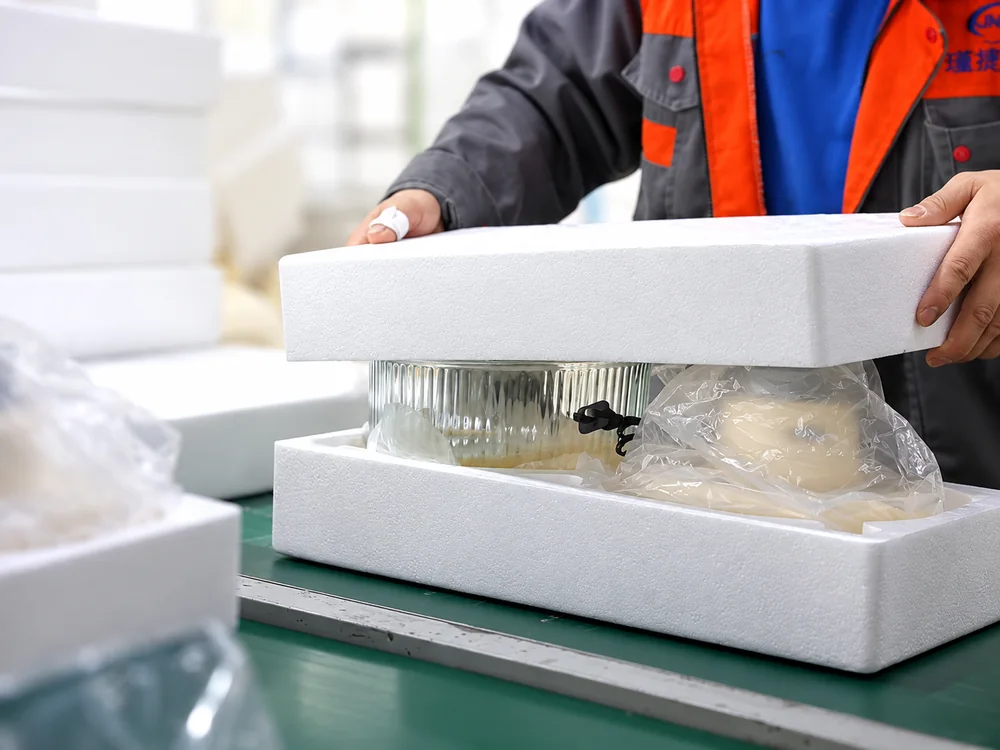
Evaluate protection for the route your stock will travel
Explain the distribution route before accepting the packing proposal. A shipment to a distributor's warehouse and a product later sent individually to online customers involve different handling stages. The factory needs to know which supplied packing you expect to serve each stage; the buyer also needs to know where its own preparation begins.
Review the actual packed set. Identify how the bowl, motor and loose components are positioned and separated in the proposed arrangement. The useful reference is the selected appliance inside its packing, not an empty insert or a photo of another model's box. A protective insert's appearance alone cannot establish its suitability.
Ask what the retail box is intended to do. It may be part of a master-carton system rather than a standalone parcel shipper. If your business plans to dispatch individual units, discuss the additional arrangement needed for that route and obtain an appropriate proposal. Do not assume a printed box is ready for every delivery method.
Connect any packing evaluation to the actual configuration through JINJIE's quality and testing information. Establish which appliance, insert, retail box and outer carton are represented, and what the evaluation covers. A test reference for another size or earlier pack should not silently become evidence for the current order.
Consider what happens after your warehouse opens a master carton. Stock may be divided between stores, demonstration use and individual deliveries. Staff need a practical way to preserve the intended protection. If repacking is expected, define the materials and method instead of relying on employees to recreate the original arrangement from memory.
Inspect the proposed customer opening experience as well. The buyer should be able to identify the contents and follow the applicable unpacking instructions without confusing a packing piece with a product accessory. This is an information and presentation review, not a reason to remove protection simply because an unprotected appliance looks cleaner in a photograph.
Record changes to the pack together with changes to the set. Adding a bowl, changing the motor arrangement or revising a supplied tool can affect the packed proposal. Ask for the resulting dimensions and weight rather than continuing to use logistics figures from the original sample configuration.
Compare glass food chopper wholesale offers on a delivered basis
Request an identifiable complete quotation: selected model, electrical version, supplied contents, retail presentation and quantity. Compare like with like before negotiating. A lower price that excludes an agreed component or assumes another bowl is a different offer, not necessarily a saving on the product your business wants.
Obtain packed dimensions, gross weight and units per master carton for the proposed set. These are needed for a realistic delivery estimate. Do not use bowl volume to infer carton size, or assume that two visually similar appliances have the same packing and freight requirements.
Keep the supplier's quotation separate from the buyer's own estimates. Transport, receiving, additional parcel protection and local handling may sit outside the quoted product price. Label estimated costs and the assumptions behind them so a later change in route does not appear to be an unexplained increase in the appliance price.
Plan the opening quantity around saleable complete units. Demonstration appliances, retained samples and any agreed service stock serve other purposes. If they are included in the purchase, identify their allocation. An order of one hundred appliances does not automatically leave one hundred available for retail when part of the order has already been assigned elsewhere.
Ask whether any proposed spare bowls can be supplied separately and on what basis. Their existence in a finished appliance does not establish a separate component business, price or minimum quantity. Keep that discussion outside the complete-appliance quantity until the manufacturer has defined the actual supply arrangement.
Where custom presentation is required, discuss the work through JINJIE's OEM and ODM options. Compare the branded complete offer with any available standard presentation on its own terms. Special artwork can be worthwhile for a retail channel, but its preparation and quantity conditions should be visible in the decision.
Do not insert an assumed breakage allowance into the supplier's proposal and treat it as agreed compensation. If your business uses an internal contingency, label it as an estimate. Ask separately how reported damage is documented, reviewed and resolved under the actual commercial arrangement. Price planning and responsibility for a particular incident are different questions.
The final comparison should show what reaches your warehouse, what still needs preparation and what support remains unresolved. That lets the buyer decide whether a lower initial price genuinely improves the usable retail offer or merely transfers additional work to its own team.
Separate receiving problems before requesting a remedy
Give the receiving team the agreed product and packing references before the shipment arrives. They should know which model, quantity and presentation belong to each order line. A carton marked with a familiar brand name may still contain another electrical version, size or set, so the brand alone is not a receiving specification.
Follow the agreed inspection and handling arrangements. Where damage is suspected, avoid putting an affected unit into normal saleable stock while the issue is being reviewed. Record the observable condition and preserve the relevant order and packing information. Staff should not use or handle damaged glass merely to see whether the appliance still works.
Separate product identity, quantity, packaging condition and physical damage in the report. These issues may require different responses. A missing lid is not the same as a damaged bowl, and a damaged outer carton does not by itself establish what happened to every unit inside it.
|
Receiving observation |
Information useful for review |
Decision to keep open |
|---|---|---|
|
Outer carton damage |
Carton reference, location and condition of affected contents |
Which units require further checking under the agreed process? |
|
A damaged glass bowl |
Model, affected quantity and relevant packing condition |
What remedy is available for the actual complete version? |
|
Wrong bowl or electrical version |
Order line and received product identification |
Can the stock serve any agreed purpose, or must it be corrected? |
|
Missing supplied component |
Agreed contents and observed shortage |
Is a matched component supply or another remedy appropriate? |
|
Different packing from the agreed reference |
Photos and identifying details of both arrangements |
Does the difference require evaluation before normal distribution? |
Use clear records to support the supplier discussion without assigning a cause before the evidence is available. A receiving observation can identify the problem, but it may not establish where in production, transport or local handling it occurred. Ask for an investigation appropriate to the issue rather than treating every difference as the same factory defect.
If a proposed remedy uses a separately supplied bowl, confirm its complete identity and compatibility before accepting it. The receiving team should not be expected to decide which loose container fits which appliance. Keep any corrected units distinguishable while the agreed work and checks are completed.
Feed the outcome back into the next order. If the business changes its delivery route or repacking method, revisit the relevant packing arrangement. If the issue was a reference error, correct the purchase and receiving information. Repeating an unchanged checklist is less useful than addressing the actual source of the problem.
Keep the retail promise and support plan within the supplied scope
Write the product description around the confirmed appliance. Glass is a bowl material, not evidence that the motor, lid and cutting assembly can be washed together or used with hot food. Use the applicable instructions for cleaning and permitted tasks, and keep unsupported material or temperature claims out of the retail copy.
Show the selected set in product photography. A second bowl used for a styled scene should not appear to be included unless it belongs to the offer. The same applies to storage lids or other accessories: pictures and written contents should lead the customer to the same understanding.
Give customer support a way to identify the sold version. The retailer's SKU, manufacturer model and any agreed component reference should stay connected. A customer's description of a glass chopper may be enough to start a conversation, but it is not enough to select a replacement part.
Agree what support your business can actually offer. If separate bowl supply is unconfirmed, do not promise an unlimited replacement service. If it is confirmed, keep its conditions, compatibility and expected availability visible to the team handling requests. The public promise should follow the accepted arrangement, not precede it.
Review a future model change against stock already sold. A different bowl or lid may require revised images, instructions and support references even when the retail name stays the same. Preserve the earlier information so a later shipment does not erase the identity of units customers already own.
For the next wholesale purchase, use actual demand and support observations to refine the offer. A request for another size may justify a second SKU; a question about supplied contents may only require clearer presentation. Choose the response that solves the observed problem without adding unnecessary versions to the range.
Request a complete glass-bowl chopper proposal
Contact JINJIE about a glass food chopper wholesale order with the preferred model, destination market, quantity and distribution route. Include the required retail contents and any separately requested service components. Ask for the complete product, packed details and current commercial conditions together so you can evaluate a usable retail offer.
FAQ
How many spare bowls should accompany the first order?
There is no justified universal percentage in the available product information. First establish whether matched bowls can be supplied separately. Then use your own service policy and relevant operating experience to decide a quantity, keeping that estimate separate from any supplier commitment.
Does a glass bowl mean the product is dishwasher safe?
No such conclusion follows from the material description alone. Check the applicable instructions for each component and use only the supported cleaning claims. The motor unit and the parts supplied around the bowl must not inherit a cleaning permission simply because the container is glass.
Can we sell a two-bowl set using a bowl from another model?
Only discuss it as a proposed matched combination, not an assumed bundle. Ask the manufacturer to confirm the complete configuration and supply terms. If a two-bowl offer is accepted, review its packing and customer information as a new complete set.
What should we do if the original bowl is no longer available?
Ask for a documented compatible alternative or another agreed support option. Do not substitute a container based on appearance or nominal capacity. Keep the affected sold model identifiable and avoid promising a replacement until its suitability and actual supply are confirmed.