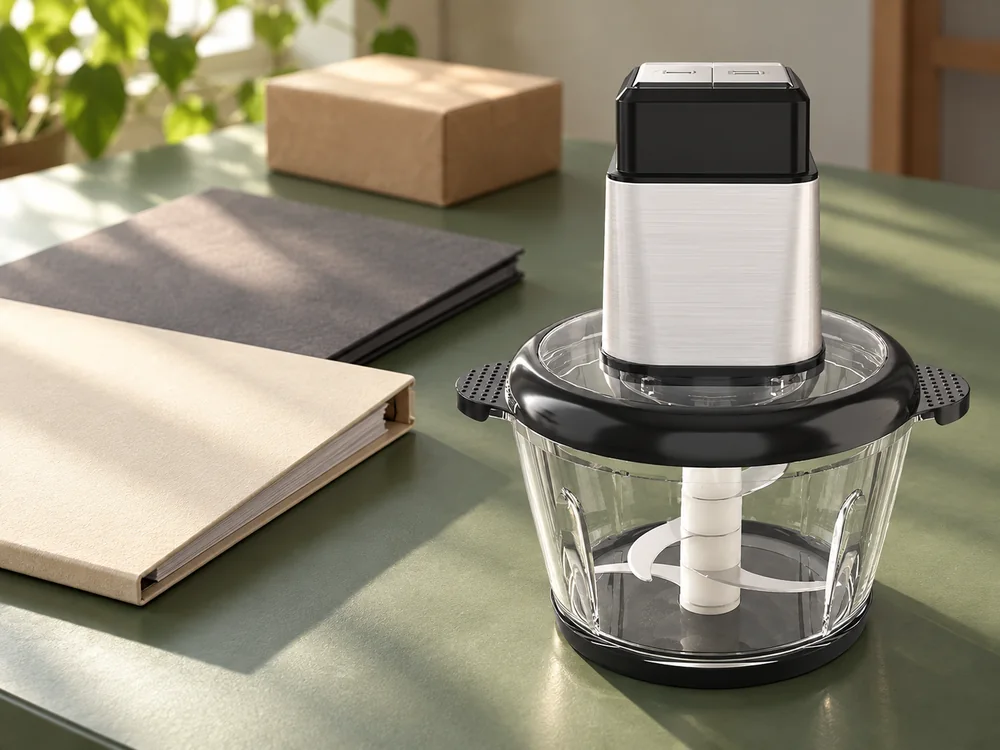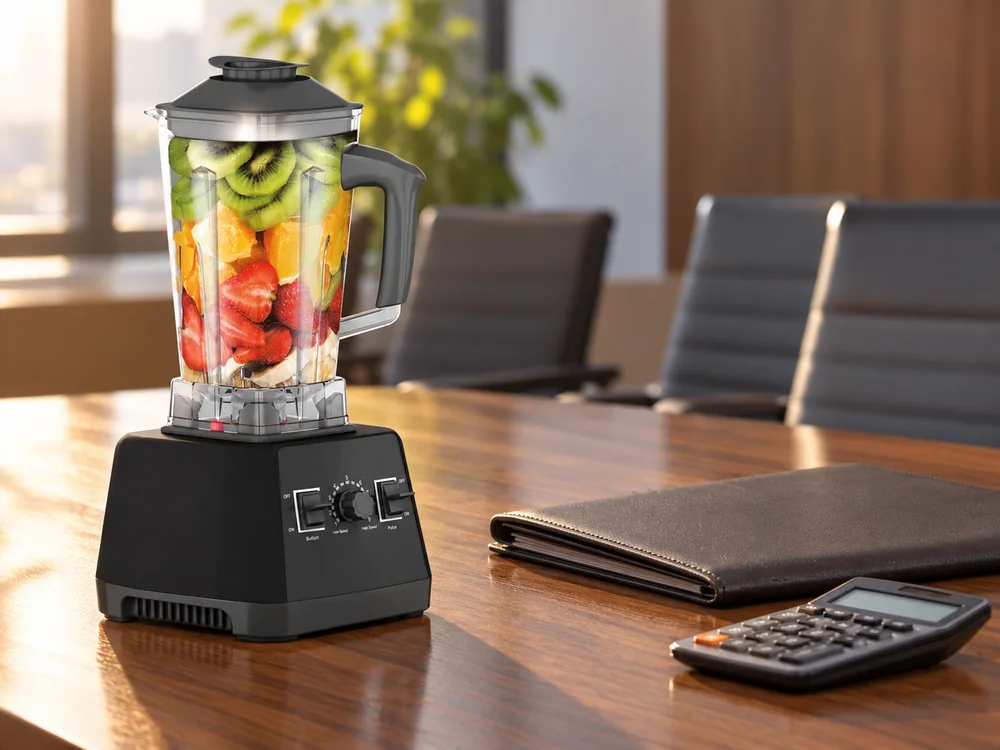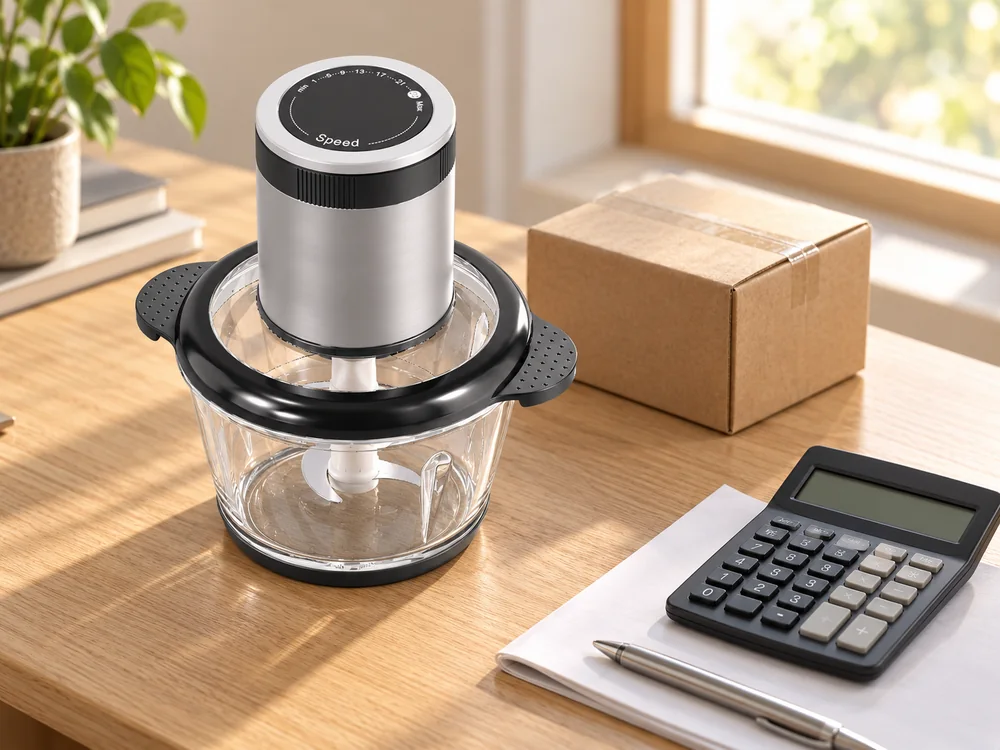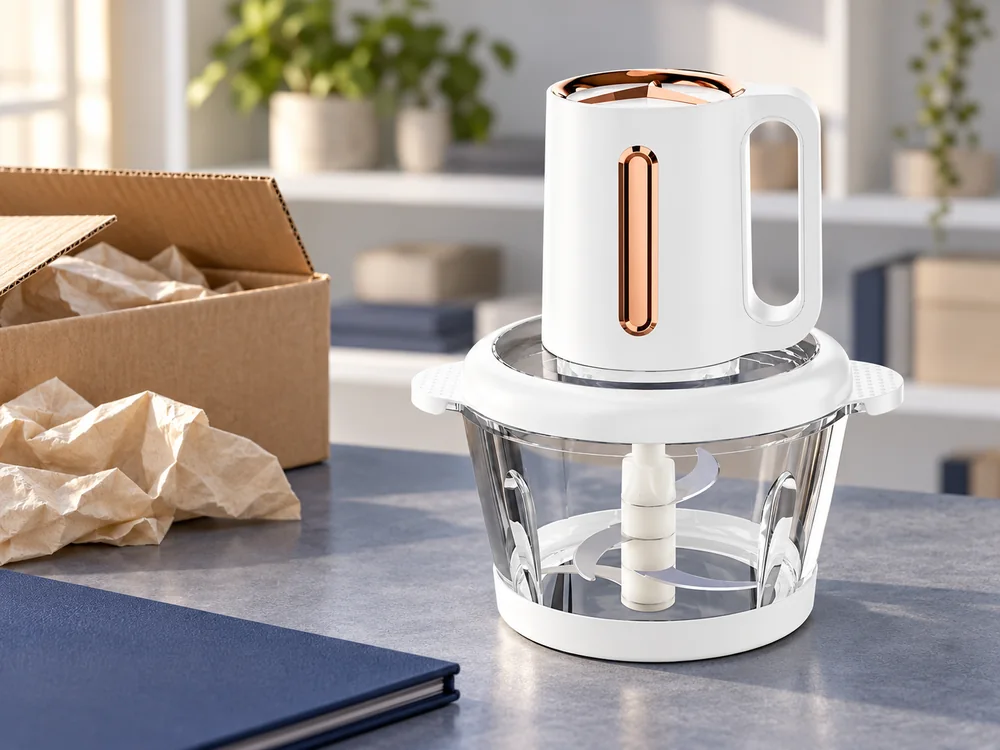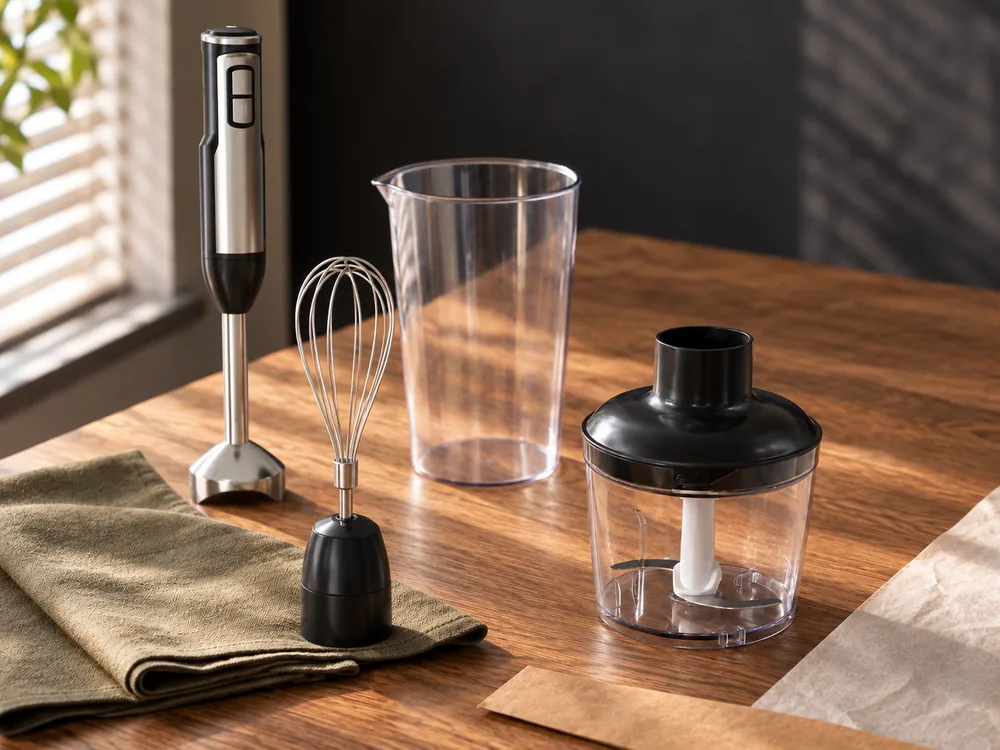
A four-in-one hand blender set is not a complete packing instruction. The phrase can count functions or accessories, and a photograph may show one motor unit repeated to illustrate several configurations. The order needs a physical included-items list with quantities.
Price a hand blender set as one saleable package. Compare the motor unit and every supplied assembly, then add the agreed printed materials and packaging. A low headline price for the core unit cannot be compared directly with a complete set.
Define the core unit and the complete hand blender set
The core product identity tells the supplier which handheld motor and blending attachment the buyer is considering. The saleable-set identity tells the dispatch and packing teams what the customer receives. Keep both in the project record.
JINJIE's HB1361 is listed twice in the current reference. One entry specifies 300 W and a stainless steel material field. The other specifies 400 W, a 0.8 L capacity field, stainless steel plus PET and a four-in-one description. A purchase order that says only “HB1361” leaves a real configuration question unresolved.
The 0.8 L capacity belongs to a container in the confirmed set, not to the handheld motor unit. Have the supplier identify that container on the included-items list.
Do not assume that a set version is simply the same core unit with more accessories added. Check the electrical and power entries as well as the attachment list.
Give the retail set a plain-language description alongside the model. “Motor unit with blending attachment” and “motor unit with a confirmed accessory package” tell the buyer different things. The exact contents still need naming, but the description prevents a discussion about the bare unit from being confused with a finished retail bundle.
Keep optional items outside the base list until they are selected. A supplier may show several useful accessories while quoting only one combination. If purchasing copies everything visible into the marketing brief, the product page can promise a larger set than the order includes.
The reverse mistake is also possible: a short list may omit a necessary adapter because the supplier considers it part of an assembly. Ask whether the quoted assembly is complete and how its parts will appear in the contents list. This resolves the counting question without forcing every subcomponent into a separate sales feature.
Count physical pieces before counting functions
Create an included-items schedule using the supplier's part identifiers where available. If no part identifier has been assigned, use an unambiguous name and a dated photograph. Avoid invented codes that look like official manufacturer numbers.
|
Item group |
Quantity or detail to confirm |
Common ambiguity to resolve |
|---|---|---|
|
Handheld motor unit |
Number supplied and exact configuration |
Repeated units in a promotional image |
|
Blending attachment |
Complete attachment and connection |
Shaft shown separately from the core unit |
|
Whisk assembly |
Whisk and required adapter |
Adapter omitted from a short set list |
|
Chopping accessory |
Container, lid, drive interface and blade assembly |
“Chopper cup” used for an incomplete assembly |
|
Beaker |
Container, nominal capacity and any lid |
Capacity assigned to the wrong vessel |
|
Printed materials |
Instructions, labels and applicable language |
Generic manual for another configuration |
For the chosen version, mark each item as included, optional or absent and record the physical quantity. Request separate prices for optional assemblies. This gives the buyer a usable basis for comparing a core set with a fuller retail package.
A functional claim needs its own check after the physical count is settled. A beaker is a supplied component, but it is not a separate motorized function. A whisk and its adapter may be two physical pieces supporting one task. Keep those counts distinct on the carton.
Use two levels where needed: the assembly the customer uses and the pieces the packing team counts. A chopping accessory can be named as one assembly in the retail description while the packing record identifies its container, lid and blade. Both views are useful, provided they describe the same physical contents.
Record exclusions that a photograph could otherwise imply. If a serving bowl, storage stand or second motor unit is shown only to explain use, make the supplied scope clear in the product information. Removing an unnecessary prop from the main product image can be clearer than adding a small disclaimer beneath it.
Check the count against an actual unboxed sample. Lay out the supplied components for identification, then compare them with the order description. The review should establish what is present and what each assembly needs, not create a new definition of “four-in-one” to fit whatever arrived.
Confirm compatibility at the connecting end
An attachment should be matched to the selected core unit by its actual connection and operating scope. Similar outlines or a shared category name do not establish interchangeability.
Ask the manufacturer to identify the compatible blending attachment, whisk adapter and chopping lid for the chosen motor unit. If a different accessory is proposed, request confirmation of the complete assembly rather than an assurance that it “fits most models.”
Use the approved sample to inspect the attachment identification and the locking process described in its instructions. Record whether the supplied parts correspond to the set list. Any fit or operating evaluation must follow the product's permitted procedure. Do not force a mismatched connection or modify a part to complete the test.
When choosing the set, compare the extra accessory cost with the task it adds. A whisk needs its compatible adapter; a chopping accessory needs its complete working assembly. Omitting a necessary piece to meet a price point leaves the customer with an unusable attachment.
Ask whether an optional accessory is available for the selected core unit, not simply whether the supplier sells that accessory somewhere in its range. A catalog may contain several motor platforms. The relevant answer identifies the matching version and the conditions under which it can be supplied.
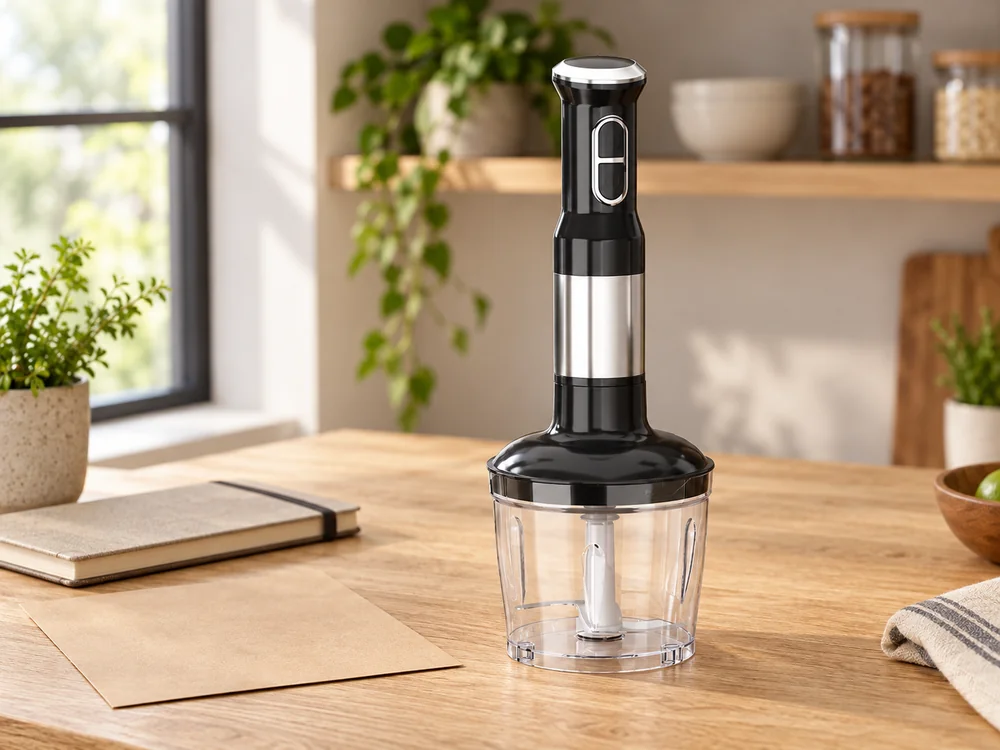
Keep the complete connection visible in the sample reference. An image of the end of a whisk alone may not show the adapter that joins it to the motor. A photograph of an assembled chopping configuration can clarify the relationship, but the physical parts and their quantities still need to be listed separately.
If a proposed accessory changes, ask which other pieces must change with it. A revised chopping lid may require a different container or drive arrangement. The buyer should compare the cost and usability of the complete approved alternative rather than price one loose part as if it were interchangeable.
The accessory-configuration illustration is a reference for understanding that relationship, not a packing list for every model. Use the supplier's identified set to settle the actual contents of the selected order.
Decide which accessories belong in the saleable package
Once compatibility is clear, choose the bundle around the customer's intended tasks. A fuller set is useful when its extra assemblies have a reason to be there. It is less useful when the buyer cannot explain what the additional parts contribute or when they repeat another product already offered to the same customer.
Ask for the core and proposed fuller sets on the same electrical and branding basis. Where the base unit itself differs, keep that difference visible. The comparison should show what changes in the entire offer, not attribute the whole price difference to one accessory.
The following table helps turn a contents list into a purchasing decision. It does not prescribe a standard JINJIE bundle or imply that every option is available for every model.
|
Proposed item or change |
Question that affects the bundle |
Decision to record |
|---|---|---|
|
Whisk assembly |
Does the intended customer need its documented task, and is the adapter included? |
Include the complete compatible assembly or omit it |
|
Chopping accessory |
Is the complete container, lid and blade configuration useful for the brief? |
Specify the assembly and its supported use |
|
Beaker |
Which container is supplied, and what does its capacity field describe? |
Name the item and confirm its actual nominal capacity |
|
Storage item |
Is it included, and does it fit the selected components? |
Treat it as a supplied item only after confirmation |
|
Larger accessory package |
Does the added value justify the full packed-cost difference? |
Choose the complete offer rather than the function count |
Use the table to remove ambiguity, not to make the set artificially small. If the proposed customer genuinely needs the whisk and chopping assembly, price and review both. If one accessory has no clear role, ask whether a simpler existing configuration is available before requesting a custom bundle.
For a hypothetical comparison, a buyer might receive one offer for a blending unit and beaker and another for a set with a whisk and chopping assembly as well. The correct comparison includes the additional complete assemblies, their instructions and their packing. Comparing only the motor price would miss what makes the second offer different.
Keep the decision tied to the intended retail package. An accessory that may be offered later does not belong in the current included-items list. It can remain a separate future option with its compatibility and supply terms still to be confirmed.
Ask what happens to the offer if one optional assembly is removed. The supplier may have an existing simpler set, or the request may create a new packing combination. Obtain the revised complete description and price rather than subtracting an assumed accessory value from the original quotation.
The same care is useful when a customer requests an extra beaker or a spare adapter. State whether the extra item belongs in every retail box or is a separate service purchase. Those quantities serve different purposes and should not be combined in a way that makes the standard box contents unclear.
Before final selection, read the contents list without looking at the promotional image. If a colleague cannot tell how many motor units, complete attachments and containers are included, the wording still needs clarification. The image should help recognize the parts, not carry information missing from the buying description.
Pack the complete set before approving the box
Prepare a pack-out reference using the actual product or an explicitly identified packaging sample. Show where every component sits and which protection belongs with it. The person opening the box should be able to match its contents to the instructions.
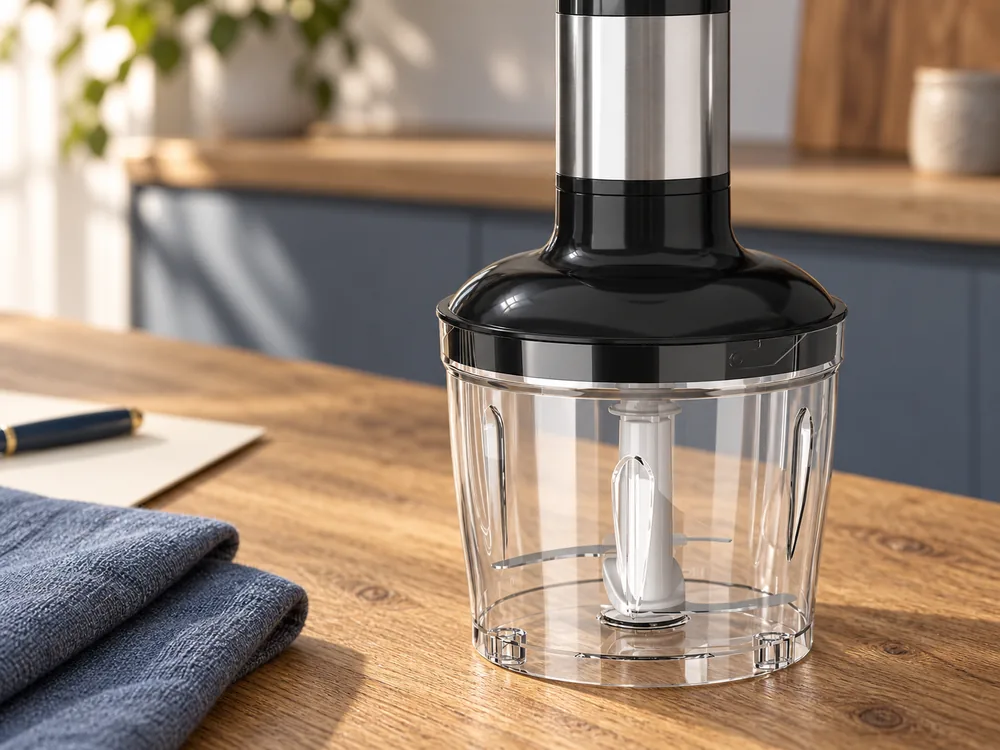
The chopping blade assembly needs handling and protection consistent with the product's instructions. Keep its identification clear so it is not mistaken for loose packing material. Ask the responsible packaging team to review separation and protection for the supplied parts rather than prescribing an untested insert design from a photograph.
Compare the packed dimensions and weight of the core and fuller sets after the actual arrangement is prepared. Include the packaging and freight difference in the SKU decision. The lowest accessory price may not give the lowest delivered cost for the complete box.
If a beaker or storage item is optional, use different set descriptions or clearly marked variants. A small “accessories may vary” line does not repair a main image that promises the wrong contents.
Check the opening sequence as well as the closed box. Components should be identifiable when the customer removes them, and the instructions should use the same names as the contents list. If the customer cannot recognize an adapter or a protected assembly, improve the explanation rather than rely on familiarity with another model.
Ask the supplier to prepare packing information for the actual selected set. A core-unit carton or another appliance's packing photograph cannot establish that a fuller hand blender set fits its intended protection. Use any generic packing image only as process context, not as proof of the final arrangement.
For a cost comparison, include only current quoted or measured values. If packed dimensions are not yet available, leave that part of the comparison open. Do not assume a small accessory adds no shipping volume or that every fuller set needs a larger carton; the actual arrangement should decide.
The pack-out review can also reveal a contents decision worth revisiting. If an optional storage item complicates the package without serving the intended customer, discuss removing it from a revised offer. If it is an essential retail feature, preserve it and review an appropriate packing solution instead.
Give the set a stable identity for repeat orders
Preserve the supplier's model identifiers and add the buyer's retail SKU as a separate field. Link the SKU to the approved included-items list, electrical version and packaging revision. Do not replace the manufacturer's identifier with an internal nickname in the only order record.
When an accessory changes, identify the change and review the consequences for the sample, manual, claims and pack-out. A revised beaker or chopping lid should not silently inherit the old photograph and part description.
For after-sales support, retain the identifiers for the assemblies most likely to be queried, such as a lid, adapter or beaker. Ask which replacements can be ordered, their minimum quantities and supply terms before deciding what to stock. Current part identification does not guarantee lifetime availability.
Keep the service-parts discussion distinct from the retail count. A replacement adapter may be ordered separately even though the original retail package described a complete whisk assembly. Record how the supplier identifies the service item so customer support does not request an entire unrelated set to replace one component.
When a replacement is unavailable, ask for a confirmed alternative and its compatibility with the customer's version. Do not recommend a similar-looking part based on a catalog photograph. The set record is useful precisely because it can identify which version the customer originally received.
For repeat orders, compare the new offer with the approved set rather than copying the old product title alone. Check whether the listed contents, electrical version and packing remain unchanged. A new product photograph can be helpful, but it should not silently replace the reference for an existing retail SKU.
Use JINJIE's quality and testing information to discuss the relevant completeness and assembly checks for the order. The review should identify the set being checked and the expected contents, so an inspection result can be interpreted against the actual purchase.
JINJIE's immersion blender page explains the review of core units and matched accessories. Its OEM and ODM page connects the product specification to artwork and pack-out. Use those discussions to approve one saleable set.
Conclusion
Send JINJIE the desired set contents and retail SKU plan. Ask for a returned list that identifies every supplied assembly, its quantity and the open decisions. That list can then travel with the sample, quotation and packaging files.
Buy the package the customer will actually receive. A clear physical count, confirmed connections and an identified packing arrangement make a hand blender set understandable without relying on a function badge to explain its contents.
FAQ
Does four-in-one mean four appliances are included?
Not necessarily. It may describe several uses of one motor unit with different accessories. The included-items list must state the physical quantities.
Can the same model number cover a single unit and a set?
Yes, that occurs in the current HB1361 reference. Use the configuration details and set list to distinguish the entries rather than relying on the model number alone.
Should accessories be approved after the main unit?
Early reviews can be staged, but the complete retail set needs approval before final pack-out. The core unit's approval does not automatically settle attachment compatibility or included quantities.
Should replacement parts use the retail SKU alone?
Keep the retail SKU, but add the supplier's specific part or assembly reference and the original configuration. One retail product can contain several serviceable items, and a later revision may look similar. Clear part identification helps the supplier answer whether the requested replacement matches the version already sold.