Choose a kitchen appliance sourcing agent or a direct manufacturer according to the work your buying team needs someone else to perform. A manufacturer develops or supplies the appliance. An agent may help find suppliers, coordinate communication and organize selected purchasing activities. Neither description tells you who will accept your order, approve a change or resolve a problem. Those responsibilities need an explicit answer before the relationship is useful.
For a private-label food-preparation range, the decision often turns on the number of suppliers involved and the buyer’s ability to manage product details. One defined chopper project can be handled differently from an assortment assembled across several factories. Adding an intermediary can provide valuable coordination, but it also creates another handover where technical information can be shortened or changed.
This comparison concerns purchasing household appliances for resale. It does not assume that agents are unnecessary, that every direct factory is suitable, or that a particular arrangement guarantees a lower price. The aim is to choose who does what, compare the complete cost of that arrangement and retain a usable product record.
Identify the service behind the sourcing label
A company calling itself a sourcing agent may offer supplier research only, a continuing coordination service or a complete resale offer. Ask how the proposed relationship actually works. Does it introduce you to a manufacturer, place an order on your behalf or sell the goods to you in its own name? These are different arrangements even when the same contact handles all the emails.
A trading company can be the seller and take responsibility for its quoted offer. An agent can provide a defined service while another party sells the goods. A manufacturer may also coordinate purchased components and other suppliers. Avoid treating business labels as a substitute for understanding the transaction and the product responsibilities.
Ask for the identity of the proposed seller and the manufacturing location relevant to your appliance. Clarify who will issue the quotation and who will confirm a product change. Where confidentiality limits disclosure, decide whether the information available is enough for your project. Do not assume that an introduction, a factory photograph or a shared email address proves the full arrangement.
For a direct discussion, use JINJIE’s manufacturing information to identify the production activities relevant to the selected appliance. The page describes component preparation, assembly, inspection and packing. A buyer still needs a specific proposal connecting its order to the model, configuration and responsible contacts.
The following comparison separates roles without ranking businesses by their label. Actual responsibilities depend on the offer and agreement.
| Proposed arrangement | Work to establish | Question before proceeding |
|---|---|---|
| Direct manufacturer relationship | Product proposal, production coordination and agreed supply | Can your team manage the remaining purchasing and market work? |
| Agent providing a defined service | Supplier search, communication or specified follow-up | Which decisions remain yours and who sells the goods? |
| Trading company selling a complete offer | Procurement and resale under its own proposal | What product responsibility and information access are included? |
| Manufacturer plus independent specialist | Factory supply alongside a separately appointed service | Where do technical, inspection and commercial responsibilities meet? |
Record the arrangement in ordinary language your colleagues can understand. If purchasing cannot explain who receives an order instruction, the project is not ready for a complicated sample or customization discussion. Clarifying that first can prevent later disagreement about whether a message was advice, a quotation or an accepted change.
Decide which coordination work is worth buying
Start with your own team. Who can compare product configurations, review the sample, coordinate packaging and return timely decisions? A capable supplier does not remove those buyer-side tasks. An agent may support them, but the buyer must still define its customer proposition and decide what it is prepared to purchase.
A direct relationship can be practical when the product category is clear and the buyer can manage the remaining work. For example, an importer looking at one identified electric chopper range can send a focused brief, receive alternative configurations and work through the sample questions with the relevant supplier team. It does not need to create a multi-supplier structure merely because the goods are imported.
An agent may add value when the assortment requires several sources or when local coordination is genuinely difficult for the buyer. Ask for a description of the work it will perform: identifying candidates, arranging visits, consolidating answers or following agreed milestones. A statement that it handles everything is too broad to compare with your actual needs.
Separate convenience from authority. A coordinator can collect comments from your packaging designer and technical reviewer. It should not silently choose between conflicting requirements unless your team has authorized that decision. Name the buyer contact who resolves commercial trade-offs and the specialist who answers technical questions.
Consider a limited service before committing to a broad one. A buyer may need help identifying suitable manufacturers but be able to manage the chosen supplier directly. Another may already know the manufacturer and need a separately arranged inspection. These are possible service scopes to discuss, not promises that every provider offers them.
Ask how the service would handle your particular product. For a hand-blender set, the contact needs to preserve the distinction between a shaft, whisk, beaker and matched chopper bowl. For a salad maker, it needs to keep the supplied cutting tools tied to the correct appliance. General purchasing fluency is useful, but it cannot replace accurate product communication.
Give the candidate one bounded question during evaluation. Request a comparison of two actual configurations or a clear list of unresolved sample points. Assess whether the response preserves the original requirement and identifies who must answer each issue. This is more informative than judging the relationship only by response speed or the appearance of a presentation.
Compare total scope rather than assumed middleman savings
Request a priced description of the service and the goods separately where that structure applies. Understand whether compensation is a fixed fee, a charge linked to order value, a resale margin or another agreed arrangement. Do not assume a standard percentage. Ask which services are included and which events create additional charges.
The relevant comparison is the cost of obtaining the same complete appliance and the same necessary work. A direct product quotation can look cheaper while leaving coordination activities with your team. An agent’s proposal can look more expensive while including useful work, or it can bundle tasks you do not need. Identify those differences before calculating a saving.
Keep quotations comparable at product level. Use the same model or a clearly described alternative, electrical version, set contents, branding and packing requirements. If one proposal includes a larger bowl or another attachment, it is not a clean comparison of direct sourcing against agency sourcing. The product difference must be separated first.
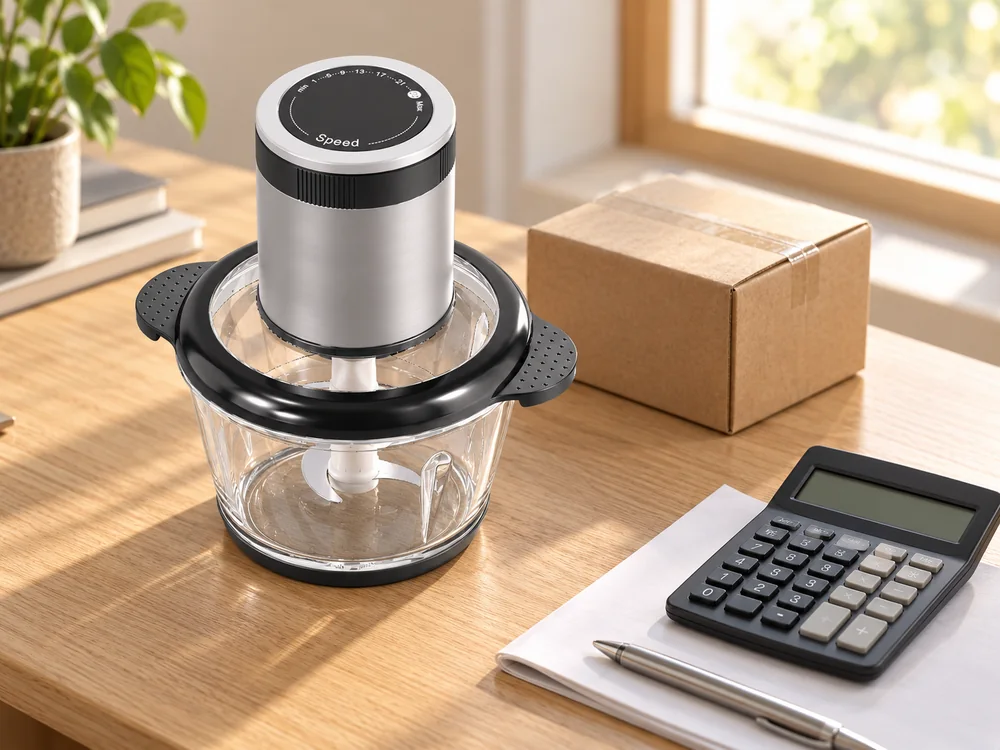
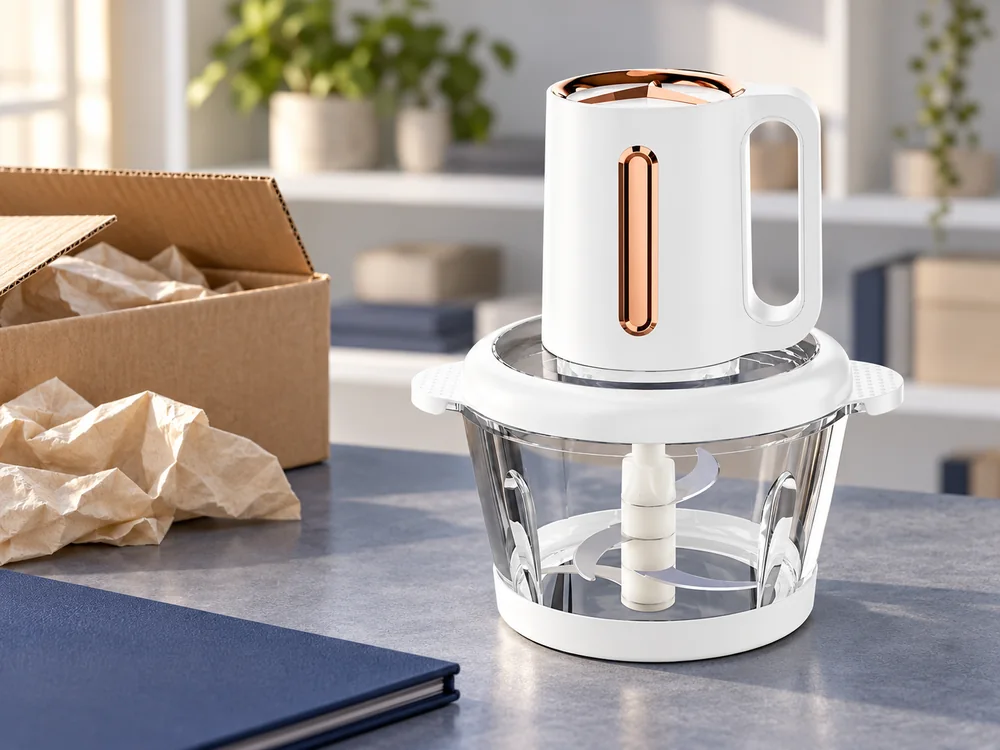
JINJIE’s electric chopper range illustrates why this matters. SD-01 and SD-02 are different quoted steel-bowl configurations. Substituting the smaller product in one route does not demonstrate that its commercial structure is more efficient. Compare equivalent requirements, or explain why a different product is acceptable to the retail plan.
Ask who pays for samples, shipping, visits and any external inspection or assessment. Clarify whether those amounts are estimates, pass-through charges or included services. Also ask what happens if no suitable supplier is selected. A research service can involve real work even when it does not result in an order, so that outcome needs an understood commercial treatment.
Disclose the costs your own business retains. Your staff may spend time reconciling translations, correcting artwork or coordinating several suppliers. These costs can inform the decision without being converted into invented savings figures. Use your actual staffing and workflow rather than a universal claim that an agent always saves time or a factory always saves money.
Ask about compensation from other parties where it could affect supplier selection. The purpose is to understand incentives, not to presume misconduct. A recommended factory may be entirely suitable, but the buyer should know whether the adviser is being paid for an independent search, a sales introduction or the eventual transaction.
Finally, compare the arrangement at the intended scale. A fee structure that is reasonable for a first exploratory purchase may need review for repeat orders. Equally, removing support too early can return unfamiliar work to an unprepared team. Agree the scope for the current stage instead of assuming the same arrangement must continue indefinitely.

Keep product decisions visible through every handover
Use one identifiable product record shared by the parties who need it. It should connect your retail SKU to the supplier’s model, electrical version, supplied components and current packaging files. An intermediary should help maintain that connection, not replace it with a private nickname that prevents your team from understanding what was approved.
Model naming is particularly important when a quotation contains more than one reference. Keep the primary quoted model visible and record any secondary manufacturing reference separately. A photograph alone is not a reliable identifier when related products share a housing. The accepted configuration should remain recognizable even if the sales contact changes.
Route questions according to who can answer them. A proposed logo location may need an appearance and process review. A different attachment connection needs a product answer. JINJIE’s OEM and ODM discussion distinguishes current-product branding from changes that may affect engineering, tooling or testing. Preserve that distinction when the conversation passes through an agent.
Ask for unresolved points to remain visible. If the supplier has not confirmed a requested material, the coordinator should not turn it into an affirmative statement merely to simplify the comparison sheet. The buyer can sometimes narrow an optional claim, but that decision should be made consciously and recorded with the product scope.
Keep sample identity with the observations. If an agent receives the sample first, ask whether it is forwarding the same unit, retaining a reference or sending another version. A sample reviewed by one party and a different unit photographed by another can produce apparently contradictory feedback. Identify the actual object before debating the conclusion.
Consolidate buyer comments before issuing changes. Several specialists may review the same sample, but the manufacturer needs one coherent response stating what is accepted, what must change and what remains a question. An agent can coordinate that response while keeping the original supporting detail available to the responsible technical people.
For a remote review, agree what can be decided from images or video and what requires physical examination or a defined test. Seeing a control operate can help explain an interface. It does not answer every question about the product’s performance, construction or market requirements. Choose evidence according to the decision rather than according to the easiest file to send.

Define inspection and problem handling before shipment
Clarify whether an offered inspection is performed by the agent, the manufacturer or a separately appointed provider. Ask what it covers, what reference it uses and what record you will receive. The word inspection alone does not establish independence, sampling scope or a decision about releasing goods.
Agree who instructs the inspector and who receives the unabridged findings where that is part of the service. A coordinator’s short summary can be useful for management, but it should not replace the agreed record needed to understand an issue. Keep photographs and observations tied to the order and product version.
An inspection finding and a commercial remedy are separate steps. Someone may identify a mismatch without having authority to accept a concession or change the purchase. Name the person who decides what happens next. This avoids a situation where the goods move because each participant believed another had approved the exception.
| Event | Information needed | Responsibility to settle |
|---|---|---|
| Sample differs from the proposal | Sample identity and exact difference | Who requests correction and who accepts the revised version? |
| Quotation changes through an intermediary | Original and revised scope | Who confirms the seller’s current offer? |
| Inspection identifies a concern | Applicable reference, observation and affected scope | Who decides on follow-up before the next logistics step? |
| Goods arrive with a discrepancy | Shipment identity and documented condition | Who receives the claim and coordinates the response? |
| A contact or service provider changes | Current product and open-issue record | Who hands over the information and outstanding commitments? |
Plan communication for an exception, not only for an ordinary order. If an issue is found close to collection, the buyer needs a reachable decision-maker and a clear path to the party controlling the goods. A long forwarding chain can consume the time needed to obtain a useful answer.
Do not let urgency settle product questions by implication. If a retailer launch creates pressure to ship, distinguish that commercial pressure from the technical assessment of the concern. Obtain the relevant response and make an explicit decision within the agreed responsibilities. Silence in a group conversation should not be treated as approval.
Keep problem reports factual. State the model, order, observed difference and affected quantity, with useful evidence. Avoid assigning cause from an isolated image or describing all stock as defective because one unit has a concern. The responsible parties need an accurate starting point for investigation and an agreed route for the remedy.
After resolution, update the record that will govern the next order. If the response changes packaging or a component, identify which version it applies to. A successful conversation is not enough if the next purchasing contact still uses the earlier files.
Preserve continuity when the relationship changes
Before appointing a service provider, discuss what information your business will retain. Relevant items can include your supplied artwork, the accepted product specification, sample references, quotations and agreed inspection records. Access and ownership should follow the actual agreement; paying a service fee should not be treated as proof of rights never discussed.
Distinguish supplier confidentiality from loss of product control. An arrangement may legitimately protect certain commercial information while still giving the buyer enough detail to identify and support the appliance it sells. Decide whether that balance meets your needs before relying on the relationship for a continuing retail range.
Ask how a replacement contact would understand the project. The answer should not depend on one person’s memory or a private message thread. A current record of the product, approved files and open decisions allows another colleague to continue the work without restarting every discussion.
Review the arrangement after real purchasing experience. Did the service reduce work you struggled to perform? Were technical questions answered accurately? Did your own late decisions create avoidable delays? Separate these observations so the next choice addresses the actual problem rather than reacting to a disappointing total lead time alone.
You may retain the same structure, narrow the service or move to a different arrangement consistent with existing obligations. Make the transition deliberately, with current files and unresolved matters handed over. Changing the contact channel should not silently change the product, seller or commitments attached to an order already underway.
Start with a defined appliance project
Send JINJIE your product and sourcing brief with the household appliance category, target market, expected quantity and customization needs. If an agent or other coordinator is involved, identify its role and your approval contact. Ask for the product proposal and the information each party needs to evaluate it before deciding how to organize the purchase.
FAQ
Can an agent receive samples while our technical team reviews them elsewhere?
Yes, if the parties agree the handling arrangement. Keep each sample identifiable, document any onward shipment and state which questions the recipient should assess. Confirm whether the same physical unit or a separately prepared unit is being reviewed so the findings remain comparable.
What if the agent will not disclose the manufacturer’s identity?
Ask what information and responsibility the proposed seller or service provider will give instead. Decide whether that is sufficient for your product, documentation and continuity needs. Do not assume disclosure is guaranteed, but do not approve a relationship that cannot meet an essential purchasing requirement.
Should the agent approve substitutions to save time?
Only within authority your business has explicitly granted. Define the permitted scope and require escalation for changes outside it. A component or electrical change can affect more than price, so a general instruction to keep the order moving is not a useful substitution policy.
Can we use a direct manufacturer and a separate inspector?
That is a possible arrangement to discuss with the parties. Set the inspection scope, access, timing and reporting route before relying on it. Keep the buyer’s release decision and any follow-up responsibilities clear; appointing a separate inspector does not transfer every purchasing obligation to that provider.