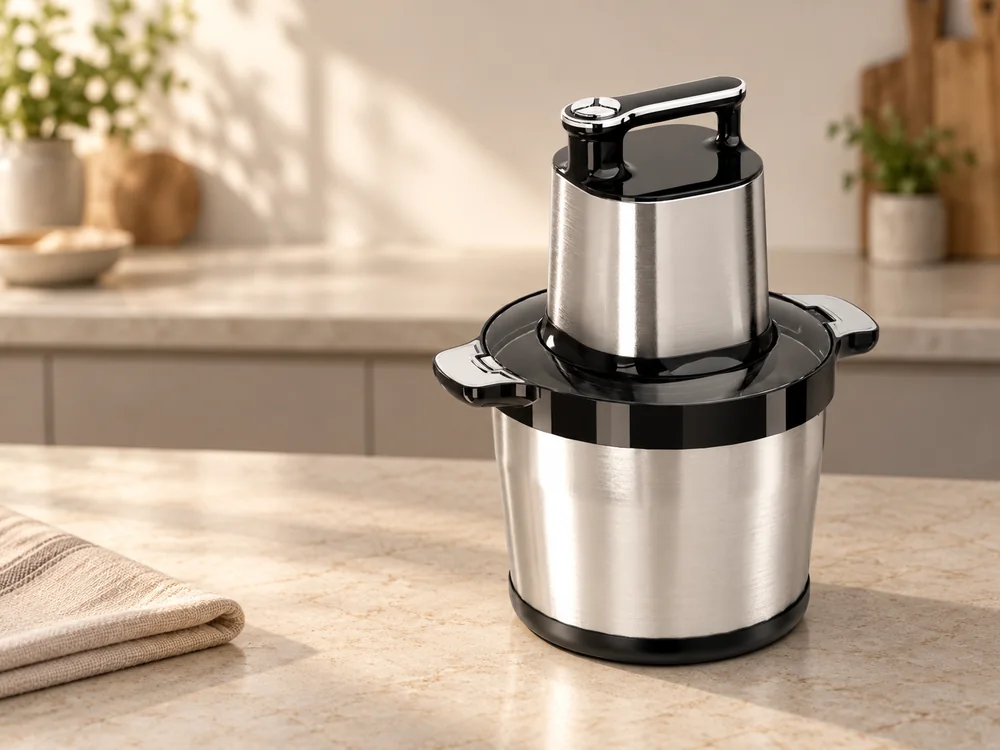
Large capacity food chopper wholesale inquiries often begin with a request for the biggest bowl available. For a retail buyer, the more useful question is whether that complete appliance earns the space it occupies in the customer's kitchen, in your warehouse and in the delivery network. A larger catalog entry needs a clear commercial role before it deserves an opening order.
This guide concerns countertop electric bowl choppers offered for a household-appliance range. It does not recommend industrial bowl cutters, screw-fed grinders or equipment for continuous restaurant preparation. If the purchase depends on a guaranteed hourly output, start with an equipment specification for that duty rather than selecting from nominal bowl liters.
JINJIE's listed range includes 6 L, 8 L and 12 L configurations. Those figures give an importer real alternatives to investigate. They do not establish permitted food loads, suitability for a particular kitchen or a reason to stock all three sizes.
Establish whether the large format belongs in your channel
Describe the customer you expect to buy the appliance. A retailer adding a larger household model is making a different purchase from a catering operator replacing production equipment. The two may use the same phrase in an inquiry while expecting different operating limits, service arrangements and results. Resolve that distinction before asking for the largest model and its price.
For a household range, identify the unmet requirement in the current offer. Customers may be asking about a larger container, a different handling arrangement or a format they can leave on a dedicated counter. These are questions to investigate through your channel, not evidence that a particular model will satisfy them. Ask the retailer what customers actually find insufficient in the smaller product.
An inquiry that only says “more powerful” is not yet specific enough. It may refer to an unsatisfactory preparation result, a desire for fewer permitted batches or simply a stronger-looking product. Each explanation leads to a different comparison. A larger bowl will not automatically resolve all three, and an appearance preference should not become a processing claim.
Separate mandatory requirements from preferences. If the product must fit a particular display fixture or be delivered through an existing fulfillment service, obtain those constraints early. A preferred finish can be negotiated later. A package outside a channel's accepted handling limits may make the entire offer unsuitable, regardless of its attractive purchase price.
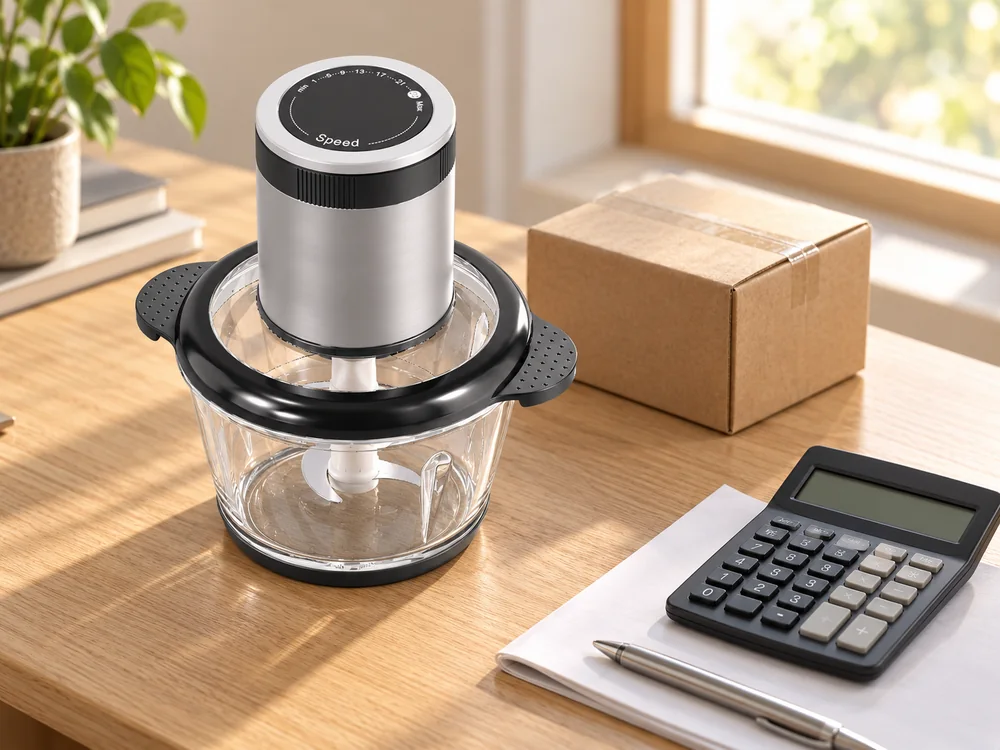
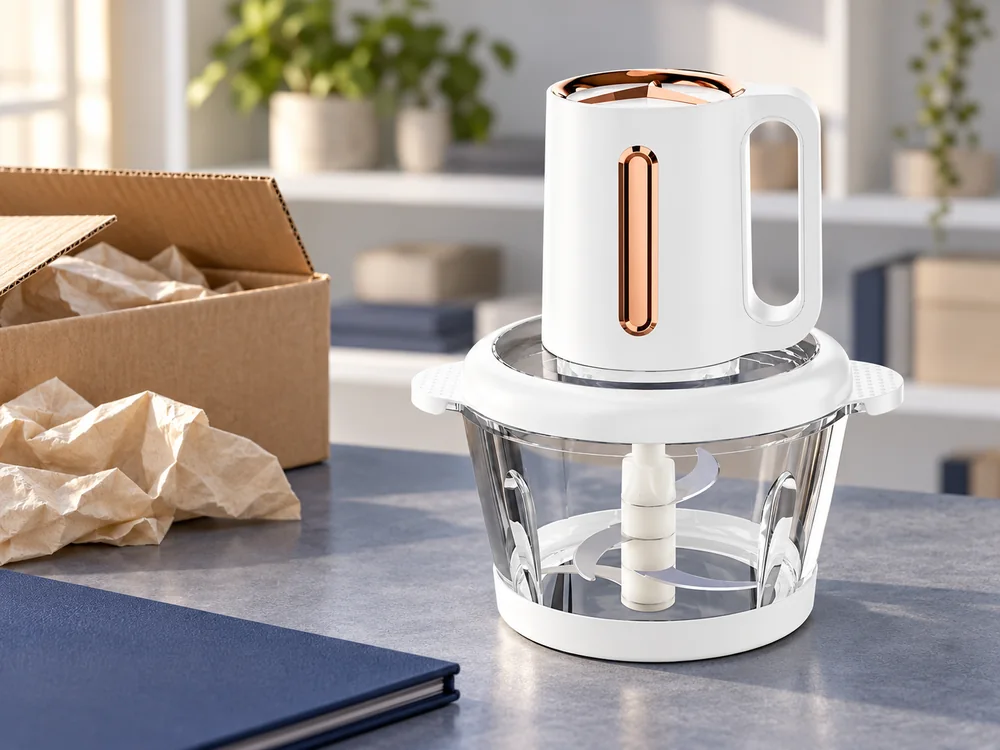
The electric meat chopper range provides a starting point for identifying the bowl-type platforms. Send the supplier the customer brief alongside the preferred model. If the application is professional food production, say so explicitly and request a supported proposal; do not infer suitability from a large steel bowl.
Compare the actual 6 L, 8 L and 12 L proposals
Begin with a small number of identified configurations. JINJIE's current reference lists MC-03 at 6 L and 1200 W, MC-04 at 8 L and 1200 W, and YW-01 at 12 L and 1500 W. All three entries list a 201 stainless steel bowl. These are nominal capacity and listed power figures, not a performance ranking.
|
Configuration |
Listed starting specification |
Useful purchasing question |
|---|---|---|
|
MC-03 |
6 L, 201 stainless steel bowl, 1200 W, three speeds |
Does this complete format answer the requirement without moving to a larger unit? |
|
MC-04 |
8 L, 201 stainless steel bowl, 1200 W, three speeds |
What changes in handling, space and the complete offer compared with MC-03? |
|
YW-01 |
12 L, 201 stainless steel bowl, 1500 W, two speeds |
Does the intended channel have a specific role for this different configuration? |
The shared 1200 W entry for MC-03 and MC-04 is useful because it prevents a simple “larger means more watts” description. It does not prove that their motors, parts or operating behavior are identical. Likewise, YW-01's higher listed power and different speed count do not establish a proportional increase in usable output.
Ask for the complete assembly behind each proposal: bowl, matched lid, motor unit, cutting assembly and included items. A larger bowl is not an interchangeable upgrade to a smaller appliance unless the supplier specifically confirms the arrangement. Obtain a quotation for a complete supported configuration rather than pricing a bowl and assuming the rest can be reused.
Keep control choices separate from size. Other MC entries have different listed features, including a bowl lock or digital controls. Choose those features only when their documented operation serves the proposed customer. Do not assign a lock to MC-04 because another 8 L entry has one, or describe every large model as digital.
For the intended preparation task, obtain the selected model's permitted ingredient, loading and operating information. Nominal liters cannot be converted directly into kilograms of meat or a number of family portions. If a sample evaluation is needed, agree a permitted method with the supplier. The result should answer the channel's actual question, not reward whichever demonstration fills the bowl most heavily.
At this stage, shortlist by the decision that matters. If the uncertainty is whether the larger physical format is acceptable, request dimensions and handling information before paying to ship several samples. If the uncertainty is a permitted preparation result, a photograph and dimension sheet will not close it.
Include the customer's ordinary smaller preparation task in the inquiry as well as the largest intended one. Buying a large model does not mean every use will involve a large quantity. Ask whether the proposed appliance supports both tasks under its instructions. If that has not been established, do not describe the model as replacing every smaller chopper in the household. This question can change whether the retailer presents it as an additional option or a general replacement.
Review the space needed from storage through cleanup
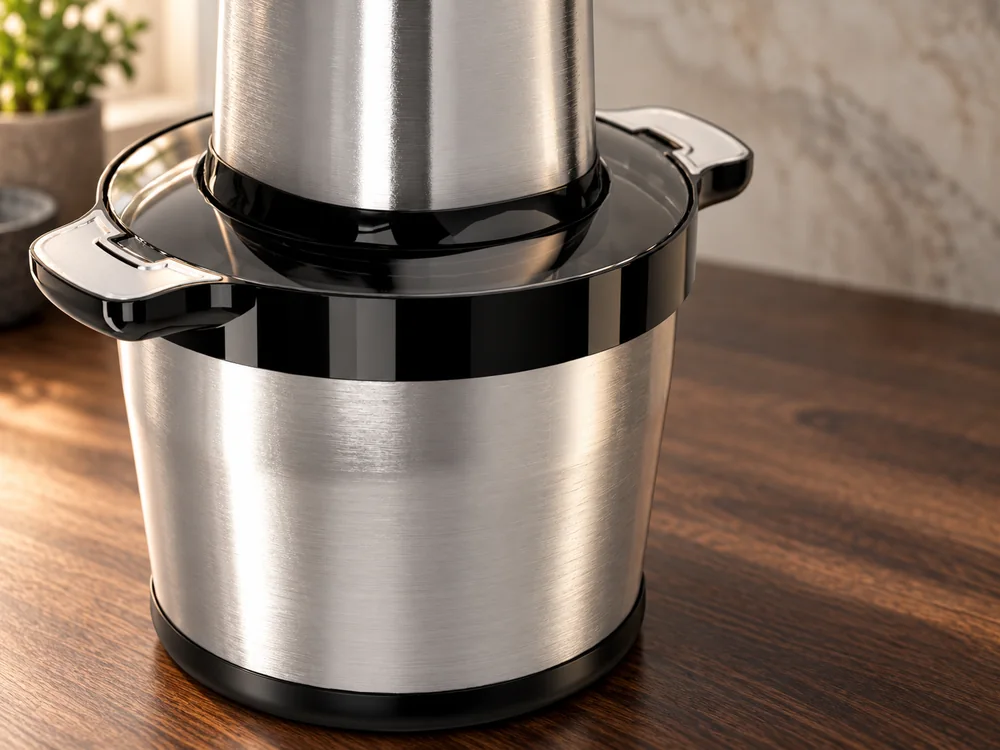
The closed appliance footprint is only one part of the space requirement. Ask how the complete unit is stored, how its components are removed according to the instructions, and where those components will rest during ordinary handling. A unit can fit on a shelf yet be inconvenient to take out and prepare for use.
Use the identified sample to examine that sequence. Start with the appliance stored as the customer would keep it. Consider the shelf opening, room above the motor unit, clear counter area and the places needed for detached components. Do not stage the sample on an unusually empty workbench and assume every household has the same arrangement.
Check the intended lifting method in the instructions. A handle-shaped feature on the motor unit does not, by appearance alone, authorize carrying the entire assembled appliance by it. Keep the evaluation within the specified handling method and ask for clarification where the permitted grip or assembly condition is unclear. Avoid demonstrations that depend on an unconfirmed carrying point.
Consider each component separately for storage and cleaning access. Ask for dimensions and weights relevant to the actual task, including the bowl and motor unit where needed. The supplier's cleaning instructions determine what can be washed and how. A steel bowl does not mean the complete appliance can go into a sink or dishwasher.
An importer does not need to invent a universal kitchen-size standard. It needs to test the offer against the intended channel. A retailer serving customers with compact kitchens may reach a different stocking decision from one whose customers routinely keep larger appliances on a dedicated surface. Use actual customer or retailer input rather than making assumptions from household size alone.
For an online listing, request an accurate dimensional view alongside the attractive main photograph. Do not rely on a decorative prop to communicate scale. Two product images enlarged to the same height can hide a meaningful size difference; two images scaled arbitrarily can exaggerate one. Use confirmed measurements for comparisons and retain each image's correct model identity.
If handling is the reason to reject a proposal, describe the problem specifically. An awkward storage opening, an unsuitable lifting arrangement and insufficient counter clearance require different responses. A different finish will not resolve them. The buyer can then request a suitable alternative or decide that this larger format does not belong in the range.

Price the larger sellable unit, including its movement
A factory unit price is an incomplete basis for choosing between sizes. Request the final or clearly provisional packed dimensions, gross weight and units per carton for each selected configuration. The packaging reference must belong to that appliance and its included parts. Do not scale an 8 L carton from the 6 L bowl ratio.
Give those figures to the transport and fulfillment providers who would handle the order. Ask them to price the actual route and handling arrangement. Where a provider uses a size or weight threshold, establish how the selected package is classified. A price difference at the factory can be outweighed by another cost, but the direction and amount require real quotations.
The same question applies after the stock arrives. Check warehouse locations, shelf capacity and order-picking practices with the responsible team. Compare the number of sellable units your allocated space can hold, not just the number of cartons. A package containing fewer units may require more handling for the same sales quantity.
|
Cost or handling decision |
Information needed |
What the buyer can decide |
|---|---|---|
|
Sample shipment |
Correct packed sample size, weight and delivery basis |
Which comparison justifies the initial sample expense |
|
Incoming order |
Confirmed carton data and route-specific freight offer |
Delivered cost of each proposed configuration |
|
Storage allocation |
Actual carton arrangement and warehouse constraints |
Affordable stock quantity within the available space |
|
Customer delivery |
Individual retail pack and channel handling conditions |
Whether the existing fulfillment route suits the offer |
|
Return or replacement |
Agreed collection, inspection and remedy responsibilities |
Provision needed for the support route the buyer chooses |
Keep packaging protection in the comparison. Reducing a carton dimension is useful only if the resulting arrangement remains appropriate and passes the agreed evaluation. Do not remove necessary protection simply to reach a delivery threshold. Ask the packaging team for a revised complete proposal and reassess the figures after it is defined.
JINJIE's quality and testing discussion is a place to establish the relevant packing checks. General factory photographs do not prove a particular MC or YW package has passed a transport test. Identify the selected configuration, packing arrangement and evaluation scope before treating a result as applicable.
Also price the route back from the customer. If the support policy involves collecting a complete unit, investigate the packaging and transport needed for that collection. If another remedy is proposed, establish its availability and responsibilities. Do not promise a replacement bowl service merely because the bowl appears detachable in a product photograph.
Compare these costs on one consistent commercial basis. Keep recoverable taxes, channel deductions and transport already included in a supplier offer from being counted twice. The useful output is an allowance for the complete product that your business can actually carry, with unresolved amounts visibly provisional.
Give the large model a specific retail role
The customer-facing explanation should survive without the words “bigger is better.” Identify the verified difference that makes the product worth considering: the stated nominal bowl size, the documented control arrangement, its physical format or another confirmed feature. Keep preparation results within the selected model's supported scope.
If you already sell a smaller chopper, explain why the new offer is being added. It might be a separate choice for customers who accept the larger storage requirement, rather than a replacement for every smaller model. If the channel cannot describe that distinction naturally, stocking an additional size may create confusion instead of a useful choice.
Avoid building three retail SKUs solely because the supplier lists three capacities. Begin with the size that addresses the channel brief, then decide whether another has its own customer role. A second SKU needs enough practical difference to justify its display, photography, stock and support work. An unresolved customer preference can remain an inquiry rather than becoming inventory immediately.
For a retailer sample, include the complete selected unit and correct product information. Make clear whether it is a display sample, an evaluation sample or the proposed production reference. An attractive display unit is not automatically approved for an operating demonstration. Any demonstration should follow the model's instructions and use supported claims.
Compare the sample in the retailer's actual presentation conditions where possible. Check whether the bowl size can be understood, whether the appliance fits its allocated display and whether staff can explain its scope. Record the objections that could prevent a sale. “Too large for this fixture” is actionable; “customers probably like big machines” is only speculation.
Review the channel's product fields before supplying listing data. A marketplace may ask for container capacity, recommended servings and processing quantity as separate entries. Enter only the supported value in the field it actually describes; leave an unsupported field unresolved with the channel instead of copying the same number across it. A correctly worded description can still mislead when the structured fields label nominal liters as an operating load.
If a buyer-branded version is planned, discuss OEM and ODM requirements after the physical offer is chosen. A color or logo decision should not conceal an unresolved size decision. Artwork, instructions and product-page images need to describe the model that will actually be supplied, including the agreed nominal-capacity wording.
Close one complete proposal before increasing the order
Bring the product decision and channel decision together. The selected proposal should name the model, electrical version, included assembly, presentation, packing and order conditions. Record why that size was chosen and which requirements remain to be confirmed. This gives the supplier a clear inquiry and gives your team a basis for accepting or declining the offer.
Ask for minimum quantities and timing for that proposal rather than borrowing terms from a smaller model. If the required commitment is too high, discuss fewer optional variants or another available arrangement. Do not assume that colors, capacities or electrical versions can share one minimum quantity. Obtain the actual conditions before promising an opening assortment to a retailer.
Keep the first-order quantity tied to a realistic route to customers. Larger carton volume can consume the space budget before the purchase budget is exhausted. Check both, along with the payment timing. A unit discount has limited value if the additional stock prevents the business from holding other products the channel already needs.
When the sample changes the decision, update the proposal rather than leaving two versions active. If the retailer selects MC-03 after evaluating MC-04, the final product images, cost calculation and carton information must follow MC-03. Retain the rejected alternative as background, not as an interchangeable substitute on a later order.
Request a size-specific wholesale proposal
Contact JINJIE with the intended retail channel, preferred configuration, target market, estimated quantity and practical space constraints. State whether the open question is permitted preparation, handling or the complete delivered cost. Request the information that can change that decision before authorizing the order.
FAQ
What if the supplier has not finalized carton dimensions?
Use an estimate only for a provisional comparison and identify its source. Ask when the selected packing arrangement can be measured. If the channel's delivery threshold determines profitability, keep the purchase decision open until reliable figures are available. A promising early freight estimate should not become a fixed commitment by default.
Can I order a large bowl as an upgrade for an existing smaller unit?
Only if the supplier confirms a supported compatible arrangement. Request identification of the associated lid, cutting assembly and connections, together with any changed instructions. Otherwise, treat the larger model as a separate complete appliance. Similar appearance or the same listed power does not establish compatibility.
Should the opening order include all three nominal sizes?
Not unless each has a defined role and the channel can support the combined commitment. A retailer's request to see alternatives does not necessarily mean it intends to stock them all. Separate sample interest from an accepted assortment, then price and plan the selected configurations individually.
What if a customer asks for restaurant use after the range is chosen?
Return to the intended application and request model-specific confirmation before making a recommendation. Do not extend the household range's promise from bowl size or steel construction. If the requirement depends on sustained production, the supplier must address that duty explicitly; the existing retail description is not sufficient evidence.