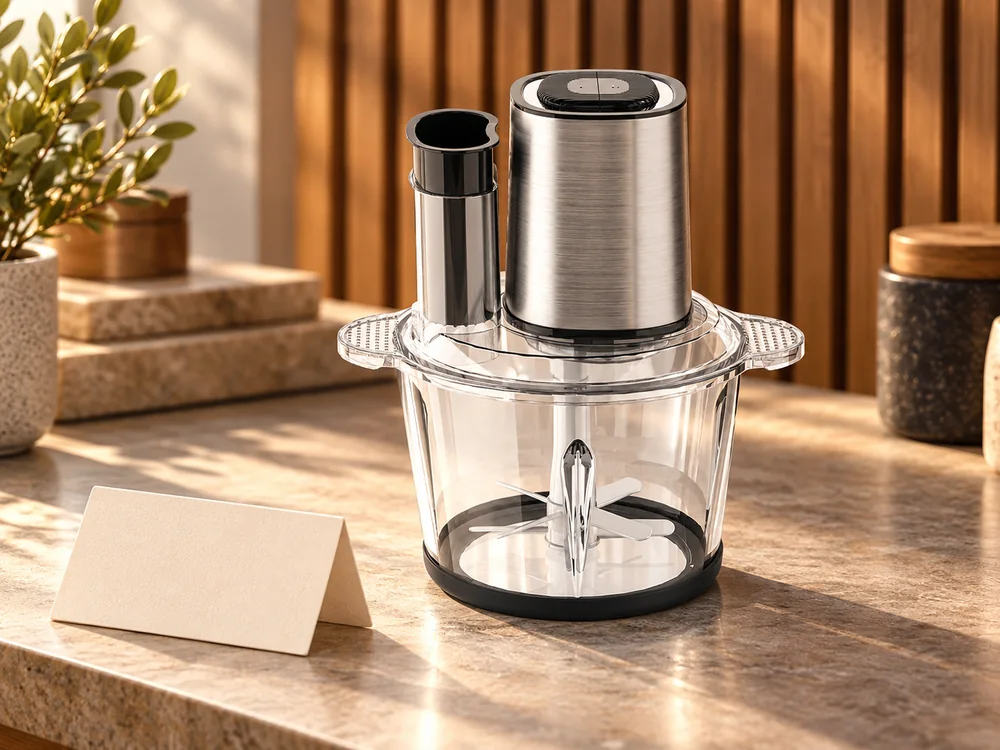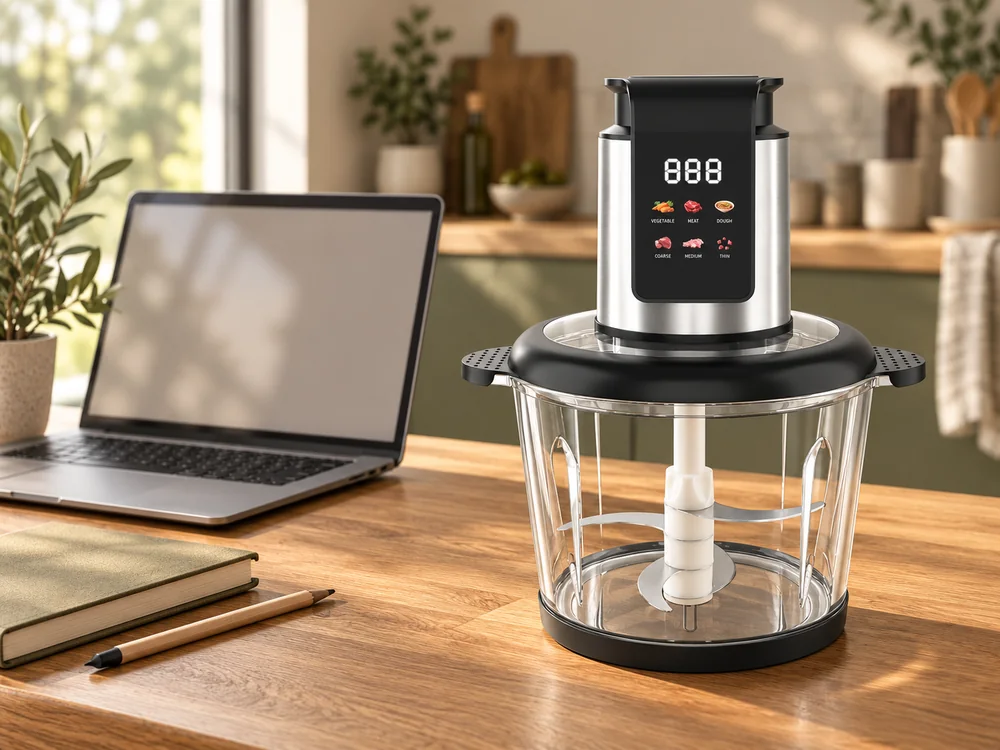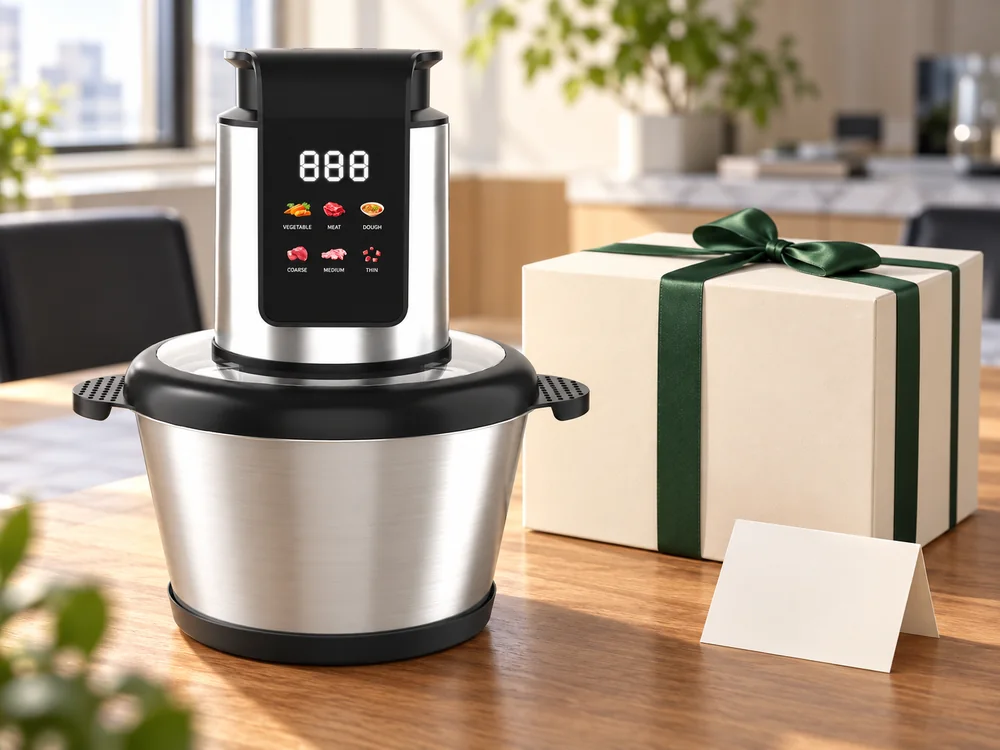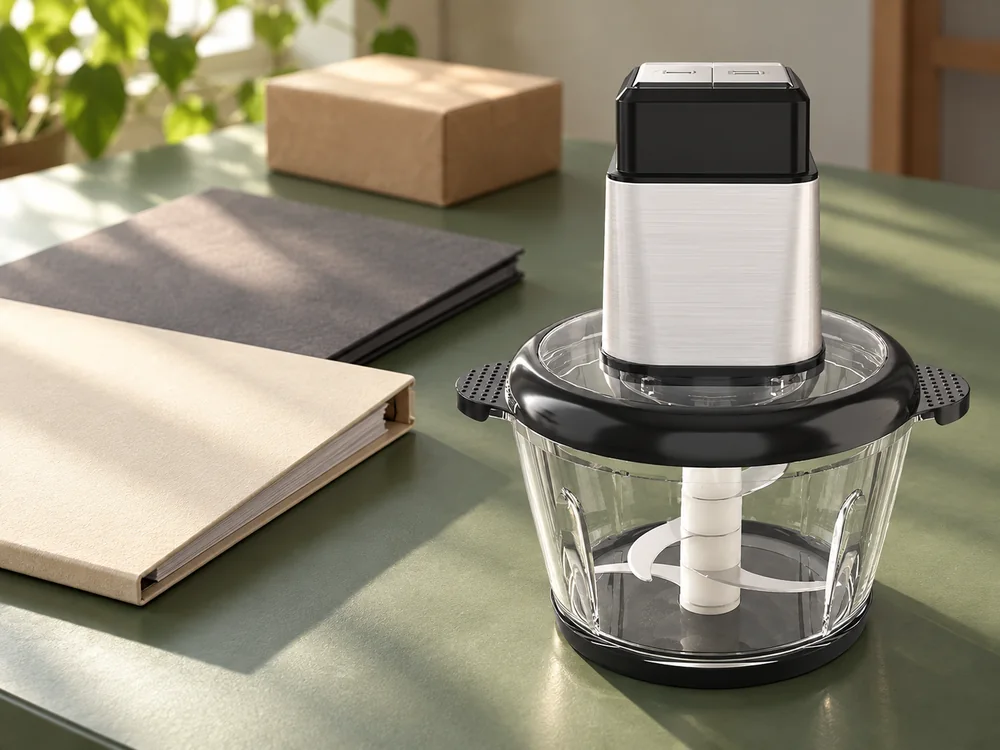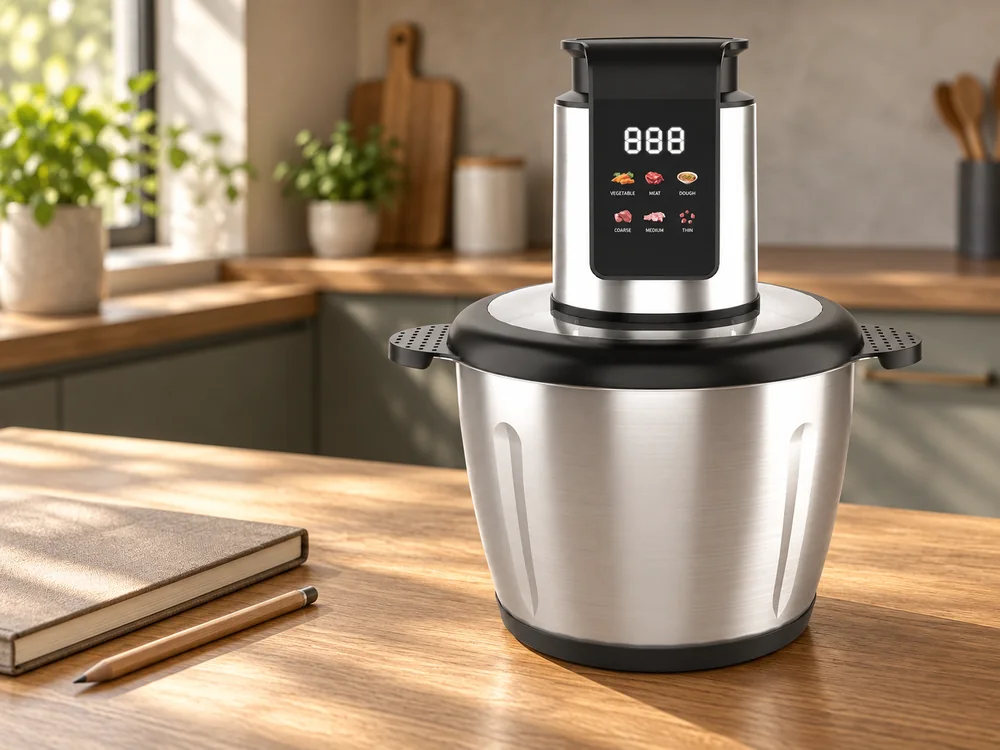
Meat chopper specifications can differ even when two products look nearly identical in a catalog. The bowl may change from glass to stainless steel, the nominal capacity may differ, or the selected motor and control version may change. A photograph of the motor housing does not resolve those differences.
For an importer choosing a meat chopper manufacturer, the practical task is to identify the complete configuration behind the image. This article concerns countertop bowl-type electric choppers. It does not describe screw-fed meat grinders or industrial bowl cutters used in meat-processing plants.
Compare meat chopper specifications within one family
A manufacturer's own product range is a useful place to see how much variation can sit beneath a similar appearance. JINJIE's SD family provides a clear example in the current configuration reference.
|
Reference |
Secondary reference |
Nominal bowl capacity |
Listed bowl material |
Listed power |
|---|---|---|---|---|
|
SD-01 |
CA1048 |
3 L |
201 stainless steel |
500 W |
|
SD-02 |
CB1048 |
2 L |
201 stainless steel |
400 W |
|
SD-03 |
CC1048 |
3 L |
Glass |
500 W |
|
SD-04 |
CD1048 |
2 L |
Glass |
400 W |
Use SD-01 and SD-03 to compare the listed 3 L, 500 W metal-bowl and glass-bowl options. SD-02 and SD-04 give the corresponding 2 L, 400 W comparison. This holds the listed capacity and power constant within each pair, although it does not prove identical internals or performance. Obtain usable-load and operating limits separately.
It also does not mean that every component is interchangeable across the four entries. A shared family name is a way to organize the range. Part compatibility still needs confirmation.
Use a paired comparison when the buying question concerns one feature. Comparing the two 3 L entries is more informative for a bowl-material choice than comparing the 3 L metal version with the 2 L glass version. The latter changes more than one specification, so the buyer cannot attribute every observed difference to the bowl material.
Include replacement-bowl supply in the material comparison if your retail offer depends on servicing the product. Ask whether the matched bowl assembly can be ordered separately, what quantity commitment applies and whether it needs its own protective packaging. If replacement supply is unavailable, compare the practical cost of supporting each complete version before promising customers that a damaged bowl can be replaced. This is a sourcing question, not evidence that either material has a higher failure rate.
Once a preferred direction is clear, ask for the exact proposed version. The comparison table is a shortlisting aid, not a complete order specification. It leaves electrical details, usable loading and the final supplied set to be agreed for the selected product.
Separate bowl choice from housing appearance
Similar housings can prompt buyers to assume that two suppliers use the same mold or buy from the same factory. Appearance alone cannot establish either claim. A source relationship, tooling ownership or exclusive design right requires direct evidence.
For the retail comparison, request the packed weight and carton dimensions of the glass and metal versions, then handle both samples. Consider whether seeing the contents through the bowl matters to the customer and how each complete unit fits the intended storage space. Use measured samples and actual freight quotes to compare the delivered cost.
If exclusivity matters, request evidence of the proposed design rights and agree the scope separately. A catalog color, handle shape or control panel does not establish an exclusive product. Keep that commercial agreement separate from the bowl and assembly comparison.
Start the material decision with a customer-facing reason. A transparent bowl allows the contents to be seen, while a metal bowl gives a different appearance and handling experience. Decide whether either difference matters to the intended range before treating one material as an automatic upgrade.
Measure the complete packed versions rather than assuming a freight difference from the material name. Protective packing, bowl shape and carton arrangement can all affect the comparison. A useful offer includes the actual packed information for the configuration being quoted, not dimensions copied from the other bowl version.
Handle both identified samples within their instructions. Consider lifting, placing and storing the complete unit, including the lid and motor assembly. If the preferred bowl makes the set less convenient for the intended customer, the buyer should weigh that observation against its visual appeal. Do not convert a personal preference into a universal claim that one material is better.
Where retail display matters, compare the product in ordinary viewing conditions. A polished studio image may hide how much of the bowl is visible beneath the motor housing. Choose the actual feature the customer will notice and describe it accurately, rather than building a price premium around an impression created only by photography.
Treat the bowl, lid and blade as a matched assembly
Changing the bowl can affect the parts that meet it. The buyer should review the lid, central support, blade assembly and the motor-unit connection together. A bowl that looks close in a photograph is not a confirmed replacement part.
JINJIE's electric meat chopper page specifically directs buyers to consider the bowl, lid, blade, center shaft and base as a compatible platform. Use that review before combining parts from different models or asking for a larger bowl on a preferred housing.
Capacity also needs a careful label. The 2 L and 3 L figures in the table are nominal bowl capacities. They should not be converted into a promised meat weight or batch output without the selected product's instructions and supporting evaluation. Leave room for the difference between container size and permitted food loading.
For the stainless steel versions, retain the listed grade accurately. The reference says 201 stainless steel for the bowl. Rewriting it as 304, “medical grade” or another stronger-sounding description changes the claim and is not supported by the source.
Ask the supplier to identify the assembly that goes with each bowl option. If a different lid or blade support is required, include it in the comparison. A quotation for the bowl alone may not represent the cost of a usable alternative configuration.
The same principle applies to an extra bowl offered as an accessory. Confirm that it belongs to the chosen model and identify any associated parts. “Additional bowl” should describe an approved item with a known role, not an invitation to combine parts from visually similar products.
For an intended batch requirement, tell the supplier the food and starting condition as well as the desired quantity. Ask which configuration can be considered within its operating instructions. A nominal-liter figure is useful for identifying the container, but it cannot settle whether the planned food load is appropriate.
If a sample cannot meet the preparation brief within its permitted method, reconsider the configuration or the brief. Increasing the quantity because the bowl appears to have empty space is not an acceptable way to establish a larger capacity claim.
Compare controls and supplied components next
The control format is another part of the product identity. JINJIE's SD entries are described as digital. The MB-01 through MB-04 entries list three speeds, while preserving their own capacity and material variants. Do not transfer a control description from one family to another because the products share a broad category.
Ask which positions, buttons or display indications apply to the chosen unit. Match the physical control layout with the manual and any words printed on the carton. A function icon should correspond to a documented operation for that model, not simply a food illustration available to the artwork designer.
Identify the supplied blade assembly and accessories in the same way. Count physical parts separately from functions. If a catalog shows several bowls or attachments, ask which are alternatives and which are included in the quoted pack.
Compare controls by what the intended customer needs to do. A display can change the appearance and interaction, but its presence alone does not prove a different chopping result. Ask which controls are available on the specific version and how the instructions explain their operation.
Look for a clear distinction between a control option and a product claim. A button icon may describe a setting or simply label a function. It should not become evidence that every illustrated food is permitted. The buyer needs the model's actual scope before using those icons in a retail listing.
If a simpler control version answers the same customer brief, request a comparable offer rather than assuming the more elaborate panel is necessary. If the retail range depends on a particular interface, include that layout in the sample reference. The commercial decision is about the value of the confirmed difference, not the number of visible buttons.
Decide which differences justify another sample
Not every catalog variant needs to be sampled. Start with the difference most likely to change the buying decision, then choose a comparison that keeps unrelated specifications as similar as the available range allows. This makes the sample spend easier to justify and the results easier to interpret.
The following table is a planning tool. It separates visible or listed differences from the additional information needed to make a purchase choice.
|
Difference under review |
Useful comparison |
Decision to make |
|---|---|---|
|
Glass versus metal bowl |
Same listed capacity and power, identified complete assemblies |
Whether the handling and presentation difference matters to the range |
|
Larger nominal bowl |
Permitted load, complete dimensions and actual preparation brief |
Whether the larger format serves a real customer need |
|
Digital versus another control version |
Model-specific operation and matched retail scope |
Whether the interface adds value worth its quoted difference |
|
Extra bowl or blade assembly |
Confirmed compatibility and complete supplied parts |
Whether to include the accessory or keep a simpler set |
|
Similar housing from another proposal |
Full configuration and applicable records |
Whether the offers are comparable before judging price |
Choose a next action that answers the open question. A packed-weight comparison needs the correct packing data. A handling preference needs physical samples. A question about permitted loading needs instructions and relevant evaluation. Ordering another attractive color will not resolve any of those gaps.
For a hypothetical retail plan, suppose one SKU must show the ingredients clearly and another is being considered only because it has a larger nominal bowl. The first requirement points to a visible customer benefit. The second still needs a preparation or range reason. Ask what the larger version would let the buyer offer before adding it to inventory.
Keep observations and preferences distinct in the comparison note. “The buyer prefers the appearance” is a legitimate reason when appearance matters to the range. It should not be rewritten as “better performance” unless the performance comparison was actually made and supports that conclusion.
Use JINJIE's quality and testing discussion for the checks relevant to the selected assembly. Define the question being evaluated and preserve the sample identity with the result. A general quality statement does not replace the specific information needed to choose between two configurations.
Choose a configuration before requesting the final price
Use a configuration line that combines the codes with a plain-language description. For example: “SD-03 / CC1048, nominal 3 L glass bowl, listed 500 W, electrical version and complete pack-out to be confirmed.” This example identifies a catalog configuration without pretending that all order details are settled.
Attach the relevant product image and date the reference. Then ask the supplier to confirm the lid and blade assembly, included parts, voltage, frequency, plug and intended preparation scope. Add the required color, logo and packaging as separate fields.
Ask for prices on the same order quantity, electrical version and pack-out. Compare any extra charge for the preferred bowl or control version with the customer benefit observed on the sample. Do not pay for a larger nominal bowl solely on the assumption that it processes more food per cycle.
Keep a record of substitutions. If the supplier changes the bowl, controls or electrical specification while discussing price, the revised quotation needs a new configuration description. Otherwise, the buyer may approve the appearance of one version and order the specification of another.
Check whether the preferred version remains commercially useful once its complete set is priced. An apparently small upgrade may require a different assembly or packing arrangement. Ask the supplier to identify those consequences so the buyer can choose the complete offer rather than approve one attractive feature in isolation.
If the budget requires a change, state which preference can move. The buyer might consider another confirmed finish while keeping the required bowl format, or a simpler available control version while preserving the intended use. Do not let a price negotiation silently change a mandatory requirement.
End the comparison with one selected configuration and a short explanation of the choice. Keep alternatives clearly labeled as alternatives. This prevents a later artwork or purchasing task from borrowing a feature from the version that was considered but not selected.
Give the commercial team a description it can use without reopening the full catalog. Include the selected bowl material and nominal size, the control version and the supplied assembly reference. Keep unresolved details visibly open until confirmed. This is more reliable than a product nickname such as “the large silver one,” which may fit several variants.
Where a customer requests two versions, give each its own configuration line even if most details match. State which differences are intentional. Separate lines make it easier to compare the two offers and prevent a shared product photograph from hiding a changed bowl or control panel.
Review future replenishment as part of that description. Ask the supplier how the selected version will be identified on a repeat inquiry, and retain the dated reference used for the first order. Availability and specifications may change, so a repeat request should still ask whether the original configuration remains available rather than assume that an old photograph guarantees it.
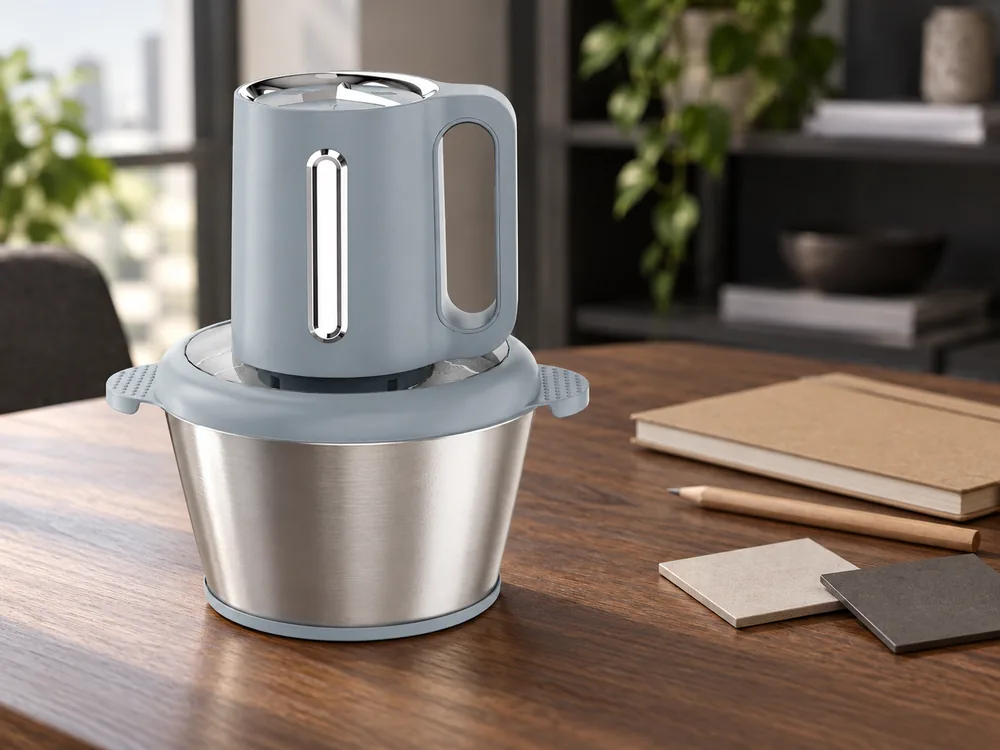
If an alternative is proposed later, compare it against the reason for the original choice. A substitute with the same nominal capacity may lose the transparent bowl that mattered to the retail offer. Another may preserve the appearance but change the controls. The buyer can then accept the actual tradeoff or keep searching, instead of treating a similar headline specification as complete equivalence.
This keeps the comparison useful after the first sample. The record explains both what was chosen and which customer requirement made that version preferable.
Conclusion
JINJIE's OEM and ODM process separates a current-product configuration from a structural change. Send the preferred image together with the bowl and control requirements so the quotation identifies one complete version.
Make the purchase choice on the confirmed difference that serves your customer: bowl visibility, handling, a supported preparation requirement or a useful control format. Preserve the full configuration behind that choice so the final price and sample refer to the same product.
FAQ
Can I identify a chopper's exact capacity from its image?
Not reliably. Similar images can represent different capacities, and renderings may not provide a usable scale. Use the model-specific specification and confirm the sample identity.
Does a larger bowl or higher power entry prove better performance?
No. It identifies a specification difference. The intended food, loading, operating instructions and evaluation determine whether that version meets the buyer's requirement.
Can a supplier change the bowl while keeping the same housing?
That possibility must be reviewed for the selected product. Ask which lid, blade and connection parts must change and whether the revised assembly needs new sample or document checks.
Is a digital-control version automatically the premium choice?
It is a different interface, not automatic evidence of better results. Compare its documented operation, complete configuration and quoted cost with the intended retail position. A simpler available version may be appropriate when it answers the same customer need without an unnecessary feature claim.