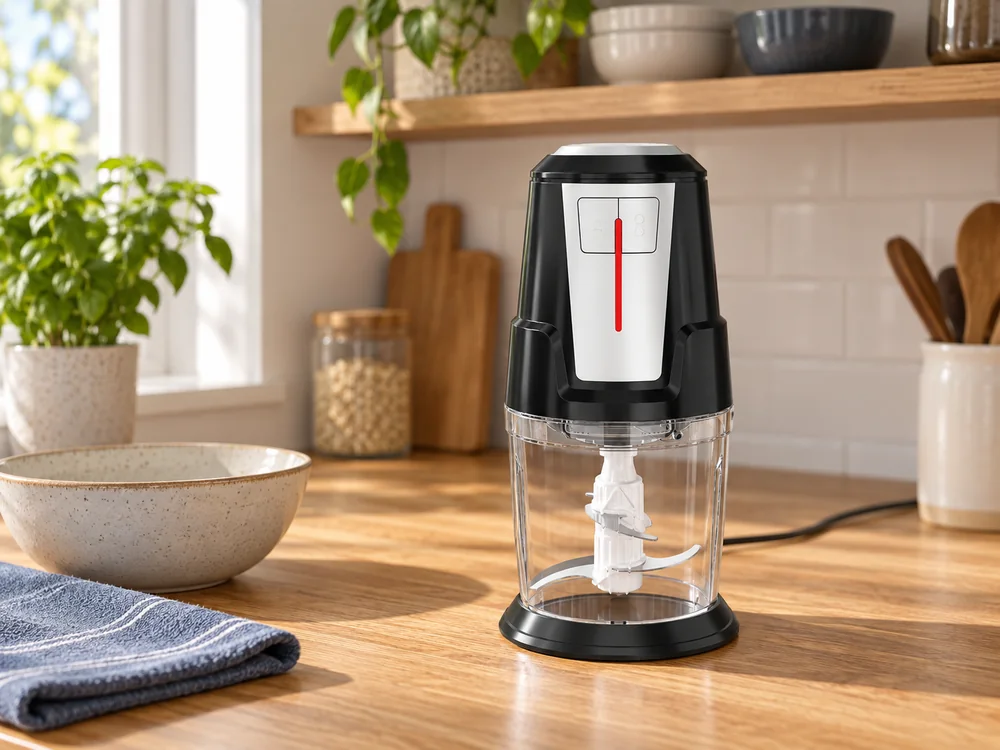
A mini food chopper factory should be able to explain what makes its proposed product compact and which preparation job it suits. A smaller-looking bowl is only part of the answer. Buyers also need to know the complete appliance dimensions, the permitted load, the supplied parts and the space needed to take the product apart after use.
For a retail brand, the useful question is whether the compact model gives customers a reason to choose it alongside a larger chopper. That reason might involve storage, handling or a specific preparation task. It should remain understandable after the product is packed, priced and photographed, rather than depend on the word “mini” doing all the selling.
This article covers household electric bowl choppers. It does not assume that a compact product is cordless, rechargeable, intended for travel or suitable for every small food quantity. Those characteristics need separate confirmation for the actual appliance.
Define compactness before choosing a mini food chopper factory
Tell the factory which constraint matters. A buyer trying to fit a product beneath a kitchen shelf has a different requirement from one seeking a small retail box. Another buyer may want an appliance for a modest preparation task without needing the smallest possible housing. Treat those as distinct requirements when requesting suitable models.
Ask for the dimensions of the complete assembled appliance, not only the container. Include the widest handles, lid and motor unit where they affect storage. A narrow bowl beneath a tall motor may not fit the intended space. The relevant measurement follows the customer's constraint rather than whichever dimension is easiest to advertise.
Separate the stored arrangement from the working arrangement. A product may need space above it to lift off the motor or lid, and the parts removed during preparation need somewhere to rest. If the retail promise concerns limited counter space, assess that complete routine. The smallest footprint in a catalog does not settle the question.
Nominal bowl volume describes another aspect of the product. It is useful for identifying a configuration, but it does not define a universal minimum or maximum food load. Ask the factory about the intended ingredient and quantity within the selected model's instructions. Do not assume that reducing the bowl size guarantees a satisfactory result with a very small amount of food.
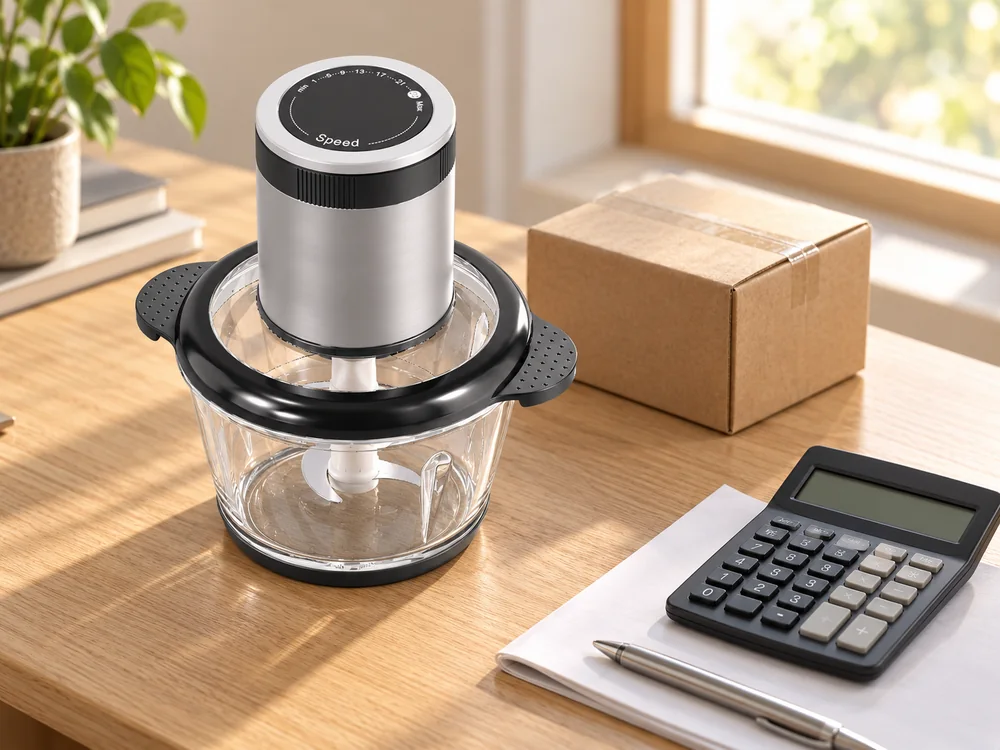
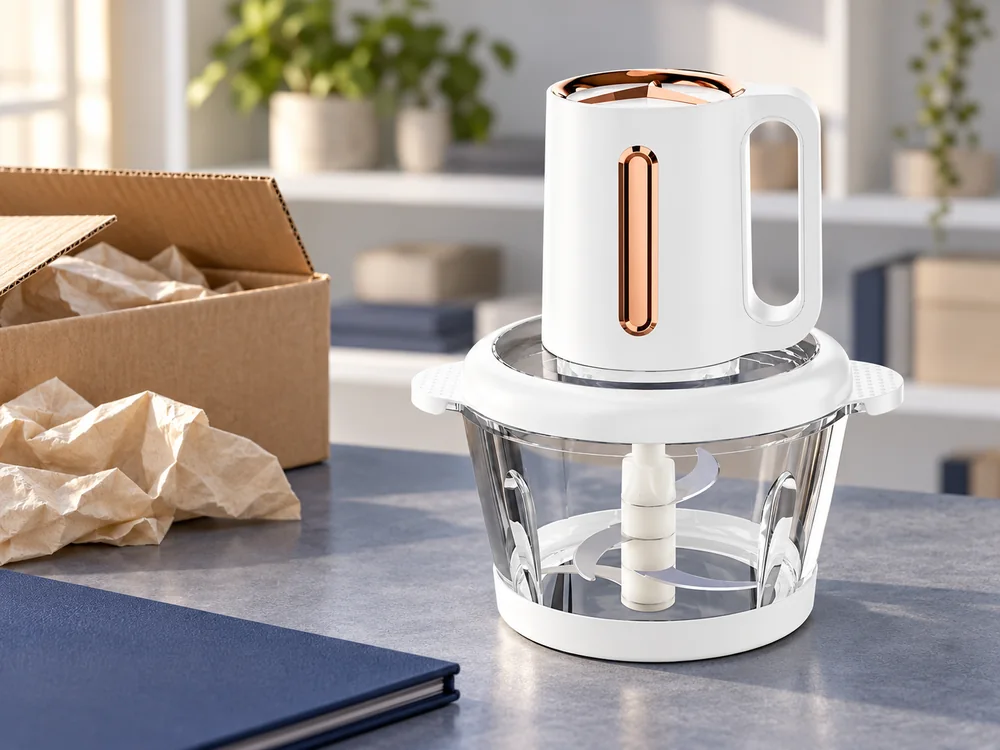
The JINJIE electric meat chopper range includes compact bowl formats alongside larger options. Use a specific reference when discussing a compact project. The factory can then respond to the required dimensions, preparation and retail position instead of guessing what “small” means to your business.
Avoid attaching unrelated promises to compactness. A small appliance is not automatically a travel product, a children's appliance or a battery-powered device. If one of those features is central to the project, make it an explicit requirement and establish whether a current product supports it. Otherwise, keep the offer within the confirmed household use.
Compare current compact configurations without guessing performance
JINJIE's current quotation provides several identifiable compact-format references. The entries below are useful starting points for a product inquiry. They list nominal container volume, material, power and control information, not measured chopping results or a guarantee that the parts can be exchanged between models.
|
Quotation model |
Listed configuration |
Question for the retail brief |
|---|---|---|
|
TY-05 |
Nominal 1.2 L AS bowl, 400 W, two speeds |
Does the actual interface and complete size suit the intended position? |
|
CO2061 |
Nominal 1.2 L AS bowl, 400 W, one speed |
Would the simpler available control arrangement answer the main task? |
|
CP2061 |
Nominal 0.8 L AS bowl, 400 W, one speed |
Does this complete format suit the required handling, storage and permitted preparation? |
TY-05 also carries the secondary reference CO2052 in the quotation. Use TY-05 first when identifying that offer. CO2061 and CP2061 appear without a separate primary model in those rows, so their listed references identify the respective proposals. Keep the descriptive configuration beside each code during comparison.
The two nominal 1.2 L entries show why volume and wattage alone are insufficient. Their listed control arrangements differ. That does not prove a performance advantage for either one. Ask what the controls do on the actual sample and whether the difference matters to the customer's preparation routine.
The 0.8 L entry offers another nominal container size, but its external dimensions still need confirmation. Do not calculate an assumed reduction in height, carton volume or food loading from the liter figures. The motor, lid, protective packing and other parts contribute to the complete product and package.
Keep the bowl, lid, blade and motor connection together as the offered assembly. Similar-looking compact models should not be treated as a box of interchangeable parts. If the project needs another bowl or a different supplied item, ask for an approved configuration and its complete quotation rather than combining attractive features from separate rows.
For the material description, retain AS as listed. Do not turn that field into an unsupported statement about dishwasher use, impact resistance or compliance. If a material characteristic is important to your market, request the appropriate information for the selected part and version. The name of a material is not a substitute for the relevant product evidence.
Choose which comparison deserves physical samples. If the decision is between control arrangements, compare the identified versions. If storage height could rule out a model, get that dimension before paying for shipping. Sampling should resolve the question most likely to change the purchase, rather than reproduce the entire compact catalog on a meeting table.
Judge handling in the space the customer actually has
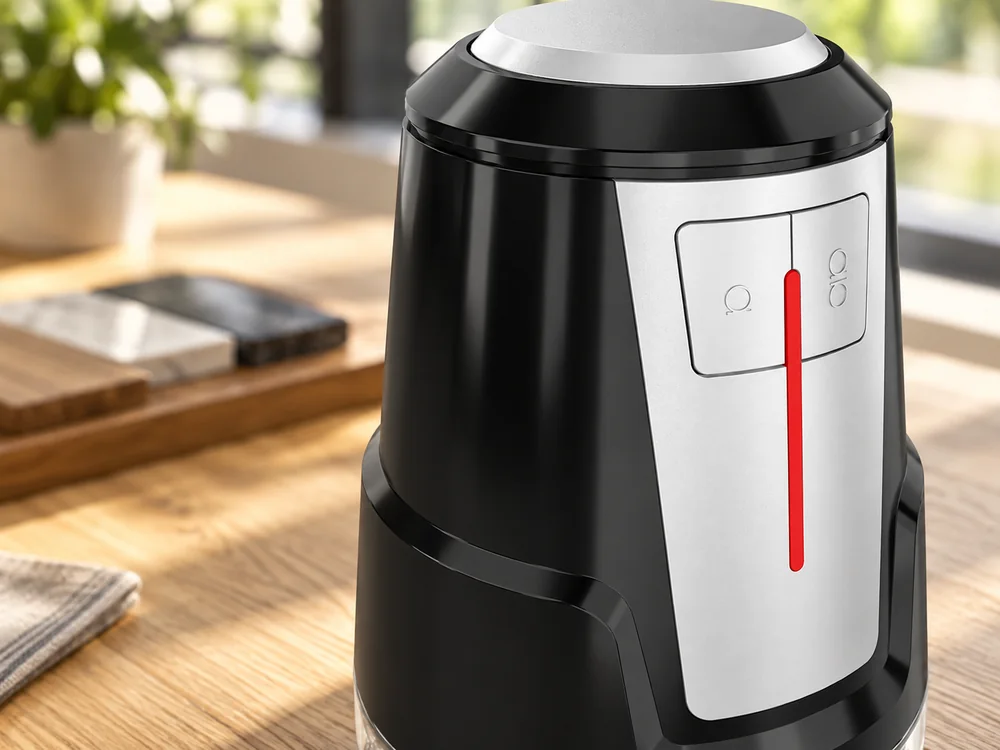
A compact appliance may spend more time being taken out and put away than being used. Observe those steps on a sample. Can the complete unit be grasped comfortably in the intended storage position? Where do the motor and lid go when the bowl is opened? These are practical selection questions, not claims that can be settled by a front-view photograph.
Set up the sample in a space representative of the retail brief, with the actual clearances measured. Keep the arrangement ordinary. A large empty studio counter can make almost any appliance appear convenient. If the intended appeal is a smaller kitchen, the evaluation should include the other objects and working room that the customer cannot simply remove.
Assess access to the bowl within the instructions. Look at how the user loads the permitted preparation, closes the assembly and removes the contents afterward. Note any step that conflicts with the intended customer experience. Do not improvise an operating method or leave a protective part out to make the demonstration look easier.
The control explanation should fit the physical interface. A one-speed model may offer a straightforward retail story; a two-speed model needs a clear account of its documented use. Neither description should become a claim that the user can process any ingredient by choosing the right button. Keep the instructions and permitted food scope with the sample.
Check the cleaning and storage requirements for removable parts. Ask which components can be washed and how the motor unit should be cared for. If a part must dry separately before storage, consider where that happens in the intended kitchen. Do not advertise the entire appliance as washable or dishwasher-safe based on a removable container.
Bring the findings back to the selling proposition. A sample may be visually compact but awkward for the storage space originally specified. Another may occupy slightly more room while making the required handling easier. The buyer can prefer either, provided the choice is based on the complete routine and the public description reflects the actual advantage.
Establish whether the small preparation job is worth buying for
Define a preparation task that the compact product is expected to make worthwhile. Give the factory the ingredient, starting condition, desired result and intended quantity. A broad request for a “small-batch demonstration” leaves important variables unstated. The permitted loading and method need to come from the selected model's operating information.
Watch the full task rather than only the powered interval. Include any cutting or other preparation before loading, then removal and cleaning afterward. A compact product may be attractive because it is easy to bring into a routine. If the required preparation and cleanup undermine that reason for purchase, the buyer needs to know before developing the retail pack.
Keep the complete result available for review. Do not judge a sample only from the portion styled for a photograph. Describe whether the result suits the intended cooking task and what further work the customer would need. Avoid inventing a time-saving percentage or a texture measurement that was never established.
If a very small quantity does not give the desired result, do not immediately conclude that the product is defective. First confirm that the task was within its instructions and that the sample was correctly identified. The result may indicate that a different preparation quantity or product is needed. That distinction matters when the entire retail proposition depends on a small task.
Likewise, do not turn one satisfactory demonstration into a claim covering all ingredients. Select the main use that supports the product's position, and keep secondary uses within the established scope. A compact appliance can have a useful, limited role without being presented as a replacement for a larger food processor.
JINJIE's quality and testing information provides a basis for discussing the relevant evaluation. Ask for the product identity and conditions behind a result. A general inspection record and a preparation demonstration answer different questions, so obtain the one needed for the open purchasing decision.
Compare the findings with the larger product already in your range, if applicable. The question is whether the compact version contributes a useful difference for the customer. It does not need to outperform the larger appliance at every task. It does need a reason to exist beyond being another catalog option with similar wording.
Price the compact retail set, including its packaging
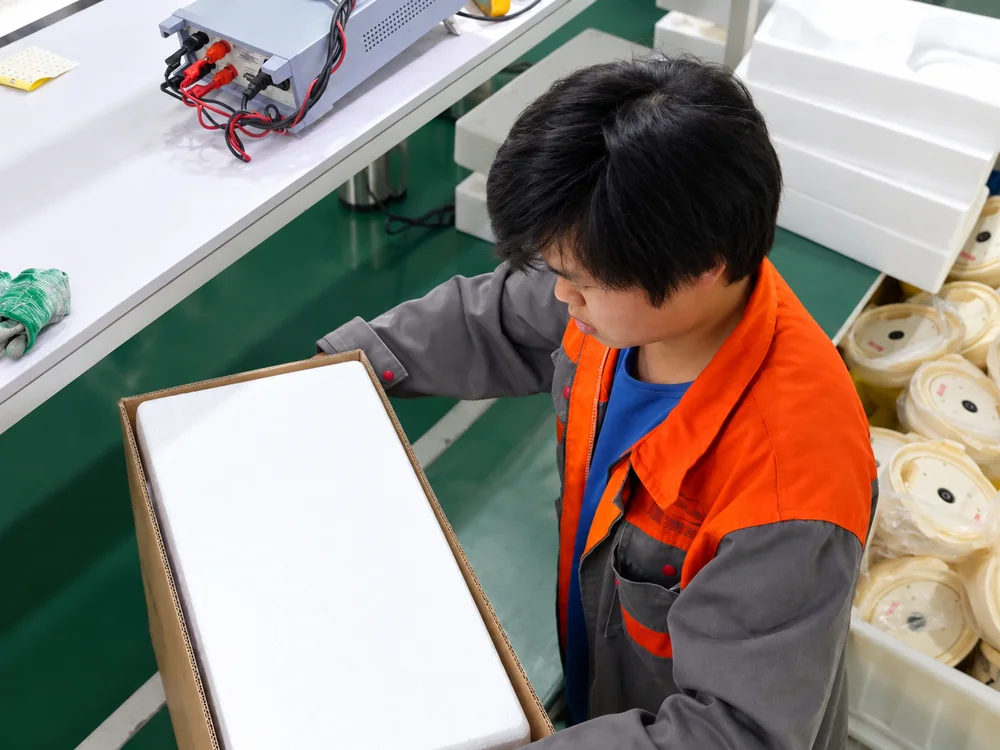
Ask the factory to quote the complete supplied set after the product choice is clear. Identify the electrical version, instructions, protective packing and retail presentation. A compact motor-and-bowl photograph does not show every item necessary for a sellable product, and a bare-product price may not describe the offer your channel needs.
Compare actual package dimensions and weights. A smaller nominal bowl does not automatically produce a proportionally smaller box. The product arrangement and protective materials affect the pack. Use the proposed packed version when discussing freight or shelf allocation, rather than estimating the savings from a product rendering.
Avoid making the box smaller by removing required protection. If the proposed pack is too large for the channel, ask the factory to assess another packing arrangement and the relevant checks. The resulting offer should still protect the identified appliance and include the agreed items. A compact-package target is a design constraint, not permission to omit necessary work.
For branding, start with the customer's main reason to choose the product. A photograph showing its complete scale and a clear preparation task may be more useful than a long list of functions. Keep props separate from included items. Do not show an extra bowl, storage lid or attachment as part of the set unless the quotation actually includes it.
The OEM and ODM discussion distinguishes branding a current product from changing its design. Use that distinction when asking for a compact project. A new color or printed presentation is different from reducing the housing, changing the container interface or introducing another power arrangement.
Ask about quantity conditions for the actual model and requested variations. A small physical product does not necessarily come with a small minimum order. If the commitment is too large, discuss fewer optional colors or a simpler available presentation. Preserve the required electrical version and product scope while considering those commercial alternatives.
Keep the total opening commitment visible. Several low-priced compact variants can still consume more stock and presentation work than one well-defined offer. Compare the complete costs and responsibilities your business will carry, without assuming that the word “mini” guarantees a lower delivered cost or an easier launch.
Give the compact model a distinct place in the range
Decide how a customer would choose between the compact product and any larger alternative. The distinction might be the complete dimensions, a supported preparation role or a different handling preference. Use the confirmed difference in the product-page explanation. If both offers require the same benefit list, reconsider whether the second SKU has earned its place.
|
Finding from the compact-product review |
Range decision |
What to carry into the final offer |
|---|---|---|
|
The complete size fits a real storage constraint |
Consider a space-led position |
Verified assembled dimensions and relevant clearance information |
|
The intended preparation task is supported |
Consider a focused preparation position |
Model-specific scope and an accurate description of the routine |
|
The control difference is useful to the customer |
Compare the available versions as distinct offers |
Correct interface, instructions and price for each version |
|
The product adds no clear benefit beside the existing range |
Keep it outside the opening assortment |
Preserve the option for a future, different customer brief |
|
The packed offer loses the expected commercial advantage |
Reassess packing or product choice |
A complete revised quotation, not a guessed freight saving |
Choose the first compact SKU before expanding colors or configurations. Give it a concise customer-facing description and a precise purchasing reference. The customer does not need to understand internal model aliases to choose a product, but the buying and packing teams need a reliable way to identify the same complete version.
Ask how the selected configuration will be identified on a repeat order. Preserve the agreed sample and product information, then confirm current availability when replenishing. A later substitute should be compared with the reason the compact model was selected. Matching nominal volume alone may not preserve the storage or handling feature that mattered.
Use the manufacturing overview to discuss preparation of the chosen version when the product decision is ready. Keep the conversation specific to the required quantity and presentation. General factory activity cannot establish when your compact order will be ready or whether a particular optional color is available.
The final choice may be one compact model, a compact and larger pair, or no compact addition yet. Each can be a sensible outcome. The purchase is justified when the complete product answers a defined customer need on terms the business can support, with a distinction the retail team can explain plainly.
Request a compact-product proposal
Discuss your mini food chopper project with JINJIE. Include the preferred reference, the space or preparation constraint behind the request, destination market, estimated quantity and required packaging. Ask for the complete dimensions, supplied configuration and applicable operating information before deciding which compact offer belongs in your range.
FAQ
What if the compact model needs more clearance than its advertised height?
Use the working clearance for the customer-space decision and the assembled height for the stored-product description. Both can be valid measurements, but they answer different questions. If the required access does not fit the intended setting, reconsider the model or narrow the space-related promise rather than omit that part of the routine.
Can I request one housing with both 0.8 L and 1.2 L bowls?
Ask the factory whether an approved combination exists for the exact product. The separate quotation entries do not establish interchangeable bowls, lids or blade assemblies. If a two-bowl set is available, obtain its complete supplied-parts description and price before showing it as a retail offer.
Does a two-speed compact chopper deserve a higher retail position?
Only if the actual control difference contributes value your customer can understand and the complete offer supports that position. Compare the documented operation and sample interaction. Do not assign a performance premium solely from the number of speeds or describe the one-speed alternative as inferior without evidence.
What if the product is compact but the retail pack is not?
Ask which elements determine the package size and whether another suitable packing arrangement can be evaluated. Keep protection and supplied contents intact. If the complete pack still does not suit the channel, compare another product or revise the commercial plan instead of promising a size advantage that the delivered offer does not provide.