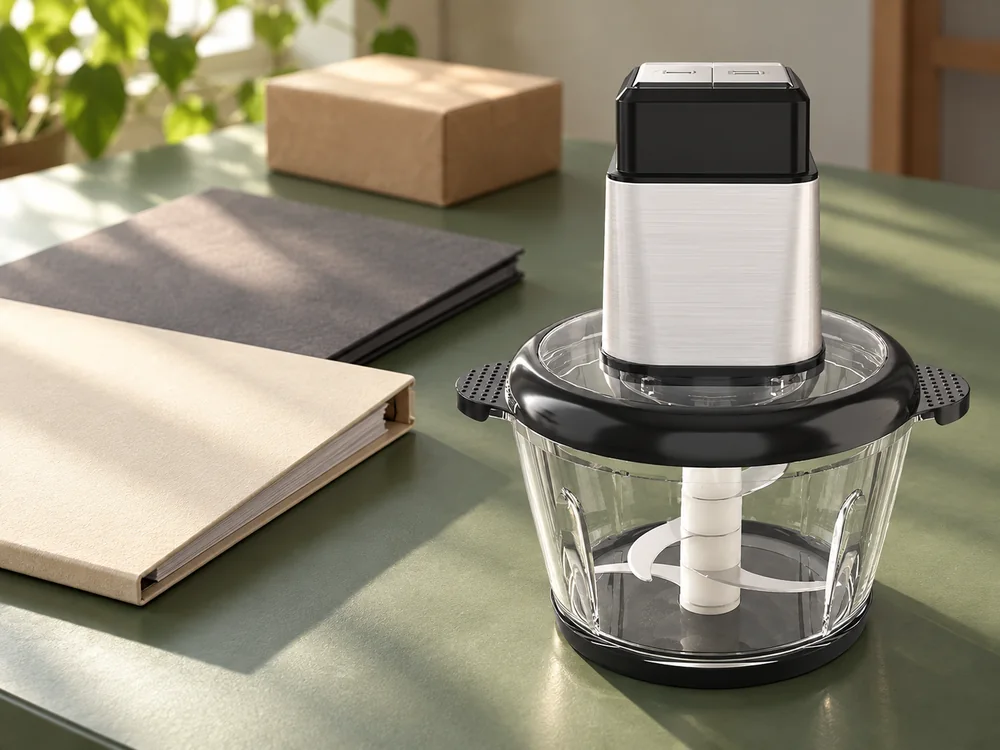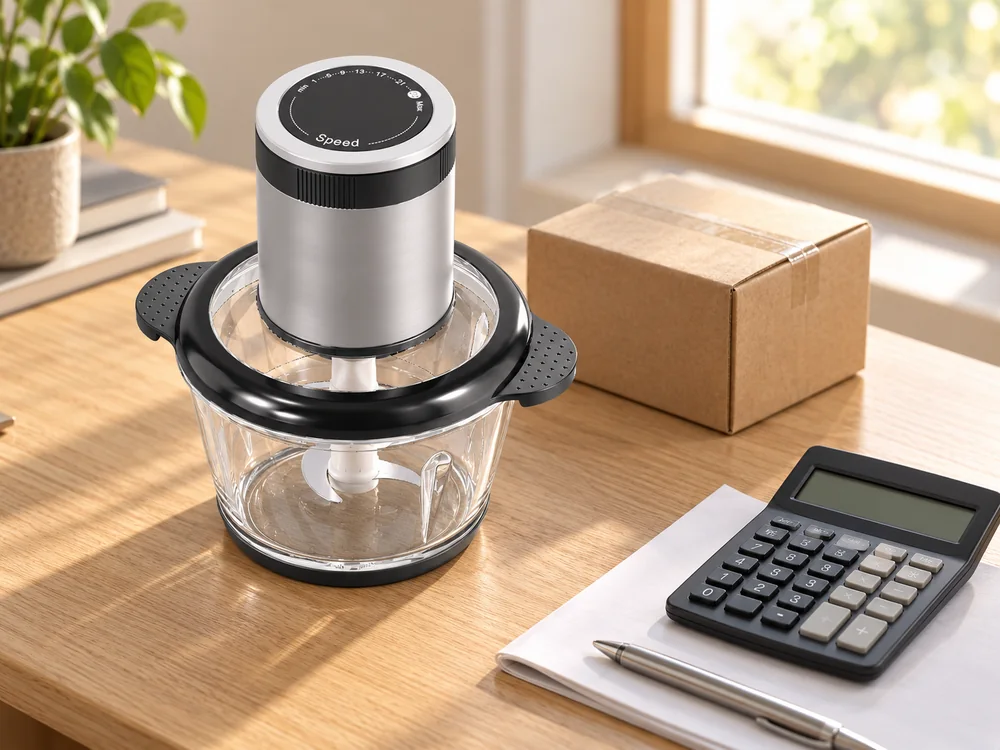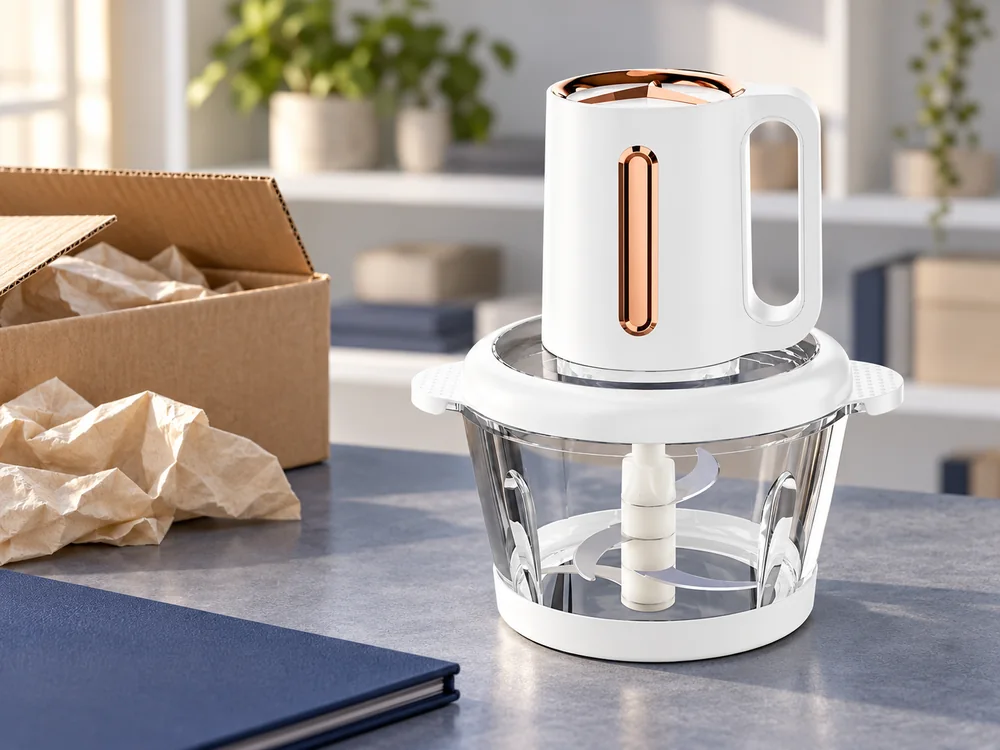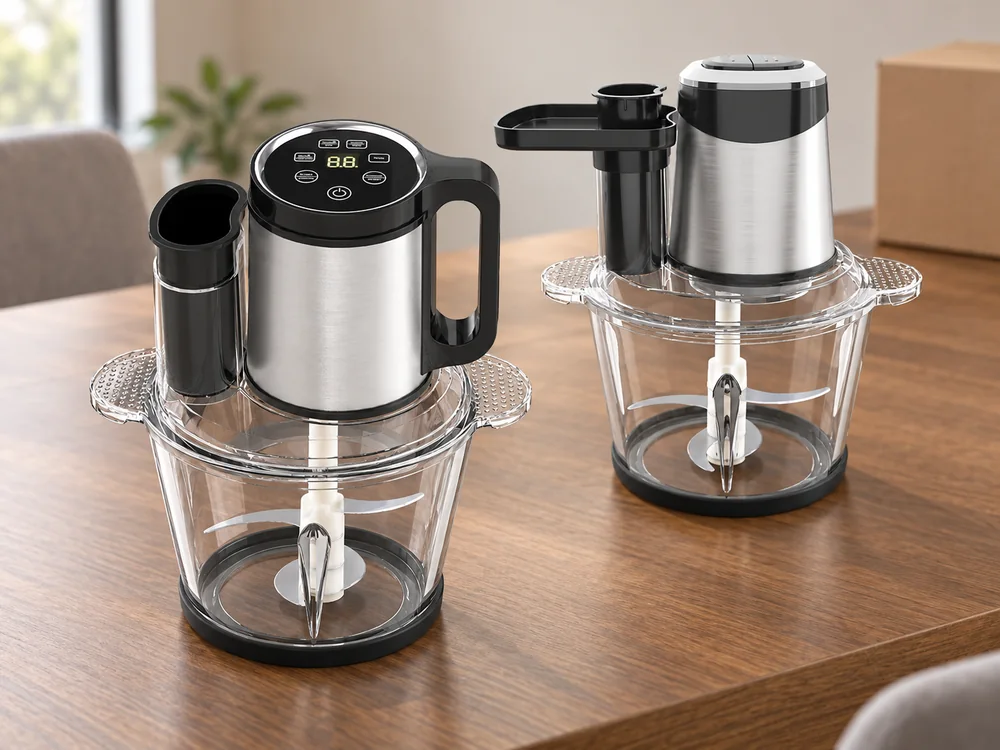
Mixed-model meat chopper orders work best when every SKU has a reason to be stocked and an agreed quantity, carton arrangement and readiness date. A correct shipment total is not enough if the allocation leaves your best-selling line short and your slower line overstocked.
For importers and private-label distributors, the attraction is a broader assortment within one purchasing program. The complication is that model count and SKU count are different. Bowl material, color, electrical version and set contents can turn two housing designs into several independently managed products.
Build the order around the combination your warehouse will receive and your customer will buy. Then test that proposed mix against minimum quantities, complete cartons and the launch schedule. This guide covers that planning task for household electric bowl choppers. Numerical examples are illustrative purchasing calculations, not JINJIE order minimums or packing specifications.
Give every SKU a place in the assortment
Start with the customer-facing difference. One line may serve an entry price point, another a preferred bowl material, and another a retailer's request for different controls. If two products answer the same need at almost the same retail price, ask whether both deserve inventory in the first shipment.
A useful assortment description is short enough for a salesperson to repeat accurately. “The glass-bowl option lets customers see the ingredients” explains a visible distinction. A claim about greater output or longer operating time requires evidence for the selected model and cannot be supplied by a different housing shape.
Browse the JINJIE electric meat chopper range to identify relevant product formats. Keep the selected model reference beside the bowl, controls and supplied set. Parts and accessories should follow the configuration offered for that model rather than an assumed common fit across the range.
Next, consider demand by line. Use your retailer's allocation, previous sales where available, or an explicitly provisional first-order forecast. A proposed equal split may be convenient for purchasing but has no commercial justification unless demand is also expected to be equal.
For a new range without sales history, decide what the first shipment is intended to learn. You might want to compare demand for two bowl formats, or establish one core model before adding a premium version. Keep that question narrow. Testing several colors, electrical versions and accessory packages at once makes a weak-selling combination harder to interpret.
Separate a confirmed customer commitment from a forecast. Units already allocated to a retailer have a different scheduling consequence from speculative stock. Recording that distinction helps decide which line must ship first if the full assortment is not ready together.
Count the combinations before discussing minimum quantities
Use one line for each sellable configuration. A base model offered in two colors and two electrical versions can create four SKUs if all combinations are ordered. Add another set configuration and there may be further lines. Count the combinations you actually plan to buy, not every theoretical option in the catalog.
Ask which minimum quantity applies to each model and customization. A general order minimum may differ from the minimum for a color, printed box or electrical version. JINJIE's product information treats minimum quantities as dependent on model and customization, so the proposed mix needs a line-by-line response.
The total order value can conceal a weak line. Suppose, as a hypothetical example, the proposed total is 1,200 units across four SKUs, but one of those SKUs represents only 100 units. Knowing that the supplier accepts the overall total does not establish that this particular version can be produced on the same terms.
If a small line requires unique materials, compare several responses: increase that line, remove an optional variation, postpone it or request the actual additional cost. Do not automatically increase quantity to satisfy a minimum. First ask whether the extra stock has a plausible sales route and whether it displaces cash needed for the core model.
Sharing a color or retail-box design may reduce separate instructions where the supplier confirms it is workable. Keep product-specific ratings, contents and language accurate. A common box with the wrong attachment pictured is not a useful simplification.
For custom colors or sets, use the OEM and ODM discussion to identify what creates a separate requirement. Ask the supplier to distinguish a cosmetic option from a change involving another component, sample or packing arrangement. This helps you remove expensive complexity without removing the product difference customers actually want.
Record acceptable substitutions in advance, if any. A different color might be commercially acceptable for unallocated stock, while another plug or bowl version may not be. An allowance should name the alternative and its limits. Silence is not permission to replace one SKU with another.
Turn mixed-model meat chopper orders into carton quantities
Put units per master carton beside the requested units for every line. Divide the line quantity by that packing quantity before issuing the purchase order. If the result is not a whole number, decide whether to adjust the order or agree a separately identified partial carton.
For an illustrative line packed six units per carton, 120 units require 20 cartons. A request for 125 units creates 20 full cartons and five remaining units. A buyer could order 126 units, accept an agreed partial carton or revise the line to 120. The appropriate choice depends on demand, permitted packing and the receiving process.
Use a table like this to expose the rounding decision. A, B and C are hypothetical SKUs, and all packing quantities are examples.
|
SKU |
Requested units |
Units per full carton |
Proposed allocation |
|---|---|---|---|
|
A, core range |
600 |
6 |
100 full cartons, no change |
|
B, second format |
250 |
4 |
62 full cartons plus 2 units, or revise to 252 |
|
C, trial line |
125 |
6 |
20 full cartons plus 5 units, or revise to 126 |
|
Total if rounded up |
978 |
Different by SKU |
184 full cartons across the three lines |
The original request totals 975 units. Rounding B to 252 and C to 126 adds three units and produces 100, 63 and 21 cartons respectively. That is a small quantity change in this example, but it still needs approval because it changes the purchase and allocation records.
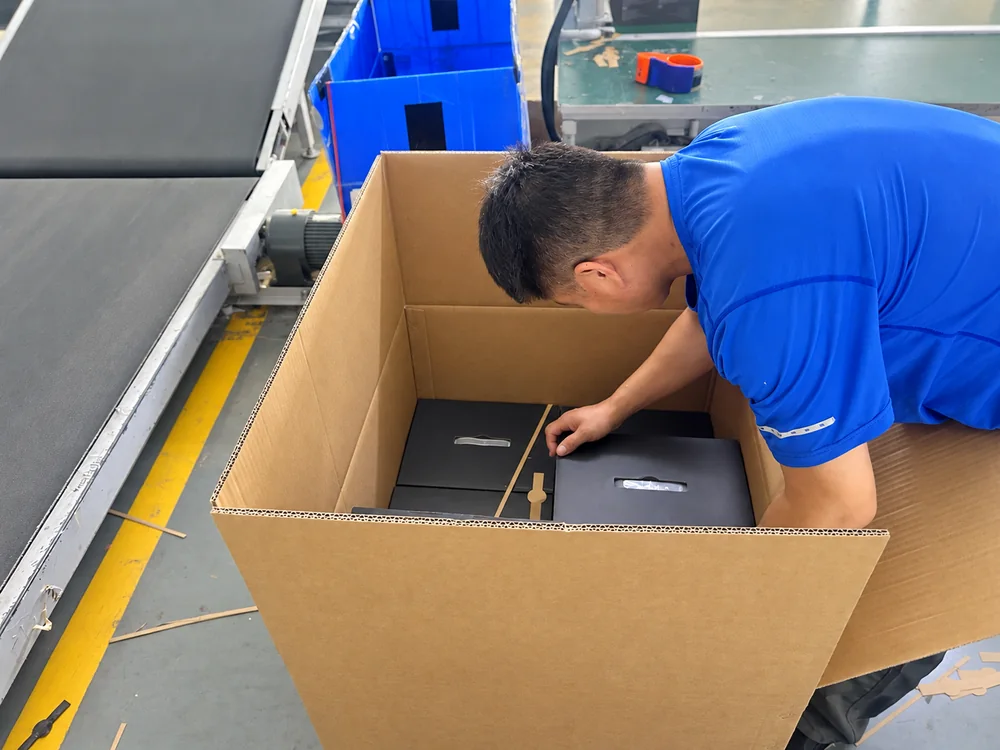
The table also prevents a misleading average. There is no single units-per-carton value that describes all three lines. Keep the actual packing quantity attached to each SKU when preparing carton totals, warehouse receipts and logistics data.
Avoid mixed SKUs inside one master carton unless the arrangement is explicitly agreed and documented. A mixed container of separately identified cartons is different from a carton containing multiple versions. The latter needs its own contents list and receiving instructions.
A partial carton may use the normal outer box or another approved arrangement. Ask for its actual contents, outside dimensions and gross weight. Do not assume that fewer units reduce shipping volume proportionally, or change protection simply to make the arithmetic convenient.
Check the onward allocation as well. In a hypothetical store launch, ten shops requesting twelve units of one SKU need 120 units in total. At six per carton, each shop can receive two unopened cartons. If the same shops each request ten units, the warehouse must break cartons or agree another allocation. That handling requirement belongs in the plan even though the factory shipment can still be counted accurately.
Ask your warehouse whether it prefers full-carton transfers or can pick individual retail boxes. This can influence the practical order mix without changing the product itself. Keep any store-level rounding separate from supplier-level rounding, or the final purchase quantity may include two allowances for the same need.
Choose which lines may wait and which may ship separately
Readiness belongs to each order line. A standard configuration may be available before a customized set, and an approved product may still be waiting for printed materials. Ask for the prerequisites behind the proposed date so your team can distinguish production time from time waiting for a decision.
JINJIE's manufacturing preparation connects scheduling with the model, quantity, components, packaging and requested timing. Use that discussion to obtain a schedule for the actual mix. A general factory lead-time statement is too broad to explain the effect of one unresolved custom line.
For a retailer launch requiring the complete assortment, shipping all lines together may be necessary. For replenishment of an existing item, holding ready stock for a new trial model can have a different cost. Ask what the delay means to customers before asking the factory simply to ship whatever is ready.
Compare the complete cost of splitting. Extra transport, handling, documentation or receiving work may matter even if the total number of units does not change. Ask the logistics provider and supplier to identify the actual additional charges, then compare them with the commercial consequence of waiting.
Set a decision date. If the slower line has not reached an agreed readiness point by then, the team can decide whether to wait, split or revise the launch. Without that date, purchasing may continue to hope for one shipment until there is no useful time left to arrange an alternative.
Keep shipment approval separate from a forecast. A tentative statement that a line “should be ready” is planning information. Release should follow the agreed checks and the confirmed quantities available. This protects the warehouse from preparing receipts for stock that is still unresolved.
If a split is accepted, issue the allocation for each shipment and identify the balance that remains open. Do not close the whole purchase order after the first shipment simply because the invoice references the original order number. Your records need to preserve both the dispatched quantities and the outstanding commitment.
Separate factory readiness from the arrival deadline. A ready line still needs the selected transport route and receiving appointment. Ask the logistics provider to work backward from the customer's required receipt date. This shows whether an earlier partial shipment would actually help, rather than merely moving stock out of the factory sooner.
Make the warehouse handover specific to each version
The warehouse should be able to reconcile a carton with an order line without opening every retail box. Agree the buyer SKU, supplier model reference and version identification used on the carton marks. A product photograph alone may not distinguish two electrical versions or accessory sets.
Keep those references consistent across the purchase order, packing list and receiving record. If the supplier uses a different internal code, include both codes in the handover rather than replacing one halfway through the process. The relationship should be explicit for the person receiving the goods.

The following handover checklist identifies the records that move with the order after the mix is selected.
|
Handover point |
Record needed |
Receiving or planning question |
|---|---|---|
|
Purchase confirmation |
SKU, configuration and accepted quantity |
Which exact line has been ordered? |
|
Production allocation |
Quantity and readiness by line |
Which items can meet the intended shipment? |
|
Packing identification |
Carton marks, contents and numbering |
Can each carton be assigned to one SKU? |
|
Dispatch record |
Actual quantities and exceptions |
What left, and what remains outstanding? |
|
Warehouse receipt |
Received cartons and units by SKU |
Does the delivered mix match the shipment record? |
|
Reorder preparation |
Current version and sales by line |
Which configurations should be retained or changed? |
A correct grand total cannot resolve a line shortage. If 20 units of B arrive instead of 20 units of A, the overall count may agree while the retail allocation is wrong. Investigate and record the difference by SKU rather than absorbing it into a total adjustment.
Agree how exceptions will be reported: missing cartons, damaged packaging, partial cartons or unexpected versions. Preserve the carton identity with photographs where useful. That gives the supplier a specific issue to investigate instead of a general statement that “the mix is incorrect.” Record expected units, received units and the difference in separate fields. Preserve the original dispatch figures while investigating, so a corrected receipt does not erase the discrepancy that needs explaining.
For the agreed checks before dispatch, refer to JINJIE's product and packing review. Ask how each configuration in the mix will be represented in the records. A review of one version should have a clear scope rather than being silently extended to every line in the order.
Use the first shipment to improve the next mix
After receiving and selling the range, compare actual demand with the original allocation. Keep sales, remaining stock and returns separated by SKU. Grouping them only under the model family can hide a weak color or an accessory set that customers do not understand.
A reorder is an opportunity to simplify. Retain a variation when it serves a distinct customer or sales channel. Remove a variation when it adds stock and handling work without supporting demand. If sales were restricted by a stockout, distinguish that from low interest before deciding which line performed better.
For a hypothetical planning example, suppose line A has 180 units left and an internal forecast of 60 units a month. That implies three months of stock at the assumed rate. Line B has 180 units left but a forecast of 30 a month, implying six months. Equal stock quantities do not justify equal replenishment quantities. These are planning assumptions, not a sales prediction.
Bring supplier minimums and carton multiples back into the revised plan. Start with demand, then see which practical order quantities fit. If rounding produces excess stock, decide whether a later combined purchase or a narrower assortment is better than ordering extra units now.
Keep the specification history. A successful SKU may later change its bowl, controls or included parts, and the next order should identify that change deliberately. Preserve the relationship between the old and new versions so sales comparisons and service inquiries remain understandable.
Conclusion
Prepare a mixed-order inquiry as one sellable configuration per line. Include its commercial role, model reference, bowl, color, electrical version, set contents and required quantity. Add carton or receiving requirements and indicate whether the shipment may be split.
Ask JINJIE to return the minimum conditions, packing data and readiness assumptions for each line. Use that response to adjust the proposed mix before purchase confirmation. The result should be an assortment your business can sell, a production order the factory can distinguish and a shipment the warehouse can receive accurately.
FAQ
Can different models travel in the same shipment?
That can be discussed with the supplier and logistics provider, using the actual configurations and quantities. Keep packing information separate by SKU and agree identification before dispatch. Combining shipments does not automatically permit mixing versions within individual cartons or combining minimum quantities that apply separately.
Should I order equal quantities of every model for a trial?
Only if that allocation fits your trial question and sales plan. Equal quantities are easy to administer but can tie up stock in less relevant versions. Use customer commitments or an explicit forecast, then account for minimums and carton multiples. Record the assumptions so you can compare them with actual sales later.
Can one manual cover several chopper models?
It may be possible when the approved instructions accurately identify and describe every included version. Ask for the proposed document and check controls, supplied parts and operating limits. If differences would confuse the customer, use version-specific instructions. Saving a printed-material line is not worth supplying an inaccurate manual.
What if one SKU is short immediately before dispatch?
Request the actual shortage and readiness estimate for that line. Decide whether to ship the available quantity, wait or revise the allocation, considering retailer commitments and extra shipment costs. Record the remaining balance. Do not accept a replacement SKU solely to preserve the original total number of units.