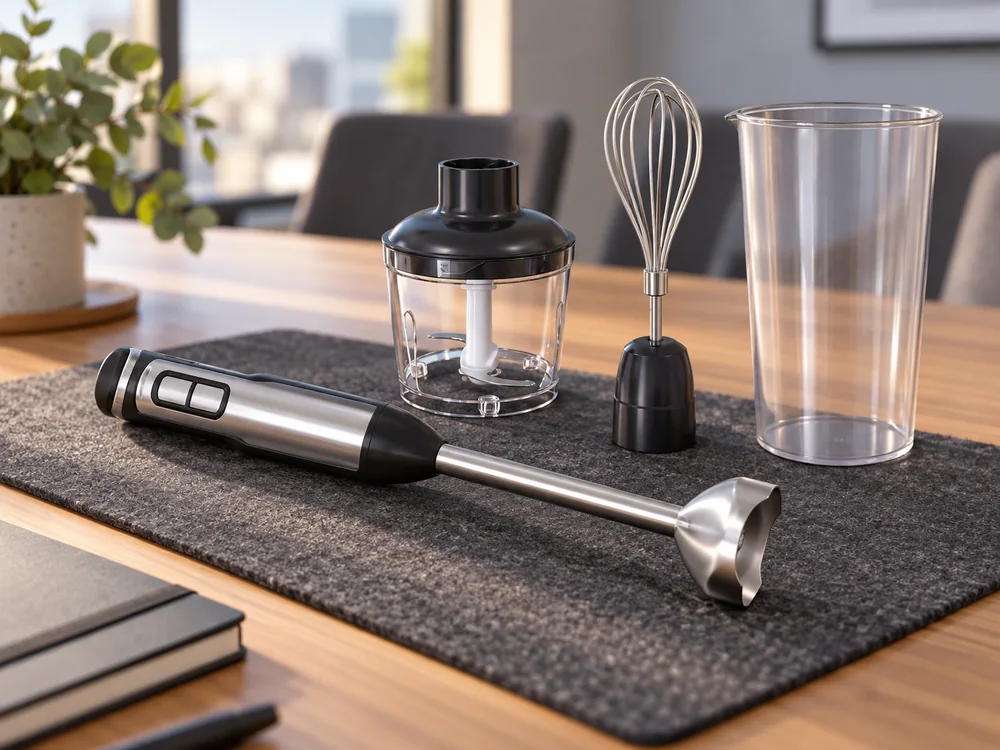
A private label hand blender project begins with an appliance your customer has a reason to buy. The brand then needs a coherent retail product: an agreed appearance, accurate operating information, suitable packaging and a price for that complete offer. Putting a logo on a sample settles only part of the purchase.
For an importer or retail brand, the practical decision is how much to change on a current product. A different finish may be enough to fit an existing kitchen range. Another project may need a different control arrangement or attachment combination. Keep those choices connected to the customer's task and the commitment your business is prepared to make.
JINJIE offers household hand blenders as standalone products and matched accessory sets, with branding and packaging options. This guide concerns developing a branded retail offer from that range. It does not assume a new mechanism, exclusive platform rights or professional foodservice use merely because the product carries your identity.
Choose the private label hand blender you want customers to recognize
Start with the role in your range. Is this a simple blending product, or a set intended to cover several supported preparation tasks? Decide what the customer should understand from the front of the box. The answer gives the supplier a product direction and gives your designer a useful starting point.
The JINJIE immersion blender range shows current motor-unit designs and attachment options. Choose a reference before requesting a branded version. Otherwise, a discussion about color can progress while purchasing and design are still imagining different controls, shafts or retail sets.
As an example, the current quotation identifies HB-C1 as a 400 W four-in-one version, with HB1151 as its secondary reference. HB-E1 is another listed four-in-one version with an adjustable-speed description. These references help distinguish starting products. They are not evidence that all parts or presentation choices can be exchanged between them.
Give the proposed retail product its own description while retaining the supplier's model reference. Your brand may use a different product name, but the inquiry still needs to identify the actual appliance. A name chosen for a box should not become the only description used to request samples or repeat orders.
Select the complete configuration before building its visual identity. The matched attachments and supplied contents need agreement, but the private-label decision goes further: which features matter enough to lead the customer message, and which simply belong in the detailed description? A crowded feature panel cannot repair an unclear product position.
Consider how the product fits beside your other appliances. Shared visual cues can make a range recognizable, but a hand blender has its own controls and handling needs. Ask which current finish and marking options can achieve the desired relationship without requiring an unnecessary product change.
Make the essential requirement visible. If a particular control or function is central to the customer proposition, retain it in the brief. If the preference is only a decorative detail, allow the supplier to propose a current alternative. This creates room for a practical offer without compromising the reason for choosing the appliance.
Decide which branding changes are worth buying
JINJIE's OEM and ODM options distinguish branding a current product from design changes and new development. Use that distinction when requesting an offer. A logo, color or printed box is a different request from a revised housing, control interface or attachment connection.
Describe the desired appearance with a clear reference rather than a broad adjective such as premium. Identify the areas to be considered, the intended color relationship and the brand assets available. The manufacturer can then explain what it proposes for the chosen product and what needs further work.
Ask which marking locations and methods can be offered on the actual housing. Do not assume that a process used on another appliance is available or appropriate here. The relevant response should identify the proposed result and how it will be reviewed, rather than leaving the designer to select a production method from a photograph.
Think about the product in use as well as in a front-facing image. Controls must remain identifiable, and the brand mark should not compete with essential operating information. Where the preferred position conflicts with a necessary product marking, ask for another location instead of treating all visible surfaces as decorative space.
|
Branding choice |
Reference to agree |
Decision for the buyer |
|---|---|---|
|
Housing appearance |
Identified product and proposed finish |
Does it fit the retail range without changing the required function? |
|
Logo placement |
Actual location, size and proposed application |
Is the identity clear while product information remains usable? |
|
Control presentation |
The selected interface and its real operation |
Can the customer understand the product being sold? |
|
Printed retail material |
Contents, language and agreed design scope |
Does the complete presentation describe the same configuration? |
|
Additional product change |
Requested difference and supplier response |
Is the extra commitment justified by customer value? |
Compare the cost of the change with what it contributes. A brand may gain enough recognition from an agreed existing finish and packaging. A more distinctive appearance may be worthwhile for another channel, but obtain the actual quotation and preparation conditions before treating it as a minor addition.
Keep future ideas outside the first commitment unless they are essential. You can discuss a second finish or a later product development without adding it to every launch decision. The first private-label offer should be sufficiently specific to price and prepare, not a collection of possibilities that the supplier must interpret.
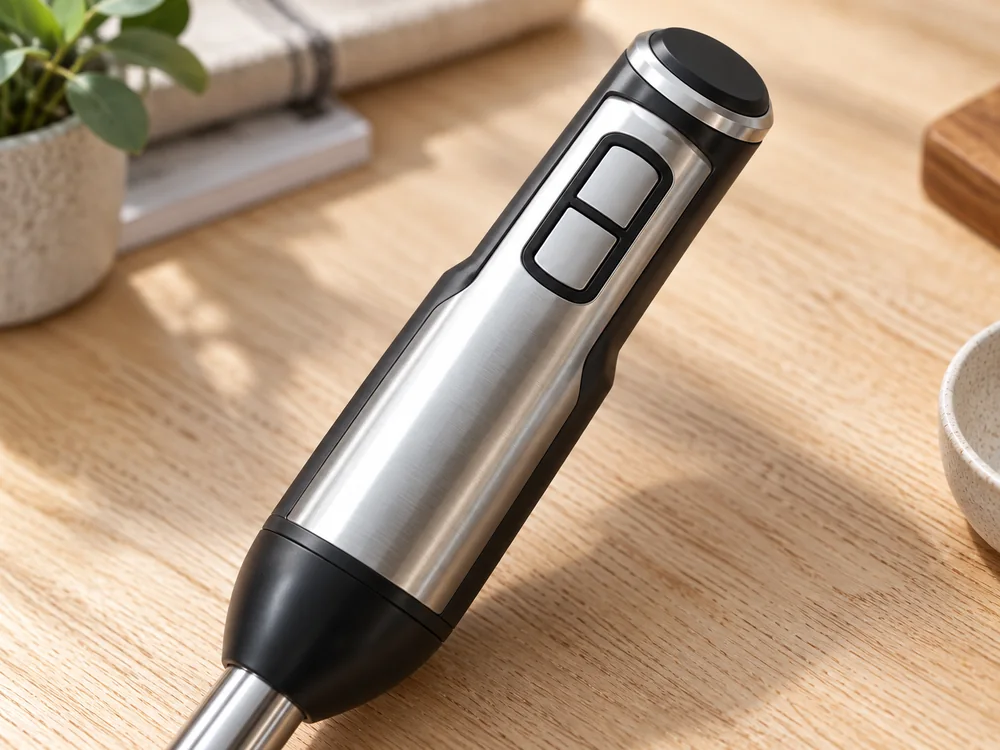
Review appearance on the actual product surface
A digital mockup is useful for deciding direction. It can show the intended location and overall relationship between the product and brand identity. It cannot establish how a finish or marking will appear on the actual material under ordinary viewing conditions. Agree which physical reference will settle that question.
Ask the supplier to explain what the appearance sample represents. It may be a current product carrying a proposed mark, a finish sample or a more complete branded unit. If only one area has been prepared, keep the approval limited to that area. The rest of the offer can remain open without losing the useful decision already made.
Review related surfaces together. A motor housing, control surround and attachment may use different materials or finishes. A request for a consistent visual family does not necessarily mean every surface should look identical. Judge the agreed combination on the product rather than approving separate images that were photographed under different light.
Use the actual scale when checking a mark. A logo enlarged on a screen may read clearly while the proposed mark on a narrow housing is difficult to recognize. Ask for the relevant physical reference and check the result at a normal viewing distance. Settle the design before treating a large digital preview as approval for production.
Identify what has been accepted with a dated reference and a clear description. This need not become an elaborate design system. It should let the supplier and buyer distinguish the chosen appearance from an earlier proposal, including any area still waiting for agreement.
If the sample is not acceptable, describe the difference that matters: location, relative size, appearance or another visible issue. A reply saying only that it looks wrong gives the supplier little to act on. Keep subjective preferences separate from a failure to reproduce the agreed reference.
For quantities intended for more than one retail channel, decide whether the appearance really needs to vary. Each version may create separate artwork, sample and purchasing work. A common appliance with a clearly identified packaging variation may suit the project, subject to the supplier's actual proposal. More variation is useful only when the channel has a reason for it.
Make the manual, label and box describe one product
Once the appliance is selected, use one agreed product description for the printed materials. The same model, electrical version, control names and included assemblies should travel into the relevant files. This prevents a designer from filling a gap with wording taken from another member of the range.
Begin with the selected model's operating information. The brand's tone can shape introductory copy, but it should not change the permitted method or remove necessary limitations. If the instructions are unclear, ask the responsible product team to clarify them before design turns the uncertainty into a polished final page.
Keep attachment illustrations tied to the supplied configuration. A drawing of a similar whisk adapter or chopping lid can leave the customer with the wrong assembly explanation. The approved set needs recognizable names and images, even when an existing manual is used as the starting point.
For multiple languages, decide who supplies, checks and approves each version. Translation and layout are separate checks: accurate wording can become difficult to use if a page is crowded or a reference points to the wrong illustration. Review the final laid-out material, not only the text file sent for translation.
Use the compliance documentation discussion to identify the relevant product and market information. Branding an existing model does not automatically settle how its records relate to the proposed name and electrical version. Request the applicable explanation without assuming that a catalog's general document list covers the entire branded offer.
On the box, lead with what the customer receives and can use. Keep the supplier's confirmed features distinct from broader claims your team would like to make. Words such as professional, unlimited or universal can change the apparent scope of a household appliance; they should not enter the packaging simply because they sound persuasive.
Check the relationship between the main picture and the contents description. A lifestyle image may include ordinary kitchen props, but it should not suggest an extra motor unit or accessory in the retail set. Where several operating arrangements are shown, make it clear that the customer is seeing uses of the same identified product.
Plan how changes will move through the files. If the control version changes, the affected instructions and illustrations need review as well as the main product image. A packaging designer should receive the revised product information, not be expected to discover a technical change from a new photograph.
Compare the price and readiness of the branded offer
Ask for the complete branded proposal, with the selected appliance, set contents, appearance and printed materials identified. A standard-product unit price is useful background, but it may not include the work required for your retail version. Make the comparison on the same scope before choosing between alternatives.
Separate any project charges from the recurring price where the supplier's proposal does so. Ask what each charge covers and what output the buyer will receive. Do not assume that paying for artwork, a sample or another preparatory item creates ownership or exclusivity beyond the actual agreement.
Quantity conditions also need the branded version attached to them. Ask whether different finishes, languages, electrical versions or pack combinations have separate requirements. One large overall estimate does not necessarily support many small branded variations. Discuss a workable opening mix before preparing every version's artwork.
|
Unresolved item |
What can be decided now |
What should remain open |
|---|---|---|
|
Logo location is not agreed |
The suitable current appliance may still be selected |
Final appearance and any affected preparation |
|
An optional finish adds work |
Compare the current appearance with the desired change |
Its cost and timing until the supplier responds |
|
Required control version differs |
Clarify the intended customer interaction |
Product approval and affected instructions |
|
A language layout is incomplete |
Confirm the accepted source information |
Approval of that finished printed version |
|
A new attachment is essential |
State the required task and complete combination |
The branded retail offer until the product question is resolved |
Use the remaining work to interpret the proposed timing. Product selection, appearance review, language material and packaging can have different dependencies. Ask which buyer decisions are needed for the supplier to proceed. A target launch date should lead to a clear discussion of those dependencies, not an unsupported promise of readiness.
When comparing two proposals, include the work your own team must provide. One offer may include more preparation of printed material, while another expects complete buyer files. Neither arrangement is automatically better. Select the one your team can support and make the division of responsibility explicit.
Consider the full packed product when evaluating value. More accessories or presentation elements can affect packing work and the shipping information, but the actual arrangement should determine the difference. Request current packed details for the chosen branded set rather than assuming the standard unit's packaging data remains unchanged.
If an optional design preference creates an unattractive commitment, reconsider that preference before changing the whole product. Conversely, if a required function remains unresolved, finishing the box does not make the offer ready. Keep the purchasing decision attached to the importance of the open item.

Carry the approved brand version into the order
Give the supplier a consolidated description of what the business has selected. Include the model and configuration, appearance reference, printed-material versions and applicable commercial proposal. The purpose is simple: the people preparing the order should not have to choose between conflicting email attachments or interpret an internal product nickname.
Assign one buyer contact to return consolidated decisions. Product, design and retail colleagues may contribute different expertise, but their instructions need to reach the supplier as one compatible request. If a late preference conflicts with an earlier approval, decide which direction is intended before asking for another sample.
Discuss the relevant product and packing checks through JINJIE's quality and testing information. Identify which approved references should be used for the branded order. Appearance, set completeness and printed information should be assessable against the actual product chosen, not against an unrelated showroom unit.
Keep approval specific when some work is still incomplete. An accepted appearance can remain useful while a language version is being finished. The record should state the outstanding item and the next decision needed. This prevents a limited approval from being interpreted as acceptance of every part of the retail offer.
For later changes, ask whether the supplier is correcting a difference from the agreed version or proposing a different product. The responses are not the same. A proposed change may affect the earlier sample, customer description or packaging, and your team needs enough information to decide whether to accept it.
Retain the branded version reference for reorders and customer questions. Keep the retail name linked to the manufacturer model and supplied configuration. A repeat order can then be compared with the accepted product even if the supplier presents a new image or another option during the next inquiry.
Launch with the product the brand can explain and support. A coherent appearance, usable instructions and accurate set description give the buyer something more substantial than a logo-bearing sample. Further versions can follow when their customer value and actual supply conditions justify the work.
Request your private-label hand blender proposal
Discuss your branded hand blender with JINJIE using the preferred product reference, intended household tasks, destination market and estimated quantity. Send the required set contents, brand assets and presentation priorities separately from optional ideas. Ask for a proposal that identifies the current product, requested changes and remaining buyer decisions.
FAQ
Can I begin without a finished retail box design?
Yes. Start by defining the appliance and customer offer, then ask what product and packaging information the designer will need. Keep the final printed version unapproved until its contents, language and layout have been reviewed. Early product selection does not require pretending the packaging is already complete.
What if my preferred logo position is unavailable?
Ask for an alternative on the selected housing and review it at the proposed size. Decide whether the original position is essential to the brand or simply a preference. A different marking location may preserve the product choice without requiring a more extensive change.
Can two retailers use the same appliance with different packaging?
That is a proposal to discuss with the supplier. Identify the differences, quantities and required contents for each version, then obtain the actual conditions. Keep the two printed versions distinguishable even if their underlying appliance is the same. Do not assume unrestricted splitting or exclusivity.
Does approving the brand appearance confirm every product claim?
No. Appearance approval concerns the agreed visual result. Operating claims and market-related information need their relevant product basis. Keep those decisions separate so acceptance of a logo-bearing sample is not treated as evidence for an unassessed function or application.