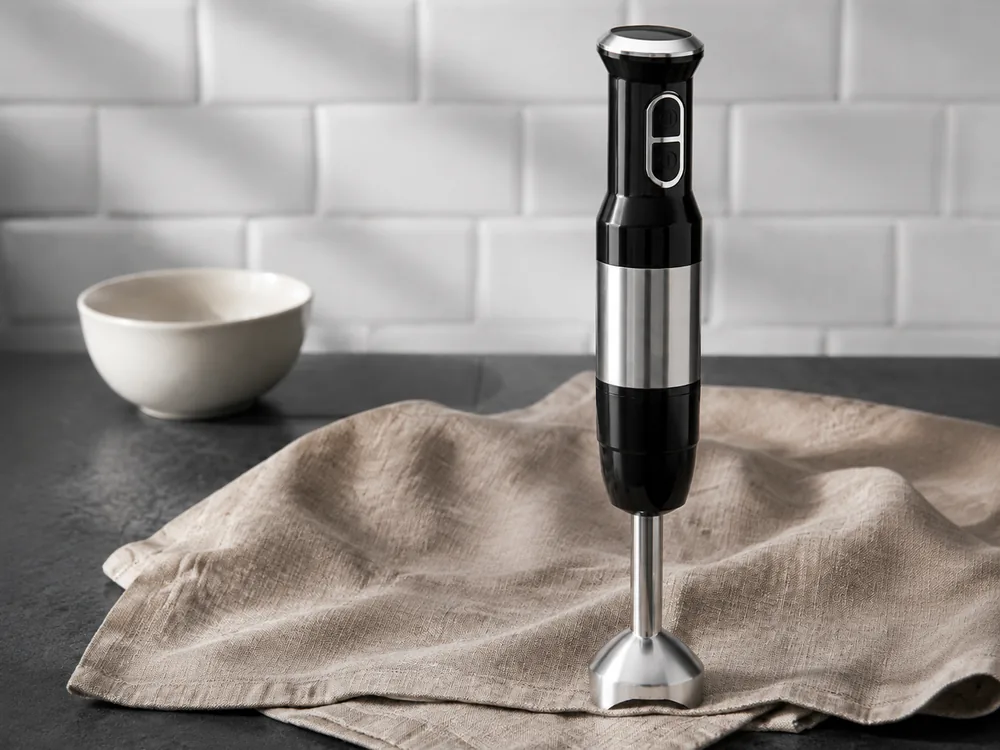
“Stainless steel immersion blender” is a useful product description, but it is an incomplete purchasing specification. The shaft, blade, outer housing and optional containers are different parts. A stainless steel entry on a quotation does not identify the grade of every metal component or the material of every accessory.
For a private-label range, decide which material feature the customer is buying. A metal outer housing addresses appearance, while a detachable shaft affects handling and cleaning. Compare the relevant parts and care instructions before paying for a more expensive finish. Neither feature alone establishes an alloy grade or longer service life.
Map the parts of a stainless steel immersion blender
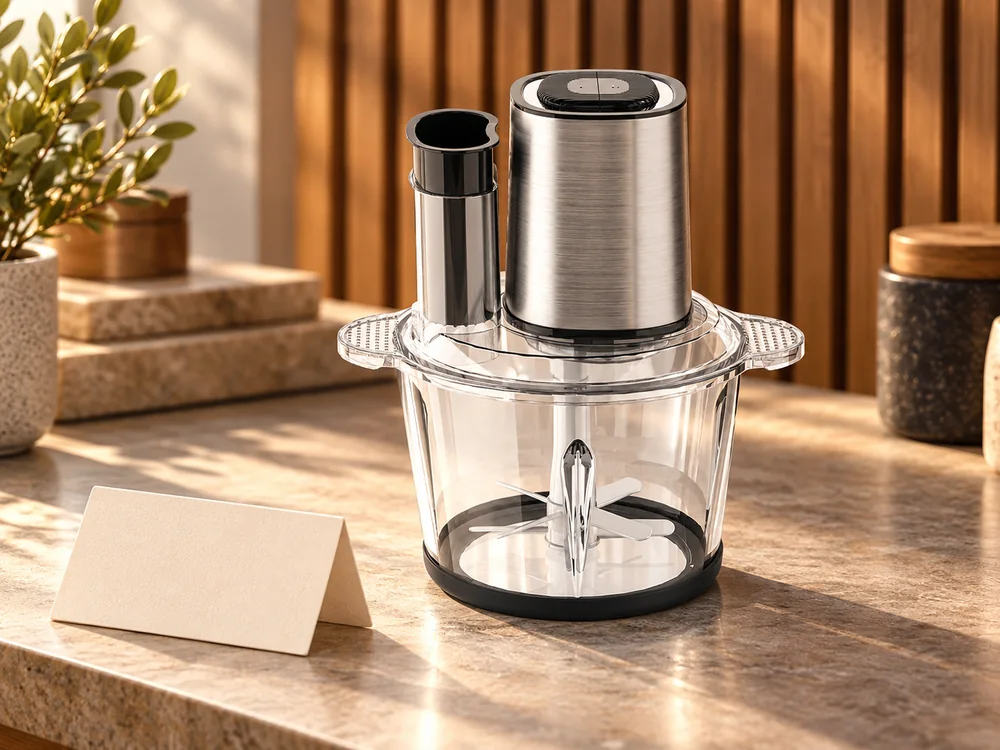
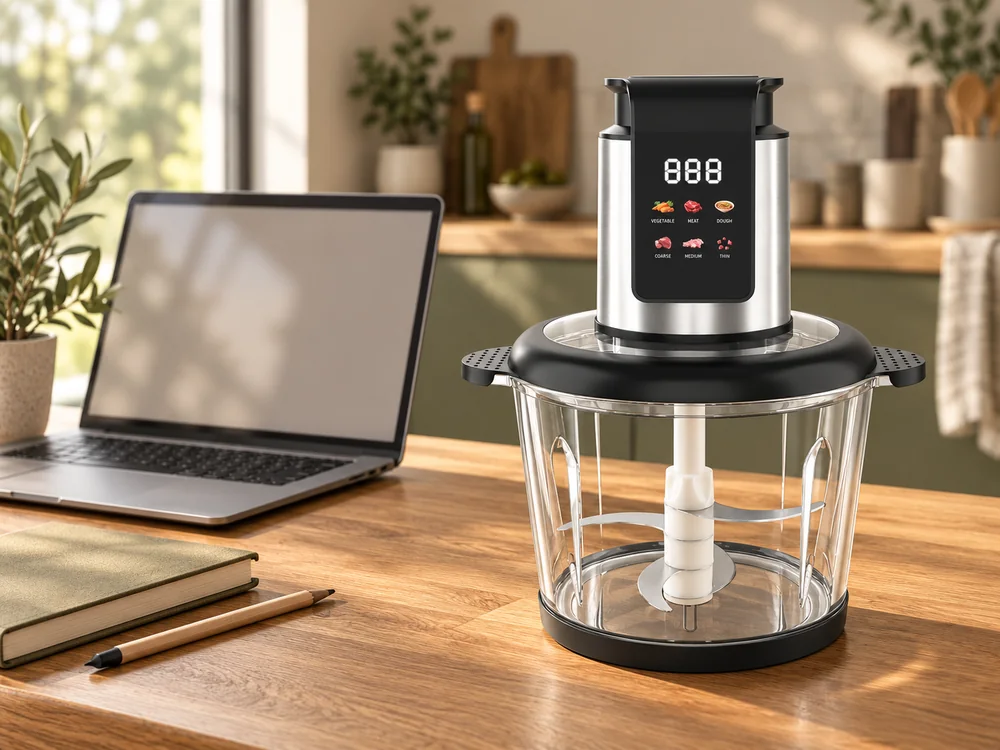
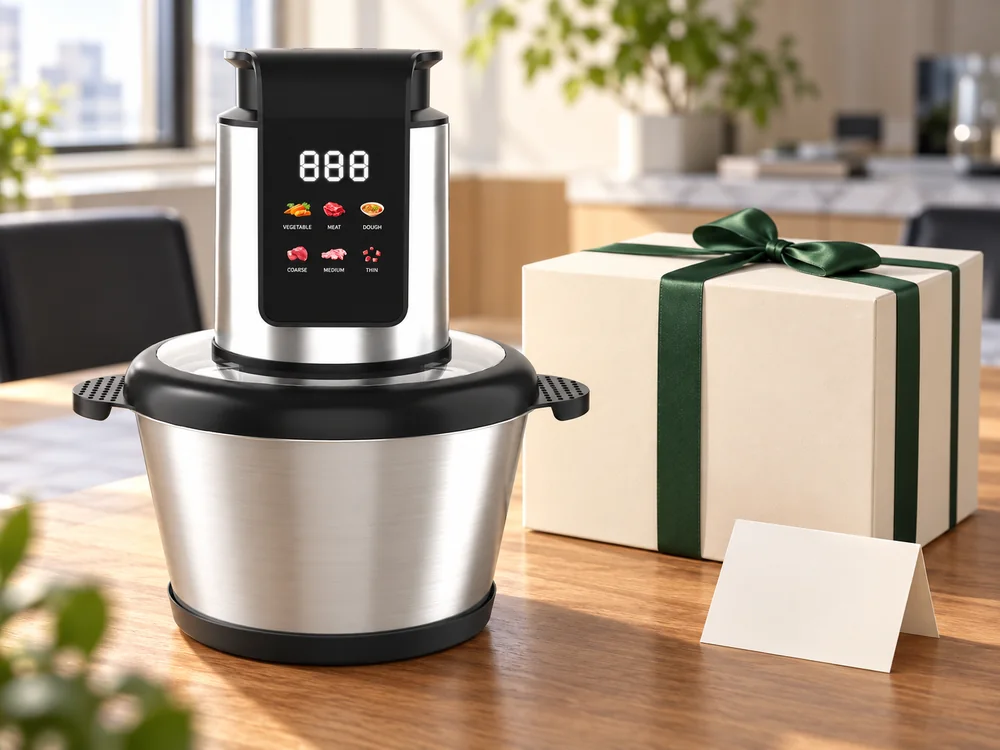
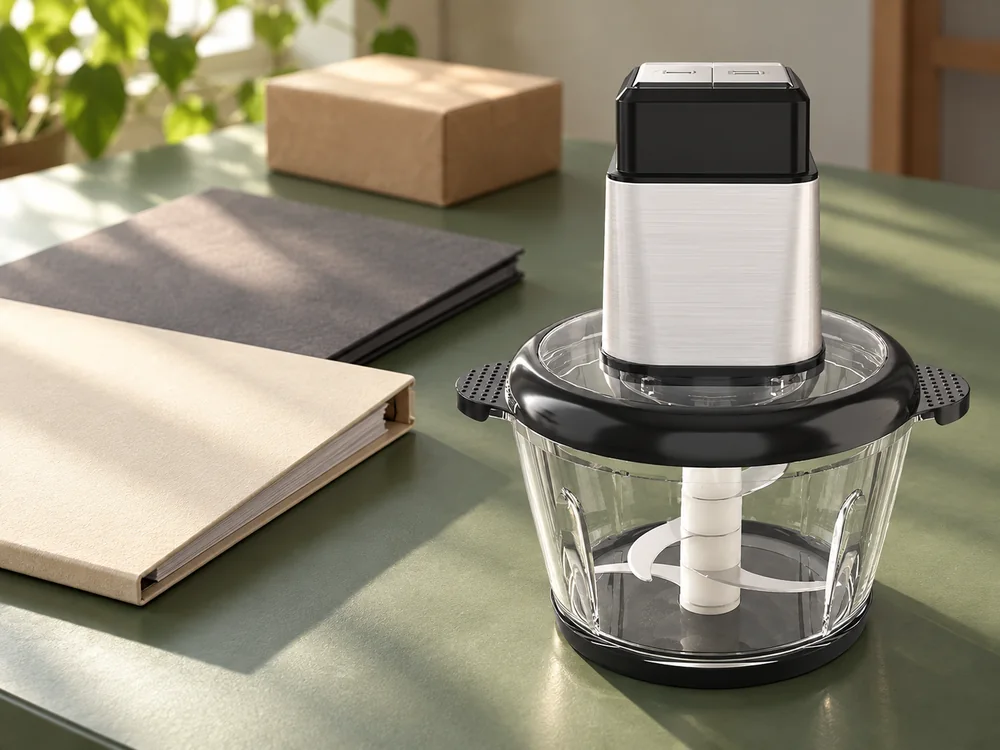
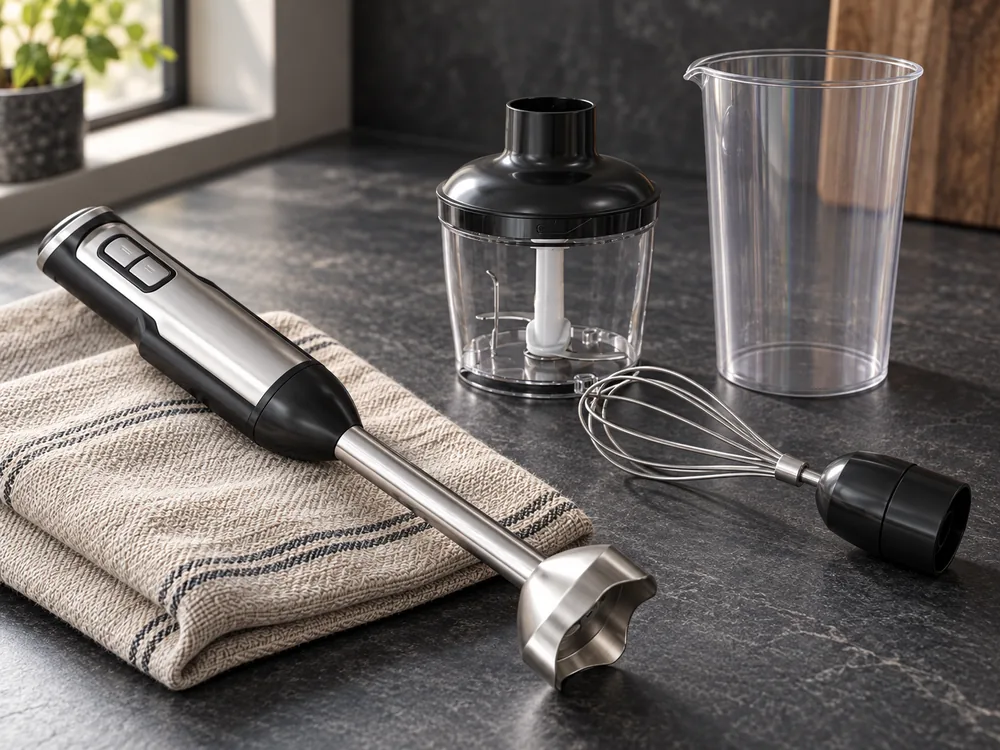
Begin with a labeled image or an approved sample. Identify the motor housing, blending shaft, blade guard and blade assembly. For a set, add the whisk, its adapter, the chopping container, lid and beaker. Use the supplier's actual part names where available.
A shiny finish is not a material test. A photograph can show that a component has a metallic appearance, but it cannot establish an alloy grade, coating system or the material hidden beneath the finish. This applies equally to a polished housing and a cutting blade.
Ask which parts touch food in the intended configuration. A decorative outer sleeve and a food-contact blade may require different evidence. Keep those records separate so a certificate or declaration for one part is not used to support another.
This first pass should produce a simple annotated part list. If the supplier cannot yet name the material, write “not specified” in the buying record. Do not replace the missing detail with a familiar grade such as 304.
Give each part a reference that stays consistent across the inquiry, sample photographs and packaging discussion. A marked photograph can be more useful than a description such as “the silver section,” especially when the shaft, guard and body have similar finishes. The supplier should be able to answer against the same marked areas.
Separate the part's function from its appearance. A purchaser might want a metal-bodied appliance for a coordinated kitchen range, while another wants a clearly specified food-contact shaft. Those are different requirements. Asking simply for a premium stainless version leaves the supplier to decide where the extra cost should go.
Avoid extending a material description through an entire assembly. A detachable attachment may contain several materials even when its exposed tube is stainless steel. Ask about the complete supplied component where the requirement concerns cleaning, food contact or replacement. Naming only the visible tube may leave the commercially important question unanswered.
Read the configuration row, not just the model name
JINJIE's current configuration reference lists primary models HB-02 and HB-01 with the shared secondary reference HB1141. The HB-02 entry lists 300 W and stainless steel. The HB-01 entry lists 400 W, a 0.8 L capacity field, stainless steel plus PET and a four-in-one set description. Use the primary model to distinguish these configurations.
That makes “HB1141 stainless steel hand blender” too broad for a purchase order. The buyer needs the configuration identifier, supplied accessories and the material allocation for those accessories. The 0.8 L field also needs to be assigned to the relevant container in the confirmed set. It is not the processing capacity of the handheld motor unit.
The reference describes stainless steel housing and a stainless steel stirring rod for these entries. It does not provide an alloy grade for each component. A final claim about grade, food-contact suitability or permitted cleaning conditions therefore needs additional model-specific evidence.
When requesting a revised offer, identify which of those entries you mean and attach its photograph. Ask the supplier to preserve the original identifier alongside any updated code. This prevents a response about the 300 W unit from being combined with an accessory photograph belonging to the 400 W set.
If the buyer is choosing between a single attachment and a larger set, settle that choice before attributing the price difference to materials. The larger offer may include extra containers, adapters and packing space. A material comparison made across different bundles will not show what the metal finish itself costs.
Treat the quotation's material field as the start of the specification. It is useful for shortlisting, but the final purchasing description should connect each important material to its part. That extra line of detail is especially useful when the marketing team receives the quotation without the supplier conversation that explained it.
Compare material specifications with the price difference
Ask for the price difference between the proposed material versions with the motor, attachment list and packaging held constant. Otherwise, an accessory change can be mistaken for the cost of a stainless steel upgrade.
|
Part or group |
Information to confirm |
Claim that should wait |
|---|---|---|
|
Outer motor housing |
Base material, sleeve and surface finish |
“All-metal construction” |
|
Blending shaft and guard |
Material for each food-contact component |
A named stainless steel grade |
|
Blade assembly |
Blade material and the covered assembly |
A material claim inferred from the shaft |
|
Beaker and chopping container |
Polymer or other material by part |
“Plastic-free set” or unspecified material claims |
|
Seals, adapters and lids |
Material and intended cleaning conditions |
“Every accessory is dishwasher-safe” |
Use the part list to separate required materials from optional finishes. If a named alloy grade is a purchasing requirement, leave that item unresolved until the supplier identifies it. If only a metal appearance is required, specify the finish without adding an unsupported grade claim.
Where a document covers a family, ask how the selected configuration is included. Similar model numbers are a clue to investigate, not proof of coverage. Record the document title, revision and applicable part or model in the approval file.
For a hypothetical comparison, suppose two offers have the same motor unit and blending attachment, but one adds a metal outer sleeve and a different retail box. Ask for those changes to be priced separately. If the supplier cannot separate them, compare the complete offers as bundles rather than presenting the total difference internally as a material surcharge.
That distinction changes the buying decision. A visual upgrade may make sense for a coordinated appliance range whose customers value the finish. A customer brief centered on a named shaft material needs a part specification first. Neither project is served by paying more for an unexplained “stainless upgrade.”
Carry the agreed scope into JINJIE's OEM and ODM discussion. State which finish is fixed, which alternatives remain acceptable and whether the change applies to the motor body, attachment or both. This gives the supplier a bounded customization request instead of an invitation to redesign the entire set.
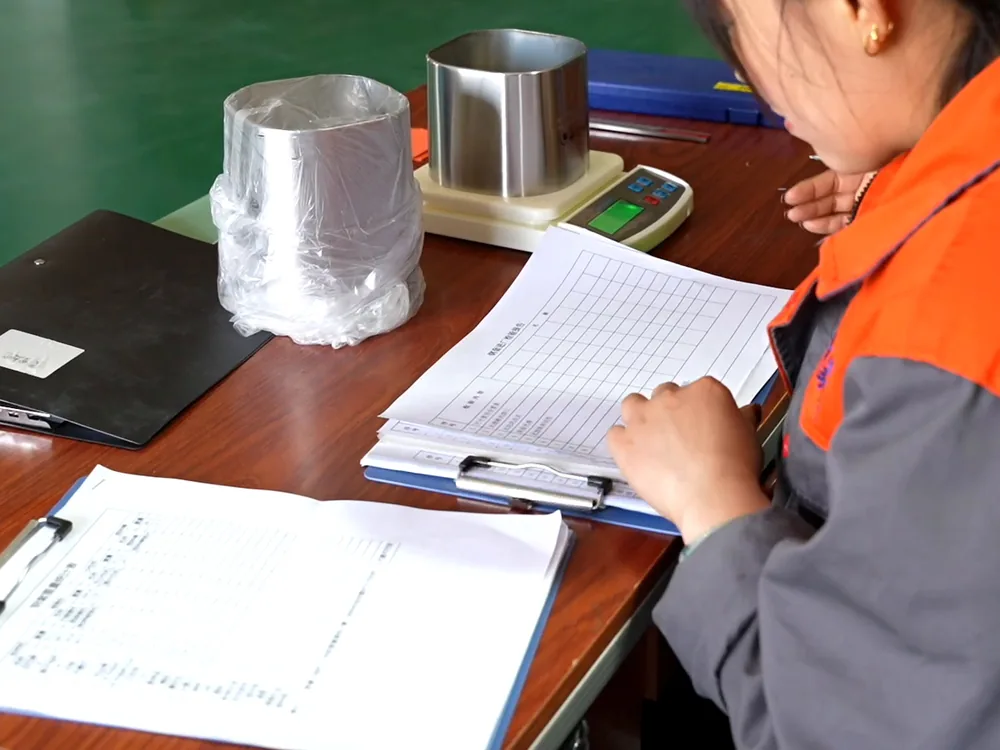
Check cleaning claims independently of the finish
Customers often associate stainless steel with easy cleaning. That expectation can tempt a brand to put a dishwasher symbol on every accessory. The product instructions must decide what is allowed.
For the selected JINJIE set, request separate care instructions for the motor unit, blending attachment, whisk adapter, chopping lid and containers. Ask which parts are removable and which must never be immersed. Resolve any difference between the manual, carton symbols and online copy before approving artwork.
Do the same with heated-food claims. The word stainless steel does not establish a permissible food temperature, immersion depth or container type. Until those conditions are confirmed, keep the public copy within the documented scope.
Review the actual cleaning sequence from the customer's perspective. Which part comes off first? Where is the permitted separation point? Can the user distinguish a washable attachment from an adapter that needs a different care method? Those questions can reveal an instruction problem even when the material description is correct.
Ask the supplier to identify care instructions on a picture of the supplied set. A generic manual illustration can be difficult to follow when the photographed attachment has another release mechanism or a different lid. The solution may be a clearer illustration or a corrected part name, rather than a different material.
Do not turn an easy-cleaning claim into a promise of maintenance-free use. Describe the actual feature the customer can see, such as a removable blending attachment, if that feature is confirmed. Leave cleaning temperatures, detergents and dishwasher permission to the applicable instructions and evidence.
Use the sample to check identity and usability
The sample review can verify that the received configuration matches the schedule. Compare the supplied attachments, control layout, connecting ends and the visible part shapes with the approved images. Note any component that arrives in a different finish or shape.
With the product disconnected, compare how the permitted removable parts detach and how easily the user can reach the surfaces that need cleaning. A sample that is awkward to dismantle may be a poor fit for a range sold on easy cleaning, even when its finish looks attractive. Follow the instructions; a handling review does not establish durability.
If a material or cleaning concern needs testing, ask a qualified laboratory or the supplier's responsible technical team for the appropriate method. A kitchen magnet, the weight of the part or its surface shine is not enough to approve a purchasing claim about an alloy.
Compare the sample with the intended retail presentation as well. A surface that looks uniform in a small catalog image may show a different texture on the housing and attachment. Decide whether that difference is acceptable for the proposed range. Record the accepted appearance in ordinary lighting so a highly edited photograph does not become the only reference.
Keep cosmetic observations separate from functional ones. A visible seam may be an appearance issue, while difficulty removing an attachment concerns handling. Describe what was observed and where, then ask the supplier for the relevant explanation or correction. “Poor quality” is too broad to help either party decide what to change.
If a revised sample arrives, compare the specific changed part with the previous version. A new finish does not automatically settle an earlier material question, and a corrected material description does not necessarily address an awkward release action. Close each issue on its own evidence rather than treating the newest sample as a blanket approval.
Turn unresolved material questions into a buying decision
A material review should end with a choice, not an expanding file of unanswered questions. Decide which missing facts prevent the purchase, which affect only marketing language and which can be resolved through an agreed sample comparison. The distinction helps a buyer keep a viable project moving without silently accepting an essential unknown.
Use a short action record for the selected configuration. The following examples show different responses to different gaps; they are purchasing approaches, not descriptions of an existing JINJIE order.
|
Open question |
Useful next action |
Purchasing consequence |
|---|---|---|
|
Named shaft grade is mandatory but unspecified |
Request a part-level specification and applicable support |
Keep this requirement open before selecting the version |
|
Metal appearance is wanted, but no grade is required |
Compare the proposed finish with an identified sample |
Select on accepted appearance without adding a grade claim |
|
A set contains unidentified container materials |
Ask for the material against each supplied container |
Complete the set description before approving copy |
|
Cleaning instructions conflict with box symbols |
Resolve the permitted care method and correct the artwork |
Withhold the affected cleaning claim |
|
A higher price includes several unrelated changes |
Request a like-for-like offer or itemized differences |
Compare the full bundle honestly if separation is unavailable |
Assign a next action that can actually resolve the question. Another catalog photograph will not establish an alloy grade. A new test report may be unnecessary if the only open point is which approved finish the buyer prefers. Matching the action to the uncertainty avoids both under-checking and spending time on evidence that cannot answer the decision.
Set an acceptable alternative where the brief allows one. If a particular exterior finish is preferred rather than essential, the buyer can consider an existing version that meets the functional and material requirements. If a specified food-contact material is mandatory, a visually similar substitute is not an equivalent alternative simply because it is available sooner.
Consider replacement supply before choosing a distinctive finish. Ask whether a replacement blending attachment can be supplied for the exact unit and how its finish will be identified. This is a commercial availability question, not a promise that replacement parts are stocked. If appearance matching matters to the brand, include it in the inquiry instead of discovering the issue after a customer requests a part.
A buyer can also distinguish the approved retail set from a service part in the internal description. The service item may need its own part reference and care information even when it is not sold in a full retail box. Keep the material claim attached to that item so customer service does not repeat a description that belongs to another version.
These details are worth resolving when they affect the intended customer offer. They do not justify requesting every possible accessory or material option. Start with the version you intend to buy and expand the inquiry only where an actual requirement remains unanswered.
When a requirement cannot be met, record the outcome plainly. Select another configuration, revise the requirement with the responsible buyer's agreement, or stop that option. Do not leave a mandatory field blank and rely on a general product name to fill the gap later.
Decide which words can go on the box
Keep approved copy close to the evidence. “Stainless steel blending shaft” is narrower than “stainless steel appliance.” A confirmed accessory list is clearer than an unexplained four-in-one badge. When the evidence does not support a stronger statement, retain the narrower wording.
JINJIE's immersion blender range can help identify a core unit and accessory format. Use the compliance documentation review to discuss which records apply to the chosen model, electrical version and destination. This review must remain tied to the actual set.
Read the front-panel promise together with the smaller specifications. A broad headline can mislead even when a narrow material description appears elsewhere on the box. The customer should not have to discover in small print that the stainless description applies only to one attachment.
Apply the same wording to the product page and sales sheet. If the agreed claim names the blending shaft, keep that part name when shortening the copy for a listing. Removing it to save space can change the meaning. A concise, accurate description is more useful than a stronger phrase that the purchasing file cannot support.
Conclusion
Ask JINJIE to review the selected set and its material claims before commissioning final carton artwork. Send the marked part image, the exact configuration and the claims you want to use. The supplier can then address a specific requirement rather than infer what “stainless steel” means to your project.
Approve the material allocation and the customer-facing wording together. That leaves the buyer with a usable purchasing description and gives the marketing team a clear boundary for the box and product page.
FAQ
Does stainless steel on the quotation mean every part is 304?
No. The general material name does not establish an alloy grade or identify every component. Request a part-level specification before printing a grade claim.
Does a stainless steel shaft make all accessories dishwasher-safe?
No. Cleaning permission depends on the complete component and its instructions, including any seals, adapters or drive parts. Confirm each removable item separately.
What should an importer send with a material inquiry?
Send the selected configuration, an annotated part image, the intended packaging claims and the destination market. Include the accessory list so the review covers the whole retail set.
Can one material description cover replacement attachments?
Only when the replacement part is identified and the description applies to it. Ask for the compatible part reference and its material information. A replacement that looks similar in a photograph should not automatically inherit the original attachment's claims or care instructions.